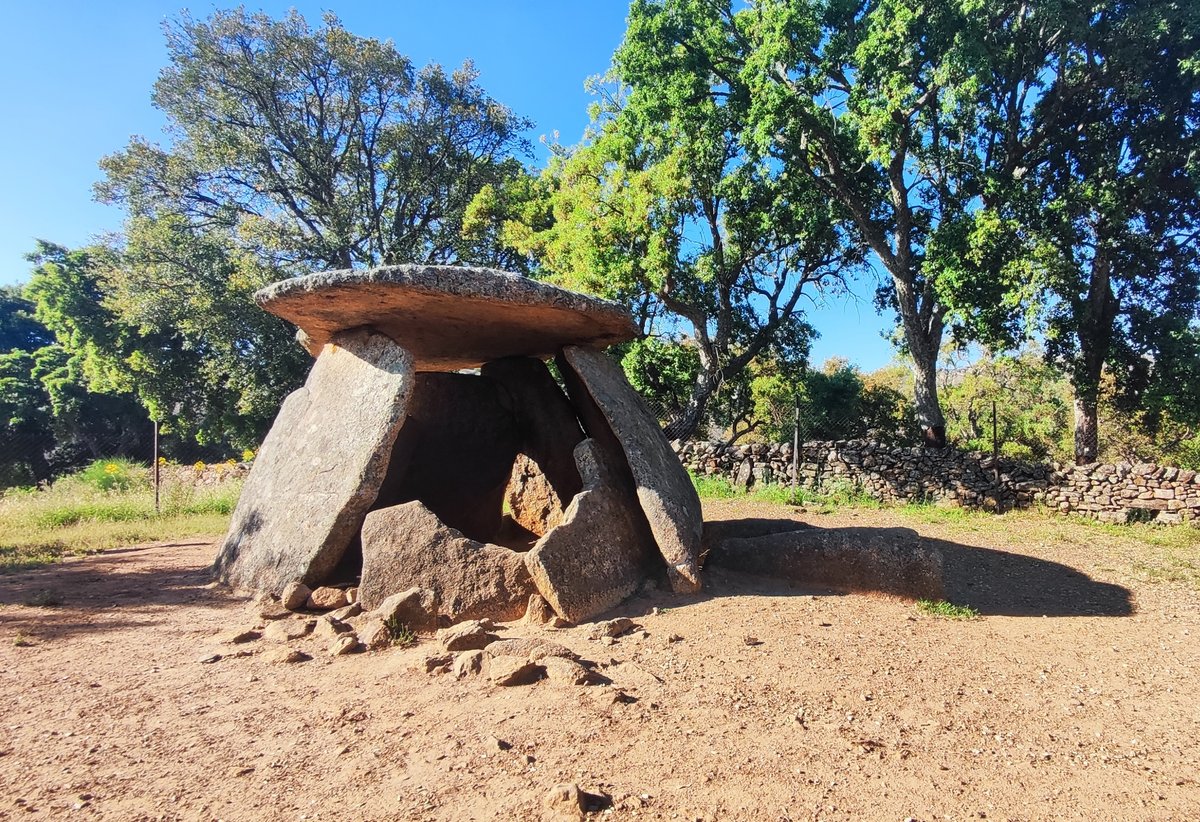

Nestled in the calm village of Aceña de la Borrega, Extremadura, Spain, the Dolmen del Mellizo stands as one of the few megalithic sites still holding a myriad of untold stories. Unlike its counterparts, this dolmen showcases an intriguing protrusion, the Deckstone, that adds to the dolmen's aura of mystery. Yet, just like its peers, the Dolmen del Mellizo hides its own secrets, an aspect that, though not extensively documented, does not dim the fascination of its history.
The Dolmen del Mellizo, dating back to the 4th or 3rd century BC, has garnered a reputation as one of the oldest megalithic sites in the region. Its framework consists of eight Trag- or Side Stones, some cracked, supporting a roughly circular, horizontal chamber. The size of this chamber alludes to a complex burial ritual, leaving archaeologists puzzled.
While the exact purpose of the dolmen remains a puzzle, it is believed to have served as a burial ground for prominent members of the local community. This theory is bolstered by the discovery of fragments of grave goods, such as shards of pottery, arrowheads, and various artifacts unearthed during the excavation led by Primitiva Bueno Ramírez in 1985.
The greatest enigma that shrouds the Dolmen del Mellizo is the proximity of similar sites, such as Data I and II, which are now in a deteriorated state. Data II, in particular, houses one of the largest chambers and the Dolmen 2 of Cajirón. These sites could potentially unveil the complete extent of the megalithic tradition in Extremadura, a practice that has mostly vanished over time.
Sources: Wikipedia, OpenStreetMap, Wikidata, Wikimedia Commons
Written by Nik Frost
Discuss this with the author and others
No comments yet. Be the first to start the conversation.