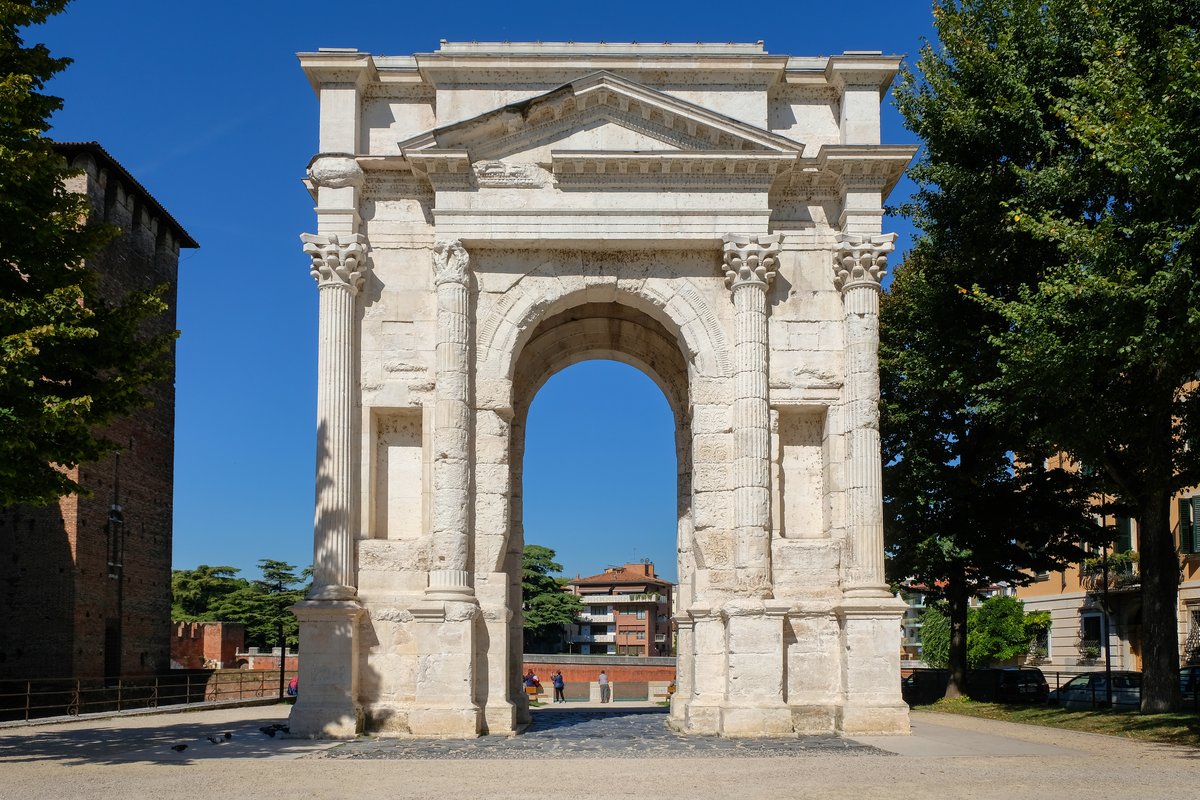

The Arco dei Gavi is an ancient structure in Verona, northern Italy, situated at the beginning of the Via Postumia just outside the city's Roman walls. Built to celebrate the gens Gavia, a noble Roman family from Verona, it is a rare example of a privately funded monumental Roman arch. Commissioned by the Gavi family and built by architect L. Vitruvius Cerdo in the first half of the 1st century AD, the arch was likely built during the reign of Augustus or the early years of Tiberius. While once interpreted as a funerary monument, its function was likely a symbolic monument of municipal liberties.
Over the centuries, the arch changed its purpose and location. It was eventually incorporated into the new city walls in the 12th century, serving as a city gate named Porta di San Zeno. During the 14th century, it was integrated into the defensive system of the Castelvecchio, where one side was incorporated into a clock tower and the other supported a walkway. This integration resulted in the partial destruction of the top of the structure. In 1550, the Republic of Venice sold the structure to private individuals, who demolished the surrounding medieval walls to reveal the arch once more.
In 1805, during the Napoleonic occupation, French military engineers dismantled the arch to improve security and traffic flow. The stone elements and decorations were surveyed in detail, and the blocks were dumped in the Piazza Cittadella or stored under the arches of the arena. In 1920, the idea for reconstruction was raised, eventually leading to the arch being rebuilt using anastylosis in 1932. The missing attic level was redesigned by Ettore Fagiuoli based on drawings by Andrea Palladio and the 1805 surveys. The arch was inaugurated on October 28, 1932, and is currently located in a small square next to the Castelvecchio.
Sources: Wikipedia, OpenStreetMap, Wikidata, Wikimedia Commons

Written by Nicolo Ciampini
Discuss this with the author and others
No comments yet. Be the first to start the conversation.