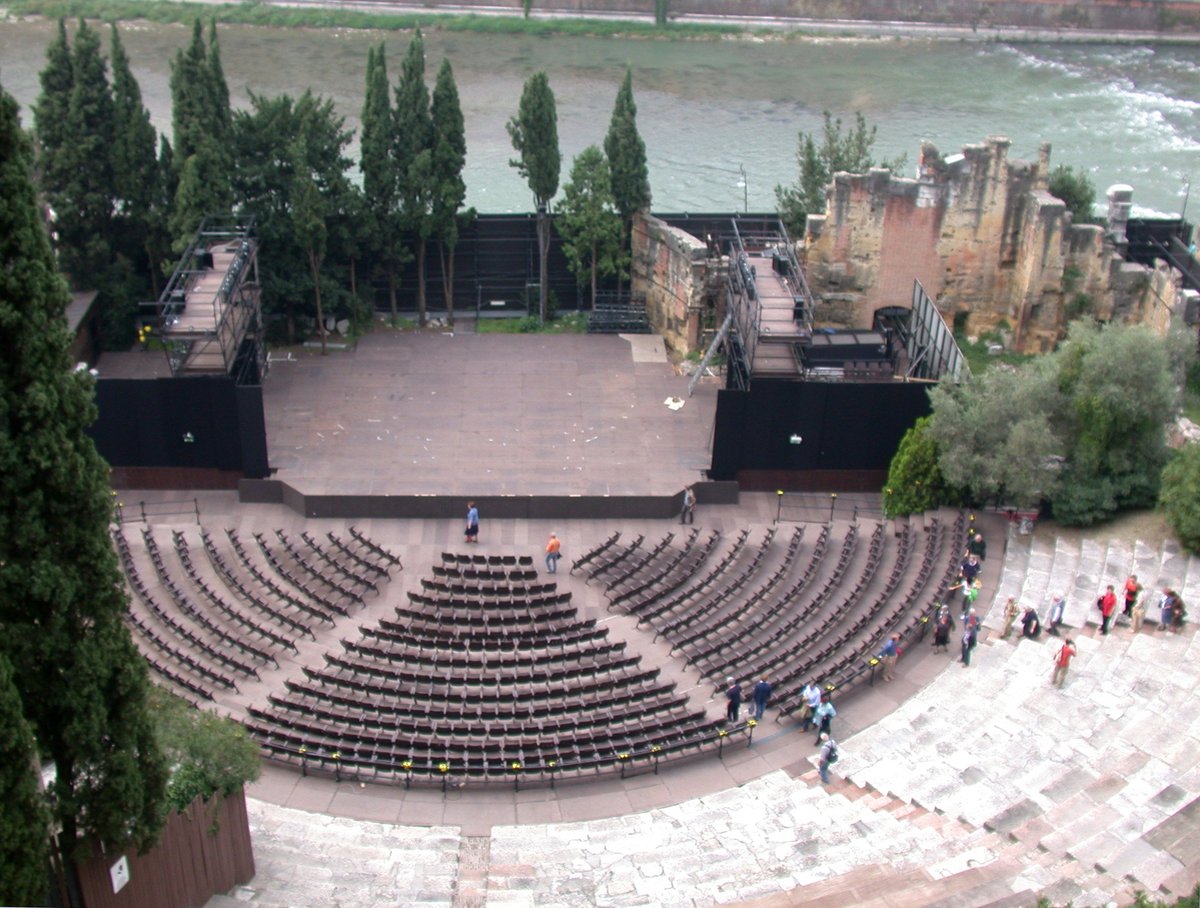

The Roman theatre standing in Verona today was built in the late 1st century BC. Before its construction, walls were built alongside the Adige River to protect it against floods. Today, only ruins remain, but they offer a glimpse into the city's past. The cavea, or seating area, is the most visible part, with several arcades of the loggias and remnants of the stage still standing. According to the source material, the church of S. Siro was built on part of the cavea in the 10th century, and the Roman theatre is not to be confused with the Roman amphitheatre known as the Verona Arena.
Several mosaics and artefacts are on display in the theatre's museum. One of the most interesting is a third-century A.D. polychrome mosaic from a Roman house outside the walls of Verona in Piazza Bra. This mosaic depicts the god Bacchus with his attribute, a panther, with the inscription 'Roropes Zeta' (Roropes lives). Another mosaic shows gladiatorial scenes, with three combats depicted and inscriptions stating the names of the gladiators and the outcome.
A marble decoration featuring a young satyr on a volute decorated with a goat head also survives. Lead pipes from the aqueduct that crossed the Postumia Bridge are on display, as well as other fragments that were recreated by Andrea Monga, including a single sphinx.
Sources: Wikipedia, OpenStreetMap, Wikidata, Wikimedia Commons
Written by Nicolo Ciampini
Discuss this with the author and others
No comments yet. Be the first to start the conversation.