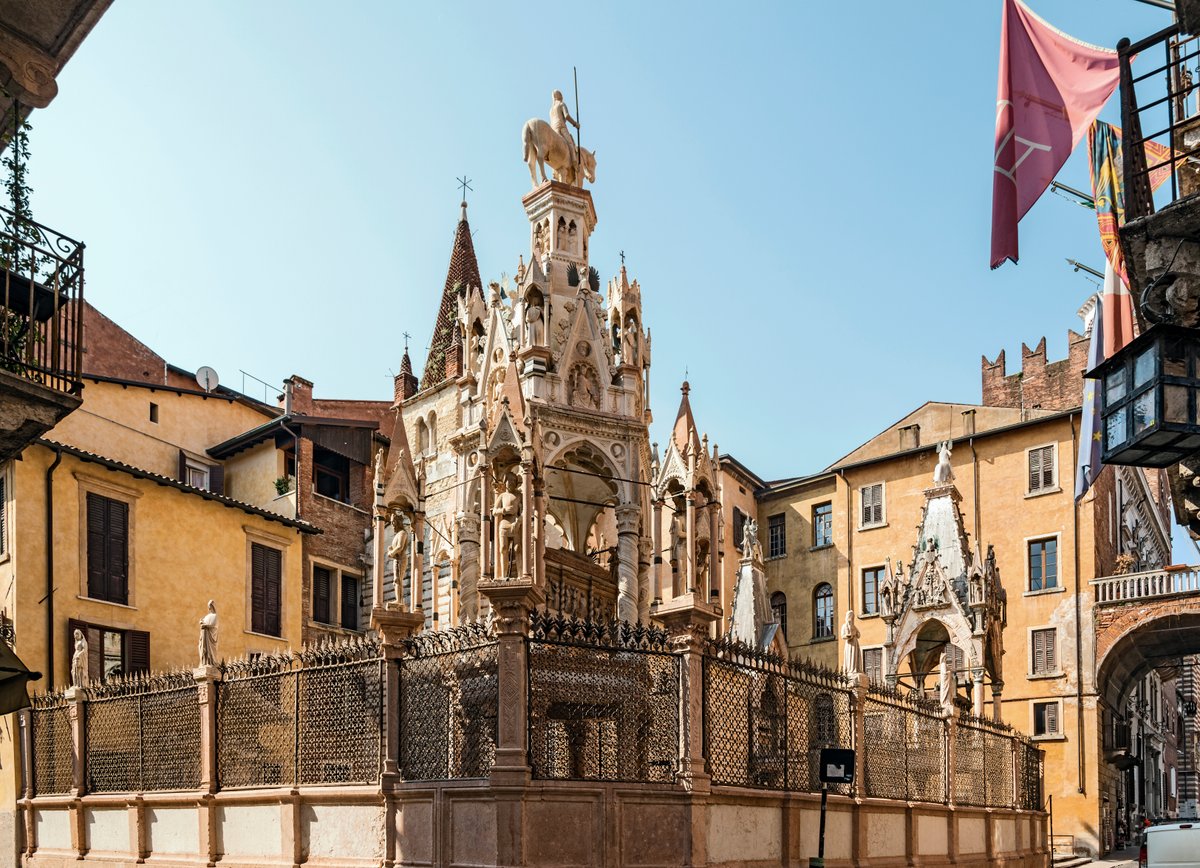

The Scaliger Tombs, located in Verona, Italy, are an extraordinary complex of five Gothic funerary monuments. These tombs celebrate the Scaliger family, who ruled in Verona from the 13th to the late 14th century. The tombs are located in a court outside the church of Santa Maria Antica, separated from the street by a wall with iron grilles. They are mostly freestanding open tabernacle-like structures rising high above the ground, with a sarcophagus surmounted by an elaborate baldachin, topped by a statue of the deceased, mounted and wearing armour.
These monuments are considered some of the most outstanding examples of Gothic art. The tombs are placed within an enclosure of wrought iron grilles decorated with a stair motif, referring to the name of the Della Scala family, meaning "of the stairs" in Italian. Although they are located in a crowded area of the city, they have stood for five hundred years. The stone pillars of the enclosure feature statues of saints.
The collection includes the tomb of Cangrande I, the most famous Scaliger ruler, whose 14th-century tomb was built in the shape of a Gothic tabernacle supported by richly harnessed dogs. Other notable monuments include the tomb of Mastino II, which was originally painted and gilt, and the most richly decorated tomb, that of Cansignorio, designed by Bonino da Campione. The tomb of Cansignorio served as the inspiration for a funerary monument in Geneva, Switzerland.
Sources: Wikipedia, OpenStreetMap, Wikidata, Wikimedia Commons

Written by Nicolo Ciampini
Discuss this with the author and others
No comments yet. Be the first to start the conversation.