

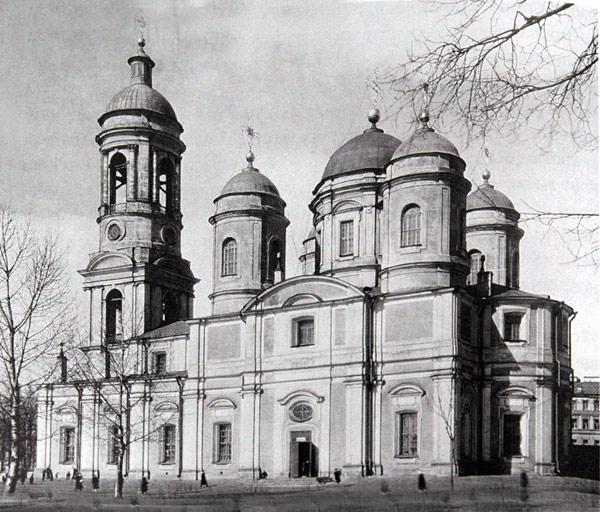
The backstory of this five-domed church with a tall bell tower, painted in yellow and white, is quite complex. These places began to be developed among the first in the new city. Here, along the shore of the Malaya Neva, west of the Peter and Paul Fortress, was the City Island with a settlement of the first builders and a small wooden church of Saint Nicholas "on the Mokrushi" because it stood on a place flooded during high waters, built in 1708.
Interesting fact. The name "Mokrushi" — a wet, marshy area — very accurately reflects the conditions in which the first citizens of "Peter's city" lived and built. Initially, all structures were wooden, and in some places — clay-walled or "mazanka" — a log frame coated with a mixture of clay and straw. Naturally, in the marshy area of the Neva delta, such buildings quickly deteriorated.
This also happened to the church of Saint Nicholas, which after a couple of years was rebuilt from the rotting wooden structure into a mazanka church, whose main altar — the Assumption — was consecrated in 1719 in the presence of Peter I himself. The new Assumption church, surpassing in size and number of altars (three in total) other contemporary city churches — Trinity-Peter, Isaac's, Peter and Paul — was granted cathedral status.
The Petersburg side was then considered the city center and was densely populated, which is why the church received the rank of cathedral. By 1732, the building had considerably deteriorated; the bell tower had to be demolished, and six years later a thorough interior renovation was carried out.
In memory of the birth of Grand Duke Ivan Antonovich in 1740, next to the mazanka church, a stone church of Saint John the Baptist was begun according to Zemtsov's design, completed in the rough two years later. From that time, its completion and decoration were overseen by Pietro Antonio Trezzini (not to be confused with Domenico Trezzini), but in 1744 work stopped because it was discovered that the altar of the church was oriented south. Empress Elizabeth Petrovna ordered in 1747 that instead of a single dome, the church be made "with five domes according to ancient Russian custom," for which Trezzini revised the project, obtaining measured drawings of the Assumption Cathedral from Moscow. However, the project was not liked, and almost all leading architects of the capital had to participate in composing a new one.
Finally, after long delays, in 1766 the most successful and simple design in the style of early classicism by Rinaldi was approved, executed by engineer Dyakov, who was building the nearby Tuchkov Buyan. In 1769, the new church was roughly ready, and its decoration had to be hurried because in 1772 the mazanka building burned down. In the still unfinished, shingled roof church, on September 8, 1773, the cold Assumption altar was finally consecrated.
Since the church under construction was also damaged by fire, in 1783 its restoration was entrusted to Starov, who apparently simplified the facade decoration and changed the dome finishes. In 1785, the warm Assumption altar was consecrated, and on October 1, 1789, the main altar in the name of Saint Prince Vladimir was consecrated, whose order was established in memory of the 800th anniversary of the Baptism of Rus. In 1799, the right Nicholas altar was consecrated, after which the cathedral could accommodate up to 3,000 people.

In 1799, during repairs, some icons in the iconostasis were replaced with new ones. On June 22, 1824, the altar of Saint Nicholas was consecrated, newly decorated at the expense of the elder F. D. Ivanov. A year earlier, changes began in the interior: choirs were arranged and the iconostasis was remodeled in the Empire style. In 1859, the church was made warm, and in 1866 the side altars were moved closer to the main one and reconsecrated. Two years later, academician Yasevich restored many icons in the cathedral.
In 1872–1873, while building a fence around the building, architect Bryullo erected two chapels in it, and another one, in memory of Alexander II, was built in 1882–1886 by Kovrigin at the corner of Bolshoy Prospect. Even earlier, in 1856, merchants built the Kazan chapel on Penkov Buyan.
Despite its long history, the cathedral did not have particularly interesting icons and items, except perhaps the icon of Saint Vladimir, the "Berlin Gospel" of the 17th century in a heavy and expensive cover, church vestments of the 18th century, a silver tabernacle of good workmanship from 1770, and one reliquary cross. In 1894, a Golgotha was installed in the interior, a novelty in church use. In 1910, a stained glass window depicting the Savior appeared in the altar.
Starting from 1843, the knights of the Order of Saint Vladimir gathered annually in the cathedral on September 22, celebrating the day of its establishment, and on the patronal feast day, a procession was held after the service. On July 10, the procession went to the Guk manufactory. The water blessing on the first Savior took place on the Zhdanovka River.
Already in 1810, one of the best parish schools in the city was opened at the cathedral on private funds, which, however, did not operate for very long. Since 1875, a charitable society with a poorhouse and two children's shelters operated, and since 1902 — a parish school. In 1887, parishioners wanted to erect a bronze bust of Alexander II in front of the cathedral.
For a quarter of a century, the cathedral clergy was headed by the popular pastor Archpriest Vasily Ioannovich Poletaev; in 1912 he was succeeded by the last pre-revolution rector — Archpriest Leonid Konstantinovich Bogoyavlensky, who in 1922 was sentenced to execution but instead served one and a half years in prison.
During the devastation, on December 6, 1920, in the baptistery, in a wooden warm room, the altar of All Russian Saints was consecrated. Services were held here in cold weather until the late 1920s.
The cathedral was temporarily closed from November 1926 to November 1927, then remained open despite the "demands of the workers," and from spring 1938 to autumn 1941 served as a cathedral. Metropolitan Alexy lived in the cell under the bell tower. From 1940 to 2001, the cathedral housed the miraculous icon of the Kazan Mother of God — the main city shrine.
In 1951–1952, the building was thoroughly restored. It is protected by the state as an architectural monument. The church's bicentennial was marked in 1989 by the issuance of a commemorative medal.
Sources:
https://www.citywalls.ru/house3698.html
https://peterburg.center/maps/knyaz-vladimirskiy-sobor
https://ru.wikipedia.org/wiki/Prince_Vladimir_Cathedral_(Saint_Petersburg)



Written by Jermaine
Discuss this with the author and others
No comments yet. Be the first to start the conversation.