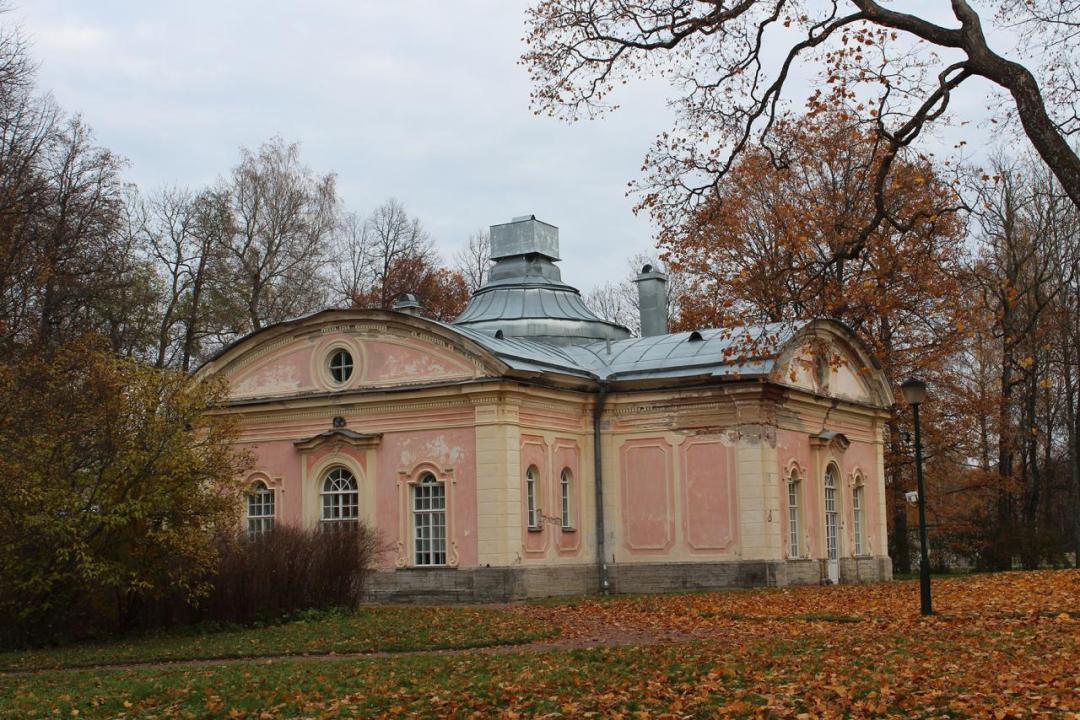

Chinese Kitchen – a small one-story, with a mezzanine floor, cruciform pavilion. The pavilion is crowned with a wide, flattened dome.
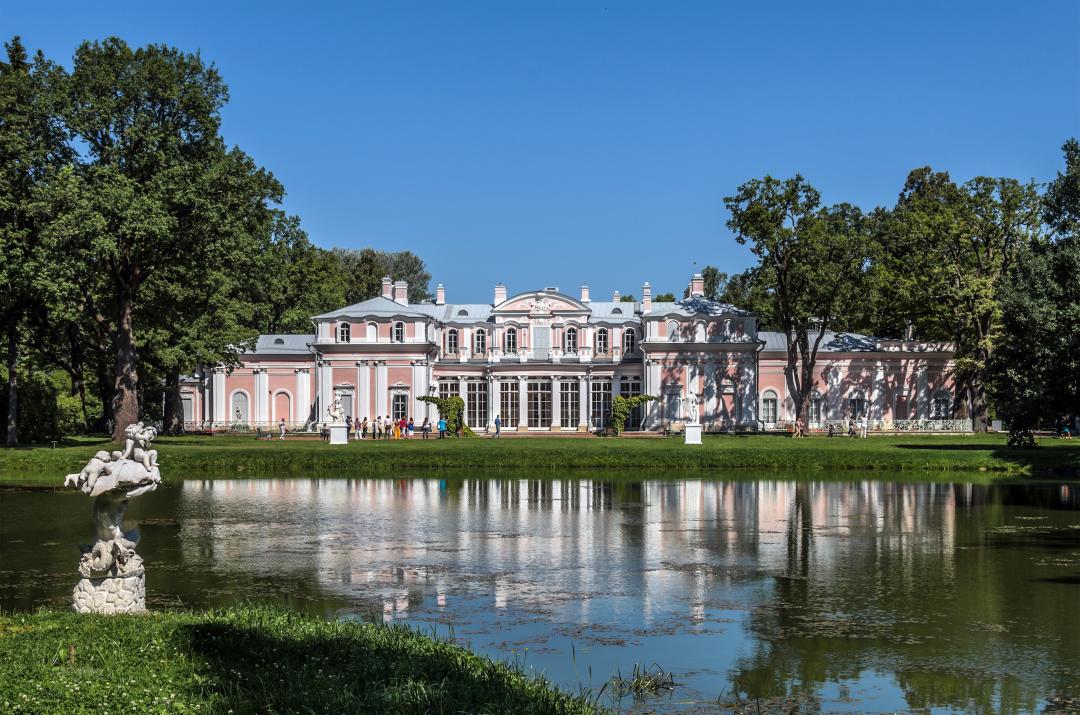
The history of the creation of the Chinese Kitchen dates back to the 1760-1770s, when Rinaldi was building the ensemble of the Private Dacha. On both sides of the pond located in front of the southern facade of the Chinese Palace, he planned to build stone pavilions: the Maidens’ Pavilion on the east side, and the Coffee Pavilion on the west. Only the Maidens’ Pavilion was constructed in the early 1760s.
It was a one-story building in the Baroque style, already showing noticeable elements of Classicism. Its central part significantly protruded toward the pond and was topped with a dome-shaped roof.
In 1852-1853, the Maidens’ House was rebuilt by architect Bronshtedt. The building came to be known as the Chinese Kitchen. This is a stylized structure characteristic of the second half of the 19th century. Since the late 18th century, the building, repeatedly rebuilt, was used as a kitchen, hospital, stable building, court and cavalry corps. Its exterior appearance changed, as did the interiors. During large-scale reconstruction works of the Chinese Palace, carried out on the initiative of Grand Duchess Elena Pavlovna, it was finally rebuilt as a kitchen intended to serve the residents of the Chinese Palace. Now seven necessary utility rooms were equipped: confectionery, "tablecloth room," "serving room," "coffee room," and others. On the second floor were rooms for the service staff. The kitchen had an icehouse and a wine cellar. To this day, the building retains a stove flue with numerous chimney openings.
Although the pavilion “Chinese Kitchen” was built in 1853, that is, much later than the main part of the buildings of the Empress’s Private Dacha, it does not stand out from the overall stylistic solution of the architectural ensemble. Architect Ludwig Bronshtedt designed it carefully imitating the artistic traditions of the mid-18th century and following the main principles of the architecture of Antonio Rinaldi, who created the Private Dacha ensemble. However, it is worth noting that the basis for the creation of the Chinese Kitchen was the Maidens’ Pavilion, built on this site during the Catherine era. The kitchen related to the Chinese Palace, originally located in the Cavalry Corps premises, was transferred to this new pavilion.
The pavilion’s roof resembles a Chinese pagoda. The two-story building is painted in a delicate pink color. In the middle of the first-floor hall was a chimney, around which were two Russian stoves (one of them for baking pies), two Dutch stoves with an oven, confectionery baking and roasting cabinets, spit devices, and cauldrons. Nearby were the "Coffee Room" with a "large English hearth with a stove and oven" and a pie oven, a service room and a buffet for dishes, the tablecloth room, confectionery, serving room, as well as a bathroom "with a water machine with three taps" and a place for washing dishes. On the second floor lived the staff – the cook and buffet workers. Not far from the Chinese Kitchen, a brick icehouse was arranged for storing products. Dishes prepared in the kitchen were then served in the Buffet of the Chinese Palace.
The building was repeatedly rebuilt, used as a kitchen, hospital, stable building, court and cavalry corps. Its exterior and interiors changed. In Soviet times, the stoves were dismantled, and communal apartments were arranged in the pavilion. Only the chimney remaining in the center of the hall reminds of the pavilion’s original use. Currently, the lower hall, freed from all partitions, is used for temporary exhibitions of the museum-reserve.
Sources:
https://peterburg.center/maps/oranienbaum-pavilon-kitayskaya-kuhnya.html
http://www.oranienbaum.org/oranienbaum/chinese-kitchen/
https://peterhofmuseum.ru/objects/oranienbaum/pavilion_kitayskaya_kuhnya



Written by Jermaine
Discuss this with the author and others
No comments yet. Be the first to start the conversation.