Imperial Parks of Tsarskoye Selo: Alexander Park

For Browsing

At the very beginning of the 18th century, on the site of Alexander Park, there was a square plot of forest enclosed by a stone wall, intended for imperial hunting. It was called the Menagerie, and Catherine I also enjoyed hunting here. Wild animals lived here – foxes, hares, wild boars. Later, during the reign of Elizabeth Petrovna, the park was landscaped and divided into four equal square sections, similar to formal French gardens. During the reign of Catherine the Great, new territories were added to the park. In 1792, architect Giuseppe Quarenghi began construction of a large palace in Tsarskoye Selo, later named the Alexander Palace. In the 1810s–1820s, the Menagerie, having lost its hunting purpose by that time, was transformed into an extensive landscape park. Here were located a small royal farm, pavilions for llamas and elephants, the building of the Retired Stables for horses that once served the royal family. Three large structures were also built in the landscape part of the park: Montbijou, intended to house a collection of weapons and military armor and called the Arsenal; an artificial Gothic-style ruin – the Chapel; and the White Tower. The greenhouses of the "Upper Garden" in the landscape part of Alexander Park are the only park greenhouses still existing on the site they occupied at the beginning of the 18th century, though they changed their appearance as a result of reconstructions in the early 19th century. The layout of the complex resembles the French fruit gardens of the Louis XIV era. At the beginning of the 20th century, the northeastern territory of Alexander Park, stretching from the Alexander Palace to the Egyptian Gates, was built up. Here the Fedorovsky Town emerged. Sources: https://www.tzar.ru/objects/alexandrovskypark https://pushkin.spb.ru/encycl/parks/aleksandrovskiy-park.html

Curtain "Mushroom"

P98Q+PQ Pushkinsky District, Saint Petersburg, Russia

The name of the curtain wall "Mushroom," located on the territory of the New Garden, is associated with the shape of the gazebo that stood here at the end of the 18th — beginning of the 19th century. The "Mushroom" curtain wall is situated in one of the four identical squares in the New Garden of the Alexander Park.

Mount "Parnassus"

P99Q+Q9 Pushkinsky District, Saint Petersburg, Russia

The mountain "Parnas" is located in one of the four identical squares in the New Garden of Alexander Park. It was constructed in 1755 during the expansion and deepening of the ponds and the Cross Canal.

Dragon Bridge

Dragon Bridge, Podkaprizovaya Road, Saint Petersburg, Russia, 196605

The Dragon Bridge, referred to in late 18th-century documents as the bridge "with monstrous figures," was built in 1785 based on a design by Charles Cameron on the avenue leading from the palace, in front of the entrance to the Menagerie.

Chinese Theater or Stone Opera

P99P+4G Pushkinsky District, Saint Petersburg, Russia

To the left of the entrance to Alexandrovsky Park, in the center of one of the squares, is the Chinese Theater, or the Stone Opera, as it was called during the time of Empress Catherine II. Originally, it was planned to create an "open-air theater" in its place—that is, a theater under the sky with turf benches. The theater project was developed by the architect Rinaldi, and its construction in 1778-1779 was carried out under the supervision of Neelov, who made significant changes to the original design.

The Great Chinese Bridge

Big Chinese Bridge, Sadovaya St., Saint Petersburg, Russia, 196601

The Great Chinese Bridge is one of the historic bridges of Alexander Park in the former Tsarskoye Selo (now the city of Pushkin, Saint Petersburg). It is located on the main axis of Alexander Park and situated near the central entrance to the park, on the side of the parade ground by the Catherine Palace—opposite the Golden Gate of the palace.

Cross Bridge

Krestovy Bridge, Podkaprizovaya Road, Saint Petersburg, Russia, 196601

Even at a glance, it becomes clear where the creator drew his inspiration from. The forms of the Cross Bridge reveal the influence of Chinese architectural traditions. It was Rinaldi himself who wanted to make a bridge styled according to the Eastern tradition, but his intention was realized by Vasily Ivanovich Neelov and Charles Cameron.

Small (Iron) Chinese Bridges

P98P+JM Pushkinsky District, Saint Petersburg, Russia

The Small Chinese Bridges are located on the Cross Canal on two transverse alleys leading from the Alexander Palace to the Grand Caprice. Originally, there were wooden bridges here, built according to a design by Charles Cameron in 1781. Carved columns installed at the entrance to the bridge supported curved roofs painted "to resemble fish scales," on which twelve tin gilded weather vanes were mounted, cut from tin and covered with gold.

Chinese village

Sadovaya St., 7a, Saint Petersburg, Russia, 196601

The Chinese Village in the Alexander Park of Tsarskoye Selo is an attempt made during the reign of Catherine the Great to build a village in the Chinese style, following the fashion for chinoiserie ("Chinese stuff") that spread in European art in the 18th century. Located beyond the Cross Canal is the Chinese Village, the construction of which was begun in the mid-1780s by architect Charles Cameron. Its concept and initial design likely belonged to both Neelov and Rinaldi.

The Big and the Small Whim

Bolshoy Kapriz, Podkaprizovaya Road, Saint Petersburg, Russia, 196603

The Catherine and Alexander Parks are separated by Podkaprizovaya Road, which got its name from two structures — the Large and Small Caprices. Both are artificially created embankments with arched spans over the road. According to an old legend, the earthen archways were named the Large and Small Caprices because Empress Catherine II, while approving the estimates for the costly construction work related to them, hesitated for a long time, and upon signing, said: "So be it, this is my caprice."

Arsenal

Sadovaya St., 7, Saint Petersburg, Russia, 196605

The Arsenal is a park pavilion built between 1819 and 1834, designed and supervised by architects Adam Menelas and Alexander Ton. It is one of the first Russian museums (the Imperial Museum of Arms). The building, in the "Gothic" style and crowned with battlemented towers, is located in the center of Alexander Park in Tsarskoye Selo, a suburb of Saint Petersburg. The very name of the building — Arsenal — reflects its function: the pavilion was used for storing and displaying the collection of medieval, European, and Eastern weapons of Nicholas I, which the emperor began to assemble while still a grand duke.

White tower and gate ruin

P9FR+C3 Pushkinsky District, Saint Petersburg, Russia

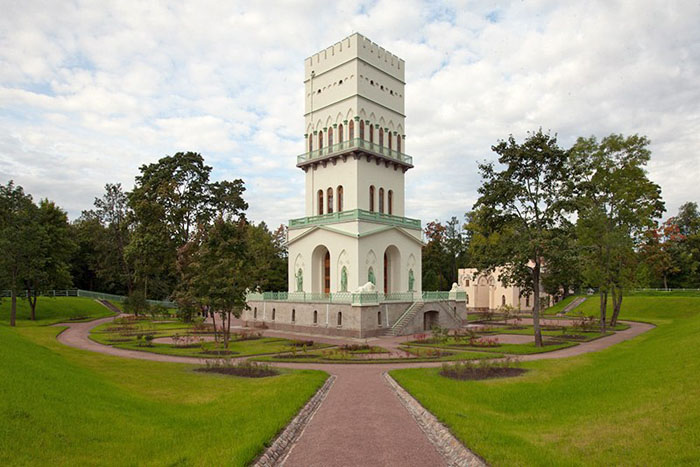
Off the main axis of the landscaped part of Alexandrovsky Park is a complex of structures inspired by the image of a medieval knight’s castle. It includes the Gate Ruin — two towers with a gate between them, as well as a moat and an embankment topped with a brick battlement. The dominant feature and core of the complex was and remains the White Tower — the "donjon," standing 37.8 meters tall, the main tower in European feudal castles, located within the fortress walls.

Children's playhouse

P9CQ+CM Pushkinsky District, Saint Petersburg, Russia

The children's house is a pavilion in Alexandrovsky Park in Pushkin, built in 1830 by the architect Gornostayev.

Horse Cemetery

Alexander Park / Alexandrovsky Park, Saint Petersburg, Russia, 196605

Not far from the southern facade of the Pensioner Stables building, a cemetery for the horses of the "Imperial Own Saddle" was established. Stone slabs bearing the names of the favorite horses of the Russian emperors from Alexander I to Nicholas II were placed on the graves.

Imperial Farm

Fermskaya Road, 6, Saint Petersburg, Russia, 196605

In the northern part of Alexandrovsky Park are located the Imperial Farm and a vast tract of land once intended for grazing livestock. The complex of buildings, resembling a small knight’s castle more than a cattle yard, was constructed between 1817 and 1822 by architect Adam Menelas at the behest of Alexander I. The complex consisted of the Pavilion of the Highest Presence, a Dairy, a Cowhouse, sheds for Merino sheep, the Caretaker’s House, and other structures. Livestock grazed on the meadows of the park adjoining the Imperial Farm complex.

War Chamber

Fermskaya Road, 5a, Saint Petersburg, Russia, 196605

In 1911, Elena Andreyevna Tretyakova, the widow of Sergey Mikhailovich Tretyakov, the brother of Pavel Mikhailovich, the founder of the Tretyakov Gallery, presented Emperor Nicholas II with a collection of visual materials and documents on the history of Russian wars, as well as military trophies. The Emperor ordered the creation of a museum based on this collection, for which the "Sovereign's War Chamber" was built in Tsarskoye Selo. The building was erected with funds from Tretyakova.

Pensioner stables (also known as Pensioner and Pension stables)

Alexander Park / Alexandrovsky Park, Saint Petersburg, Russia, 196605

The Pensioner Stables (also known as the Pensioner and Pension Stables) were established on the territory of the former Menagerie, near the northern boundary of Alexander Park, by order of Nicholas I between 1827 and 1829 for the elderly horses that carried the imperial family under saddle — so that they could have a happy old age until their natural death. The building of the Pensioner Stable is located there. In January 1826, Emperor Nicholas I ordered the transfer of eight riding horses from the "Personal Saddle of Emperor Alexander Pavlovich," who were spending their final years "on pension" in the stables of Saint Petersburg, to Tsarskoye Selo, where accommodations were to be provided for them. It was initially planned to prepare stables for them at the Farm in the summer, but due to lack of space there, a special building was constructed between 1827 and 1829 according to the design of architect Menelas, which was named the Pensioner Stable.

Lamsky Pavilion

Alexander Park / Alexandrovsky Park, Saint Petersburg, Russia, 196605

The Llama Pavilion was built between 1820 and 1822 by architect Adam Menelas to house llamas. The llamas were gifted to Emperor Alexander I by the President of Peru and brought to Tsarskoye Selo as early as 1816, but they lived together with two turtles near the Upper Greenhouses. The appearance of these exotic animals in Russia marked a successful beginning to Russian-American trade relations.

Tower Ruin Chapel

P98H+4X Pushkinsky District, Saint Petersburg, Russia

On September 15, 2018, the Chapel—the most romantic pavilion of Alexander Park—reopened to visitors after restoration. For more than seventy years, the building had been in a state of disrepair. Built in the 19th century in the form of a Gothic chapel ruined by time, the "Chapel" pavilion sustained numerous damages during the Great Patriotic War. Especially

Grigori Rasputin's grave

P9FC+PM Pushkinsky District, Saint Petersburg, Russia

Grigory Yefimovich Rasputin was buried in a deserted place in Tsarskoye Selo, on the territory of the under-construction Verubova Seraphim Lazaret in Alexandrovsky Park. This church was being established in memory of the miraculous rescue of Anna Alexandrovna Verubova — a friend of the Sovereign Empress — during a railway disaster in January 1915. This place was located by the dam blocking the Kuzminka River in the area of the Lamskiye Ponds.

Fedorovsky Town

Akademicheskiy Ave, 18, Saint Petersburg, Leningradskaya, Russia, 196607

The Fedorovsky Town (also called Feodorovsky) is an architectural ensemble in the Neo-Russian style, located in Pushkin within the territory of Alexandrovsky Park and near the borders of Fermsky Park. The terem, towers, and walls made of light stone, adorned with magnificent carvings, evoke the cultural traditions of Orthodoxy and symbolize the unity of the Russian state. The original name was the Houses for the clergy and servants of the Fedorovsky State Cathedral. Currently, it serves as the Patriarchal Compound.

Artificial grotto with a spring

Sadovaya St., 7, Saint Petersburg, Russia, 196605

A little off the road, not far from the Arsenal, a spring flows from a small artificial grotto and trickles as a thin stream into the Lamskiye Ponds. Once, even Emperor Nicholas II himself did not disdain the waters from this spring.

Dot of the Spanish SS division in Alexandrovsky Park

The pillbox was built by the Spaniards during the war on the bank of the Kuzminka River.

Alexandrovsky Palace - The Palace of Catherine II's Beloved Grandson

Alexandrovsky Park, Dvortsovaya St., 2, Saint Petersburg, Russia, 196601

The history of the creation of the palace here, surrounded by an oasis of man-made nature, is connected with the names of two august figures – Empress Catherine II and her grandson, the future Emperor Alexander I, as well as the architect Giacomo Quarenghi. In the northern part of the picturesque Alexander Park, a magnificent building was erected — the New Tsarskoye Selo (later Alexander) Palace. It was founded in 1792 by order of Catherine II and was built for the wedding of her beloved grandson, Grand Duke Alexander Pavlovich (the future Emperor Alexander I), to Grand Duchess Elizabeth Alexeievna.

Elephant (Krasnoselsky) Gate

P9C8+6J Pushkinsky District, Saint Petersburg, Russia

Along the road branching off from the Lam building toward Yelovaya in the direction of Stolbovaya, there was a wooden pavilion with small towers and service buildings and sheds surrounding a quadrangular courtyard. This is the "Elephants." The "Elephants" building stands aside from Yelovaya Alley, almost at Stolbovaya Road itself, near two stone guardhouses from which the aforementioned Staro-Krasnoselskaya and Novo-Babolovskaya roads begin. These guardhouses stand symmetrically on either side of the iron gates, which form one of the many entrances to the part of Alexander Park enclosed by a white fence. The guardhouses serve as residences for two pairs of park guards.

The Feodorovsky Sovereign Cathedral

Akademicheskiy Ave., 34, Saint Petersburg, Russia, 196607

It was built between 1909 and 1912 by order of Emperor Nicholas II as a church for His Majesty's Own Convoy and the Combined Infantry Regiment, consecrated on August 20 (September 2), 1912. From 1933 to 1991, the church was closed. The cathedral houses a revered copy of the miraculous Theodorovskaya Icon of the Mother of God. In 1895–1896, His Imperial Majesty's Own Combined Infantry Regiment was stationed in the area of the Egyptian Gates of Tsarskoye Selo. Wooden barracks were built for it. Nearby was also stationed His Imperial Majesty's Own Convoy.