Imperial Parks of Tsarskoye Selo - Catherine Park

For Browsing

Yekaterininsky Park is a park that is part of the State Museum-Reserve "Tsarskoye Selo." It is located in the town of Pushkin near Saint Petersburg and is an architectural monument of the 18th–19th centuries. Together with Alexander Park, it forms an integral part of the Tsarskoye Selo Imperial Residence and is named after the Catherine Palace located within it. Yekaterininsky Park consists of two parts: the formal Old Garden and the landscape-style English Park. Sources: https://www.tzar.ru/objects/ekaterininskypark https://pushkin.spb.ru/encycl/parks/ekaterinenskii-park.html

Ekaterinsky Park

Yekaterininsky Park, Sadovaya St., 7, Saint Petersburg, Russia, 196601

During the Swedish period (1609–1702), on the territory of Catherine Park, there was an estate belonging to a Swedish magnate — the Sarskaya Myza (Finnish: Saari mojs, Swedish: Sarishoff — "elevated place"). It was a small estate consisting of a wooden house, utility outbuildings attached to it, and a modest garden divided by two perpendicular alleys into four squares. On maps created for Boris Godunov, the estate is named "Saritsa." Later, influenced by Russian folk etymology, the name transformed into "Sarskaya Myza," then into "Saarskoye Village," and finally became Tsarskoye Selo.

Park sculpture

Sadovaya St., 7, Saint Petersburg, Russia, 196601

For more than two centuries, the regular section of Catherine Park has been adorned with marble statues and busts created by Venetian masters of the early 18th century: Bonazza, Baratta, di Taliapietra, Modolo, Zeminiani, Zordzoni, and Tarsia. The sculptures intended to decorate the garden laid out in front of the Catherine Palace were brought to Tsarskoye Selo in the mid-18th century from Saint Petersburg, mainly from the Summer Garden, and originated from collections of sculptures acquired during the Petrine era.

The Upper Bath or The Soap Room of Their Highnesses

Sadovaya St., 7, Saint Petersburg, Russia, 196601

On the shore of the Mirror Pond stands the pavilion "Upper Bath," or, as it was called in the 18th century, the "Soap Room of Their Highnesses," built in 1777–1779 by the Neelov architects. The Upper Bath is executed in the style of early classicism. The sparsely decorated facade creates an impression of refined simplicity due to the proportional relationship between the main volume and the three-sided risalit facing the pond.

Lower Bathhouse or Cavalier's Soaphouse in Tsarskoye Selo

Sadovaya St., 14, Saint Petersburg, Russia, 196601

Not far from the Upper Bath is the Lower Bath, or, as it was called in the 18th century, the Cavalier Soap House. This pavilion, located off the park alleys and intended for courtiers, was built according to the design of architect Neelov in 1778–1779. Its facade is half hidden from the view of garden visitors by trees and shrubs. The Lower Bath consists of ten rooms grouped around a central hall with a large round bath. The water was heated in two boilers, which had separate entrances, and was supplied by pipes to the bathhouse and the rooms with baths.

Hermitage Pavilion

Sadovaya St., 7, Saint Petersburg, Russia, 196601

The Hermitage is a park pavilion (belonging to the so-called hermitages (from French — "secluded corner")) in the Baroque style located in the Catherine Park in Tsarskoye Selo.

Grotto Pavilion

P97X+9C Pushkinsky District, Saint Petersburg, Russia

Grottos, decorated inside with shells and tuff, were an almost mandatory feature of large formal gardens in the 18th century. The pavilion was built during the reign of Elizabeth Petrovna in 1755–1756 according to a design by Chief Architect Bartolomeo Rastrelli. The construction and interior decoration were carried out by Court Councillor Ivan Rossi. The grotto became the first pavilion built on the shore of the Large Pond.

Hermitage Kitchen

Sadovaya St., 16, Saint Petersburg, Russia, 196601

The construction of the Hermitage Kitchen had two purposes – to serve receptions held at the Hermitage and to decorate one of the main entrances to the Tsarskoye Selo Garden, which is why it is also called the Red Gate.

Admiralty

Parkovaya St., 30, Saint Petersburg, Russia, 196604

The Admiralty pavilions were built by Neelov in 1773 to commemorate the annexation of the Crimean Khanate to Russia, on the site of the old wooden boat shed. Imitating Dutch buildings, the pavilions were constructed from red brick, and the facades were left unplastered. The towers feature spires and battlement parapets.

Hall on the island

Catherine Park / Ekaterininsky Park, Saint Petersburg, Russia, 196601

Originally, a wooden hall with galleries was built on the island located in the middle of the Large Pond. The pavilion "Hall on the Island," located, as its name suggests, on the island of the Large Pond, was rebuilt in the late 1740s according to Chevakinsky's design into a new, luxuriously decorated Baroque-style pavilion and adorned based on Rastrelli's drawings.

Chesme Column

Big Pond, Saint Petersburg, Russia, 196603

…surrounded by waves, Above the solid, mossy rock A monument has risen. Spreading its wings, A young eagle sits above it. And heavy chains and thunderous arrows Have thrice entwined around the formidable pillar; Around the base, roaring, the gray ramparts, Have settled in shining foam.

Marble Bridge

Marble Bridge, Podkaprizovaya Road, Saint Petersburg, Russia, 196603

The Marble Bridge was built in 1774 in the Landscape section of Catherine Park. The bridge stands over a channel connecting the Large Pond with the Swan Ponds, which are still called that to this day because swans lived on them. Seven small islands were specially created for the swans, and on the islands, houses were built, painted according to the designs of A. Rinaldi.

Turkish bath

Parkovaya St., 40, Saint Petersburg, Russia, 196603

In memory of the signing of the Treaty of Jassy in 1791, Empress Catherine II commissioned architect Giacomo Quarenghi to design a pavilion called the Turkish Bath. This project was never realized. Nicholas I decided to fulfill his grandmother the Empress's intention by decorating the park with a pavilion dedicated to the victories of the Russian army over the Turks, but during another victorious war for Russia against Turkey in 1828–1829 and the subsequent Treaty of Adrianople concluded as a result.

The Pyramid in Tsarskoye Selo

Unnamed Road, Saint Petersburg, Russia, 196603

In Catherine Park on the shore of Lebyazhiy Pond, among the surrounding greenery, stands one of the first pavilions of the park's landscape section – the Pyramid.

Red (Turkish) Cascade or Red Bridge

Catherine Park / Ekaterininsky Park, Saint Petersburg, Russia, 196603

In the 1770s or already in the 1780s, Gerard and the court architect Neelov created the lowest of the three dams on the canal section between the Upper and Swan Ponds — the Red Cascade, called the "Red Bridge." Originally, one of the slopes of the Sledding Hill — an amusement structure located on the site of the current Granite Terrace — led to the place where the cascade was arranged, but in 1791–1795 it was completely dismantled.

Gothic gates

Catherine Park / Ekaterininsky Park, Saint Petersburg, Russia, 196603

Gothic Gates — decorative gates in the Catherine Park of Tsarskoye Selo. Created in 1777–1780 based on a design by Felten, taken from an English architectural publication. Several wooden carved models were made in Saint Petersburg and Yekaterinburg for the production of the cast-iron gates, on the basis of which the parts of the structure were cast at the Kamensky State Cast Iron Foundry.

Tower-ruin with an artificial hill

Orlovskie Gates, Saint Petersburg, Russia, 196603

The tower-ruin with an artificial hill is one of the memorial architectural structures in the Catherine Park of Tsarskoye Selo, dedicated to the victories of the Russian army in the Russo-Turkish War of 1768–1774. It is one of the artificial imitations of ancient ruins in the park, alongside the garden pavilion Kitchen-Ruin by the sculptor Conchezio Albani.

Orlovskie (Gatchina) Gates

Orlovskie Gates, Saint Petersburg, Russia, 196603

The Orlov (Gatchina) Gates were erected between 1777 and 1782 on the border of Catherine Park, at the exit to the road leading to Gatchina, the former estate of General Feldzeugmeister Orlov. Empress Catherine II honored one of her favorites with this lifetime monument to commemorate the success of the campaign he led against the plague epidemic that swept through Moscow in 1771. On the facade of the gates facing Gatchina, a frieze bears an inscription taken from a poetic epistle to the general by the poet Maikov: “Moscow was saved from disaster by the Orlovs.” Another inscription, on the side facing Catherine Park, provides a more detailed account of this event.

Granite terrace

P97R+5J Pushkinsky District, Saint Petersburg, Russia

For three decades of the 18th century, the site of the current Granite Terrace was occupied by the Sliding Hill, with slopes used for sliding in winter and summer. In the form we see it today, the Granite Terrace was constructed in early 1810 according to a design by architect Rusk. The history of structures on this site dates back to the 1730s, when a hill was built here for sliding on "boats" and "bark sleds." Later, a stone Sliding Hill appeared here for sliding at any time of the year. The Sliding Hill was a complex and grand entertainment structure.

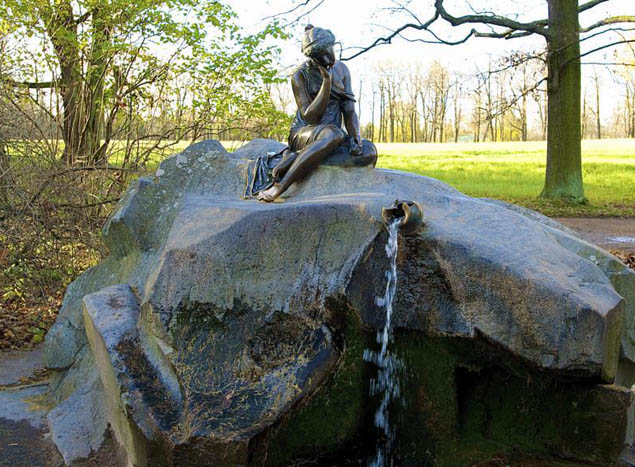
Fountain "Milkmaid"

Girl with a pitcher, Podkaprizovaya Road, Saint Petersburg, Russia, 196603

The fountain "Milkmaid," known as the "Tsarskoye Selo Statue" or the "Girl with a Pitcher," holds a special place among the park sculptures of Tsarskoye Selo: it is the only sculpture specifically created for the Catherine Park.

Concert hall in Catherine Park

Catherine Park / Ekaterininsky Park, Saint Petersburg, Russia, 196603

In the 1780s, architect Quarenghi built a Concert Hall in Catherine Park, which he described as "a music hall with two cabinets and an open temple dedicated to the goddess Ceres." Confirmation that the pavilion was conceived as a temple to Ceres was provided by the panel "Sacrifice to Ceres" in its large hall, depicting a statue of the goddess in the temple portico, in front of which an altar is placed. Initially, the pavilion was called the "Temple of Friendship," but from 1788, at the request of Catherine II, it became known as the "Music" or "Concert" Hall.

Kitchen-ruin

Catherine Park / Catherine Park, Saint Petersburg, Russia, 196603

Located next to the Concert Hall, the Kitchen Ruin, built by Quarenghi in the 1780s, is among the architect's finest works. The entrance to the pavilion—a circular in plan structure complicated by two rectangular projections—is designed as a niche, with a door set deep inside. The curved parts of the facade between the projections are decorated with columns.

Squeaky (Chinese) Gazebo

Catherine Park / Ekaterininsky Park, Podkaprizovaya Road, Saint Petersburg, Russia, 196603

The exotic pavilion, called the Squeaky (Chinese) Gazebo, is located on the border between the landscaped part of Catherine Park and Podkaprizovaya Road, just beyond which lies the Chinese Village. On the roof of the gazebo is mounted a weather vane in the shape of a Chinese banner, which produces a loud creaking sound when it spins in the wind: this explains one of the gazebo’s names — the Squeaky. The gazebo was constructed according to the design of architect Felten; the work was carried out under the supervision of Neelov from 1778 to 1786.

Pavilion "Evening Hall"

Alexander Park / Aleksandrovskiy Park, Podkaprizovaya Road, Saint Petersburg, Russia, 196603

Not far from the Private Garden is the pavilion "Evening Hall," the construction of which began in 1796 based on Neelov's design, but was only completed a decade and a half later, according to Ruski's plans.

Monument to Alexander Dmitrievich Lanskoy or Marble Pedestal in Honor of Virtue and Merits

Catherine Park / Ekaterininsky Park, Saint Petersburg, Russia, 196603

Monument to Alexander Dmitrievich Lansky ("Marble Pedestal in Honor of Virtue and Merit") — a monument in the Catherine Park of Tsarskoye Selo, dedicated to the memory of Catherine II's favorite, A. D. Lansky. It was presumably constructed according to a design by the Italian architect A. Rinaldi in 1773 as an abstract architectural allegory of "virtues and merits," not associated with any specific person or event. It became a monument to Lansky after his death in 1784.

Kagul (Rumyantsev) Obelisk

Catherine Park / Ekaterininsky Park, Saint Petersburg, Russia, 196601

Intoxicated with memory, With reverence and longing I embrace your formidable marble, The proud monument of Kagul. Pushkin, 1819

Gate "To My Dear Colleagues"

Catherine Park / Ekaterininsky Park, Naberezhnaya St., Saint Petersburg, Russia, 196602

On the southeastern edge of Catherine Park stand monumental cast-iron gates, constructed according to the design of architect Stasov in 1817 in honor of Russia's victory in the Patriotic War of 1812. The words inscribed on them – "To my dear comrades-in-arms" – belong to Emperor Alexander I.

Own little garden

Sadovaya St., 3, Saint Petersburg, Russia, 196601

In 1856, the part of the landscape park adjacent to the palace was fenced off with a low cast-iron grille featuring cast gilded bronze decorations and three gates, designed by the architect Vidov. Finally, in 1865, architect Vidov laid out the Private Garden here by order of Alexander II, intended for members of the royal family and their closest circle.

Moreyskaya Column

Devil's Bridge, Catherine Park, Saint Petersburg, Russia, 196609

The Morea Column is a monument in the Catherine Park of Tsarskoye Selo, erected in honor of the victories of Russian troops on the Morea Peninsula (Peloponnese) in 1770 during the First Archipelago Expedition of the Russian fleet in the course of the Russo-Turkish War of 1768–1774. The monument is designed in the neoclassical style and represents a rostral column made of marble. It was constructed according to the project of the Italian architect Antonio Rinaldi in 1771.

Damn bridge

Devil's Bridge, Catherine Park, Saint Petersburg, Russia, 196609

The walkways between the ponds were transformed into "stone cascades with decorations," featuring romantic rapids made of large boulders, one of which, between the first and second ponds, was named the "Devil's Bridge," and another between the second and third cascade ponds, the "Green."

Cast iron gazebo

PC64+VP, Saint Petersburg, Russia, 196602

The famous cast-iron gazebo is shrouded in romance – this place was already beloved by park visitors in the 19th century. According to legend, Catherine II ordered the manufacture of nine such gazebos for parks, with the order placed at the Sestroretsk Arms Factories in 1767.

Cold Bath in Tsarskoye Selo

Sadovaya St., 7, Saint Petersburg, Russia, 196601

The central place in the ensemble built by Charles Cameron belongs to the pavilion "Cold Bath." The model of the Cold Bath was completed in 1780, and in the spring of the same year, construction of the pavilion—a small two-story building—began. On its lower floor were rooms for water treatments, and on the upper floor, six richly decorated rooms for rest and entertainment, called the "Agate Rooms," were located.

Agate Rooms

Sadovaya St., 7, Saint Petersburg, Russia, 196601

Special importance was attached to the finishing of the entrance halls on the second floor of the Cameron Cold Bath: the interiors of the Agate Rooms are decorated with marble, paintings, gilded bronze, parquet floors, and colored Ural and Altai jasper, which Russian craftsmen of the 18th century worked with exceptional skill.

Cameron Gallery

Sadovaya St., 7, Saint Petersburg, Russia, 196601

The gallery was named after its architect, Charles Cameron. It is located on a hillside, at the border between the formal and landscape parts of Catherine Park. The idea of constructing the gallery belonged to Catherine II. Construction of the gallery began in 1784 and was completed in March 1787. Cameron Gallery is a place from which one could see not only Tsarskoye Selo but the world at large; it represented a viewpoint elevated above everyday life. In height, Cameron Gallery matches the Catherine Palace, but because it stands on a gentle slope, the height of its lower floor increases significantly as it moves away from the palace, due to the gradual elevation of the plinth, made of hewn blocks of Syas stone slabs.

Hanging garden and terrace

Catherine Park / Catherine Park, Saint Petersburg, Russia, 196601

The terrace of the Cameron Gallery, the bel étage of the Zubov wing, where the private chambers of Catherine II were located, and the Agate Rooms of the Cold Bath, where the empress read, reviewed state papers, and replied to letters in the morning hours, are connected by the Hanging Garden.

The Hanging Garden and the Stairway of the Gods in Tsarskoye Selo

Catherine Park / Catherine Park, Saint Petersburg, Russia, 196601

An unusual monument of classical architecture, resembling the romantic ruins of an ancient Roman bridge