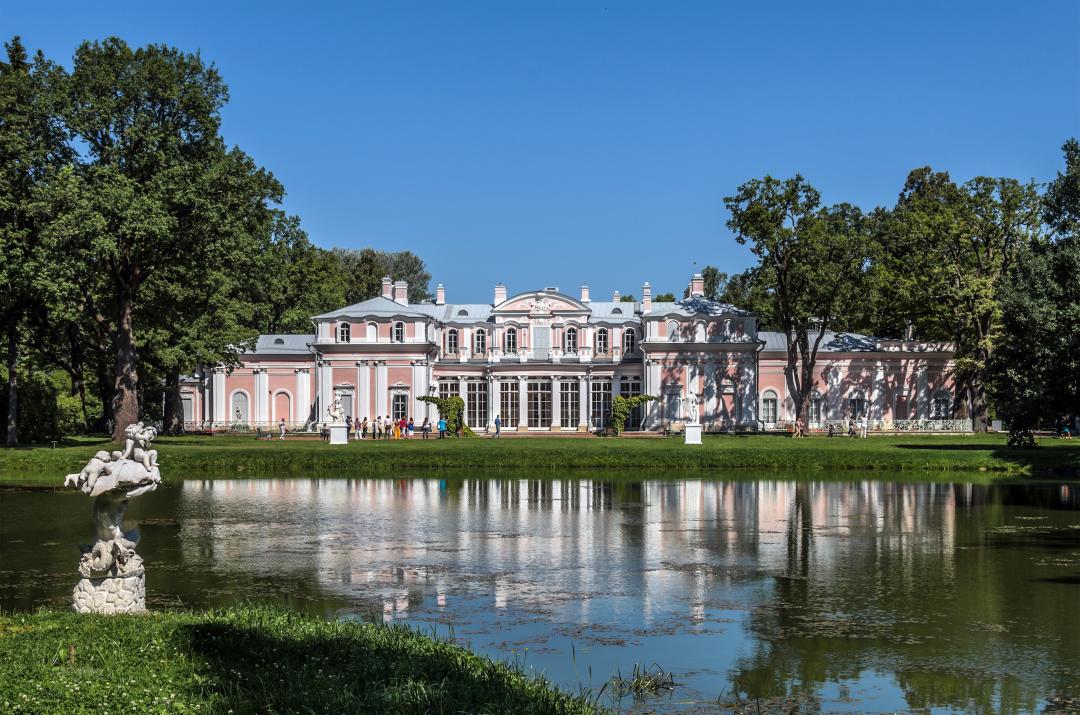
Chinese Palace

Verkhny Park, 7, Saint Petersburg, Russia, 198412

Striving to avoid participating in her husband's rough soldierly games, Catherine, still a Grand Duchess, erected on the opposite bank of Karosta, according to the same Rinaldi's design, a picturesque ensemble of the Private Dacha with the architectural masterpiece of the Chinese Palace at its center. The Chinese Palace became the favorite place of solitary retreat for the future Empress Catherine II during her "straw widowhood," at a time when her husband was throwing noisy orgies among her young and undemanding ladies-in-waiting. Here she tried to overcome the forced boredom in the narrow circle of faithful and devoted friends. Perhaps that is why there was a legend in St. Petersburg that Catherine embroidered the panels for the Beaded Cabinet of the Chinese Palace with her own hands during the long hours of enforced solitude. It is said that the shadow of the Empress still occasionally visits the Chinese Palace and wanders through its enfilades.
Striving not to participate in her husband's rough soldierly games, Catherine, still a grand duchess, erected on the opposite bank of Karosta, according to the same Rinaldi’s design, a picturesque ensemble of the Private Dacha with the architectural masterpiece of the Chinese Palace at its center. Built between 1762 and 1768 based on Antonio Rinaldi’s project, the originally one-story palace was only given a second floor in the mid-19th century for the daughter of Grand Duke Mikhail Pavlovich, Catherine Mikhailovna. A glazed gallery appeared, and small rooms were added to the eastern and western ends of the building. The Chinese Palace became the favorite place of solitary retreat for the future Empress Catherine II during her "straw widowhood," at a time when her husband was hosting noisy orgies among her young and undemanding ladies-in-waiting. Here she tried to overcome forced boredom in the close circle of faithful and devoted friends. Perhaps that is why a legend lived in St. Petersburg that Catherine herself embroidered the panels for the Glass Bead Cabinet of the Chinese Palace during long hours of enforced solitude. It is said that the empress’s shadow still occasionally visits the Chinese Palace and wanders through its enfilades.
The name "Chinese Palace" first appeared in 1774 in the chamber-porter’s journal. Before that, the palace was called the "Dutch house" (just like the Monplaisir Palace in Peterhof), the "house in the Upper Garden," or simply the "small house." The name "Chinese" arose because, in accordance with mid-18th-century taste for "chinoiserie," several interiors of the palace (the Large and Small Chinese Cabinets, the Chinese Bedroom) were decorated in the spirit of Chinese art or with the use of authentic works of art from China and Japan.
The center of the palace’s layout composition is the Large Hall, decorated with paintings, gilded stucco, mosaics, and artificial marble. On the walls are two medallions with marble bas-reliefs depicting Peter I and Elizabeth Petrovna. From the Large Hall, along the main axis in both directions, extend the ceremonial rooms, ending with the Hall of the Muses to the east and the Large Chinese Cabinet to the west. In the "Anteroom" of the Chinese Palace, Serafino Barozzi painted the ceiling "Apollo and the Arts" and created ornamental frescoes. For the Large Chinese Cabinet, brothers Serafino and Gioacchino Barozzi created the ceiling "Union of Europe and Asia." According to J. A. Kuchariants, Serafino Barozzi "plays a leading role in the decorative design of the interiors of both the Chinese Palace and the Pavilion of the Sliding Hill."
The most famous room of the Chinese Palace is the Glass Bead Cabinet, which has preserved its original decoration from the 1760s. The walls of the room are decorated with glass bead panels. These are canvases embroidered with glass beads. The glass beads were produced at the mosaic factory founded near Oranienbaum (in Ust-Ruditsa) by the Russian scientist M. V. Lomonosov. Against the background of the glass beads, complex compositions are embroidered with chenille (velvety silk) depicting fantastic birds among an equally fantastic landscape. For a long time, it was believed that the panels were made in France; however, it is now established that they were embroidered by nine Russian gold embroiderers under the guidance of Maria de Shel. The panels are framed with gilded carvings imitating tree trunks entwined with leaves, flowers, and grape clusters.
Originally, the floor in the Glass Bead Cabinet was made of multicolored smalts, also produced at the Ust-Ruditsa factory, but by the mid-19th century, it had deteriorated and the smalts were replaced with parquet flooring preserving the original pattern.
The Chinese Palace is unique in Russia as a monument of the Rococo style. Most of the palace interiors have preserved their original mid-18th-century decoration. It is also especially valuable for its unique items of decorative and applied art from China and Japan from the late 17th to mid-18th centuries, as well as the surviving parquet floors from the second third of the 18th century (made according to Antonio Rinaldi’s sketches).
During the war years, the Chinese Palace was conserved, and the museum valuables were evacuated. In 1946, the palace was reopened as a museum. Striving to oppose her hateful husband’s rough soldierly games with refined sophistication and carefree leisure in a close circle of chosen ones amid the luxury and splendor of painting, architecture, and sculpture, Catherine, still a grand duchess, erected on the opposite bank of Karosta, according to the same Rinaldi’s design, a picturesque ensemble of the Private Dacha with the architectural masterpiece of the Chinese Palace at its center. Around the palace, Rinaldi laid out a landscape park, including almost the entire Upper Park with the Concert Hall and the colossal toy—the Sliding Hill, more than half of which has been lost to our time.
From the Concert Hall, or as it was called in the 18th century, the Stone Hall, to the Chinese Palace, Rinaldi laid a wide Triple Linden Alley, slightly shifting its axis from the palace’s axis, as required by the canons of landscape park design. Thanks to this impeccable technique, the palace suddenly opens to the traveler’s view, striking with the subtle elegance of a balanced facade that retains in its plasticity the features of the fading Baroque, already classical in its simplicity and clarity. The northern facade is especially attractive. Its central part is marked by three-sided, column-decorated projections topped with a complex sculptural finish. The southern facade, whose fate was affected by the reconstruction undertaken by architects Bonstedt and Stakenschneider in the mid-19th century, is less impressive, although it still looks festive and elegant against the backdrop of tall centuries-old oaks. This festivity is delicately emphasized by a very Rinaldi-style low Baroque fence surrounding the palace on all sides.
Rinaldi paid special attention to the interior decoration of the Chinese Palace, where all types of fine and applied arts merged into one. The most significant are the Small and Large Chinese Cabinets, illustrating the rather vague contemporary ideas of the architect about distant China, and the famous Glass Bead Cabinet. Its walls are completely covered with twelve unique panels depicting exotic birds against fantastic oriental landscapes. All are hand-embroidered with wool on canvas, previously covered with glass beads—tiny milky-colored glass tubes. The panels were made by domestic craftsmen under the guidance of the Frenchwoman de Chen in a St. Petersburg workshop.

Sources:
Naum Sindalovsky: Legends of St. Petersburg Gardens and Parks
https://peterhofmuseum.ru/objects/oranienbaum
https://ru.wikipedia.org/wiki/Oranienbaum_(palace_and_park_ensemble)

Follow us on social media

More stories from Great Architects: Antonio Rinaldi

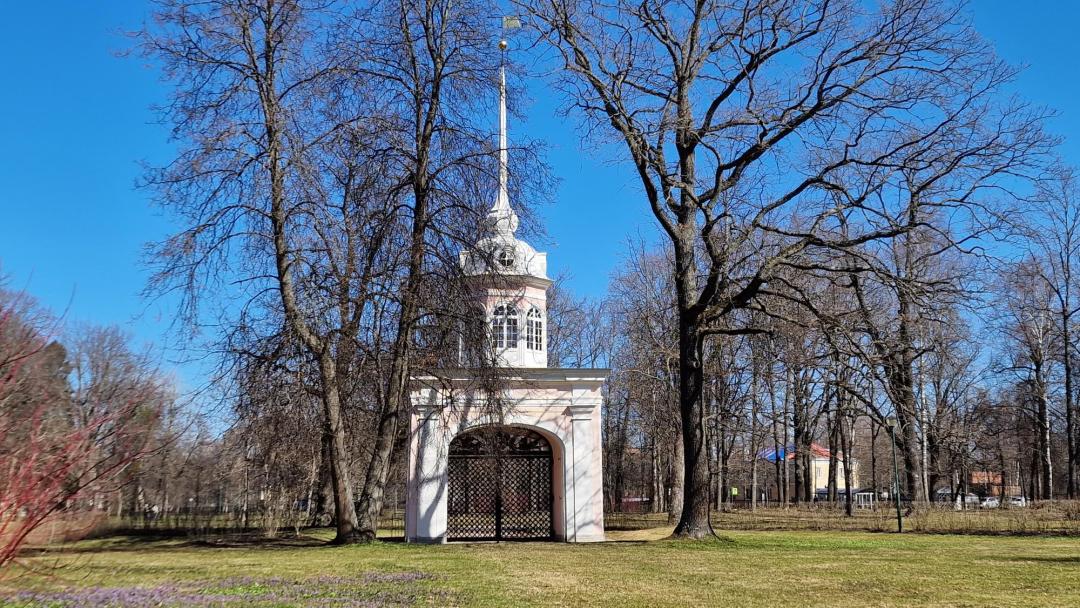
Entrance Honor Gates

Museum-Reserve "Oranienbaum", Saint Petersburg, Russia, 198412

The gates of Peter III's toy fortress on the territory of Oranienbaum are a characteristic example of small-scale architecture. They served as the entrance to a miniature training ground built for the young heir to the throne. Here, the future emperor studied military science in a recreated setting of a fortification. The entire complex occupied an area of 2 hectares.

Cavalry Corps

WP5W+XJ Petrodvortsovy District, Saint Petersburg, Russia

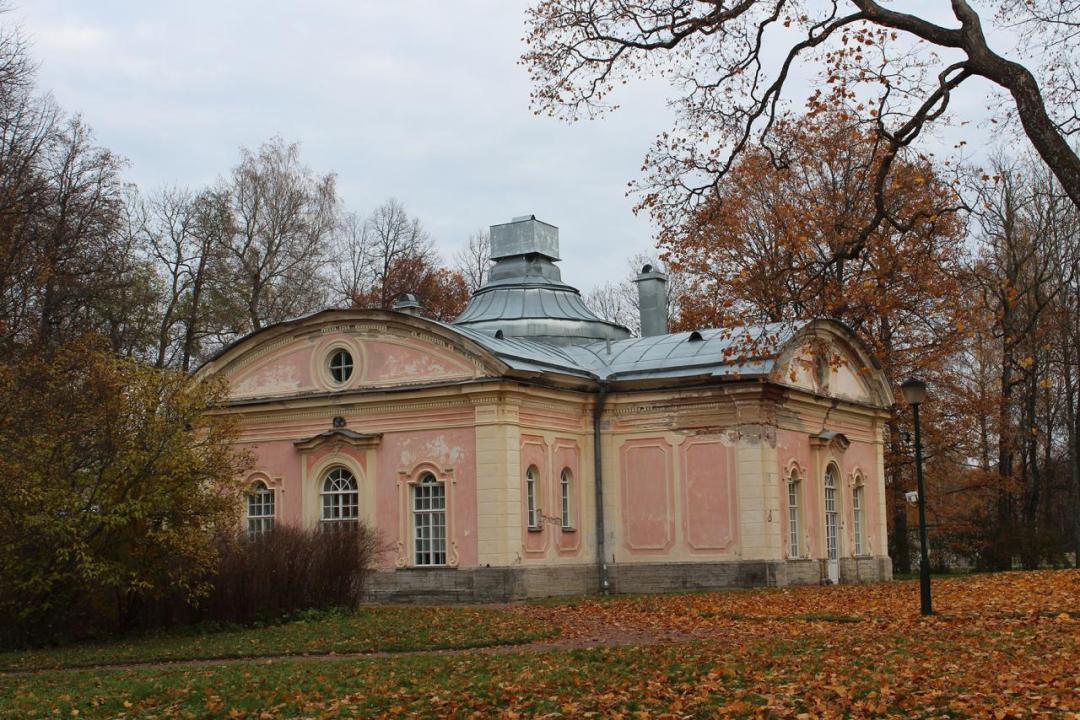
Former kitchen building of the Chinese Palace. In 1808, the central part was reconstructed into a hospital, which existed until 1842. It was named the Courtyard Building, and later the Cavalry Building, as in the second half of the 19th century it housed apartments for palace servants.

Chinese cuisine

WP5V+MR Petrodvortsovy District, Saint Petersburg, Russia

Chinese cuisine – a small one-story, with a mezzanine floor, cruciform pavilion. The pavilion is crowned with a wide, sprawling dome.

Chinese Pond

WP5V+P5 Petrodvortsovy District, Saint Petersburg, Russia

In the southwest of the Oranienbaum museum-reserve, Antonio Rinaldi created a beautiful ensemble, with the central role given to the Chinese Pond. Like the Lower Pond, it is not natural but man-made, created somewhat later than the Lower Pond during the reorganization of the estate by the architect Antonio Rinaldi. The pond's name comes from its location – near the Chinese Palace.

Petersstadt and the Palace of Peter III

Ilikovsky Ave., 18A, Saint Petersburg, Russia, 198412

The Petersstadt fortress ensemble was created between 1758 and 1762. On the right bank of the Karasta River was a mock fortress for Grand Duke Peter Fedorovich, the future Emperor Peter III.

So are the slides Russian or American after all? Pavilion "Sliding Hill"

Krasnoflotskoye Highway, 6, Saint Petersburg, Russia, 198412

One of the most popular attractions in amusement parks is known worldwide by different names. In Russia, it is called "американские горки" (American mountains), in France — *les montagnes russes* ("Russian mountains"), and in the USA — roller coaster or Russian mountains. The confusion with the names is clarified by the history of the attraction: the "горки" (slides) appeared in Russia as a folk pastime, gained mass popularity in Europe, and the attraction with turns resembling the infinity symbol was patented in America.

Grand Gatchina Palace

Krasnoarmeysky Ave., 1, Gatchina, Leningrad Region, Russia, 188307

The Great Gatchina Palace was built between 1766 and 1781 in Gatchina according to the design of the Italian architect Antonio Rinaldi in the neoclassical style for Catherine II’s favorite, Count Grigory Grigoryevich Orlov. Situated on a hill above Silver Lake, the palace combines themes of a medieval castle and a country residence. The palace interiors are an example of Russian neoclassicism at the turn of the 18th and 19th centuries. The palace was one of the favorite retreats of the royal family.

Grotto "Echo"

Dvortsovaya Sq., 1, Gatchina, Leningrad Region, Russia, 188307

The "Echo" Grotto with an underground passage is a complex of structures located within the territory of the Gatchina Museum-Reserve. It consists of a grotto on the shore of Silver Lake in the Palace Park and an underground passage that connects the grotto with the cellars of the Grand Gatchina Palace. The underground gallery is the only such object among all palace and park ensembles in the suburbs of Saint Petersburg. The entire complex was created in the 1770s by architect Rinaldi simultaneously with the construction of the palace for the then owner of Gatchina, Prince Orlov.

Eagle Column

Palace Park, Leningrad Region, Gatchina, Leningrad Region, Russia, 188307

The Eagle Column is an architectural structure in the Palace Park of Gatchina. One of the earliest objects in the park, it was erected according to a design, presumably by the Italian architect Rinaldi, in the early 1770s, during the period when Gatchina belonged to Count (later Serene Prince) Grigory Orlov. It is a marble column on a high quadrangular pedestal, decorated in accordance with the canons of classicism. Its top is crowned with a sculpture of an eagle. The column forms a unified ensemble with the Eagle Pavilion, built in the years when Gatchina was owned by the heir to the throne, Grand Duke Pavel Petrovich. The monument has been restored multiple times. Various explanations are proposed for the eagle symbolism of this structure.

Moreyskaya Column

Devil's Bridge, Catherine Park, Saint Petersburg, Russia, 196609

The Morea Column is a monument in the Catherine Park of Tsarskoye Selo, erected in honor of the victories of Russian troops on the Morea Peninsula (Peloponnese) in 1770 during the First Archipelago Expedition of the Russian fleet in the course of the Russo-Turkish War of 1768–1774. The monument is designed in the neoclassical style and represents a rostral column made of marble. It was constructed according to the project of the Italian architect Antonio Rinaldi in 1771.

Kagul (Rumyantsev) Obelisk

Catherine Park / Ekaterininsky Park, Saint Petersburg, Russia, 196601

Intoxicated with memory, With reverence and longing I embrace your formidable marble, The proud monument of Kagul. Pushkin, 1819

Monument to Alexander Dmitrievich Lanskoy or Marble Pedestal in Honor of Virtue and Merits

Catherine Park / Ekaterininsky Park, Saint Petersburg, Russia, 196603

Monument to Alexander Dmitrievich Lansky ("Marble Pedestal in Honor of Virtue and Merit") — a monument in the Catherine Park of Tsarskoye Selo, dedicated to the memory of Catherine II's favorite, A. D. Lansky. It was presumably constructed according to a design by the Italian architect A. Rinaldi in 1773 as an abstract architectural allegory of "virtues and merits," not associated with any specific person or event. It became a monument to Lansky after his death in 1784.

Crimean (Siberian) Column

Parkovaya St., 64, Saint Petersburg, Russia, 196603

Monument in the city of Pushkin (Saint Petersburg). It was erected according to a design, presumably by Rinaldi, as part of the complex of buildings of the Reserve Yard and guardhouses, constructed in the 1770s beyond the Catherine Park, on territory later incorporated into the Babolovsky Park. The column was erected after the Treaty of Küçük Kaynarca, likely in memory of the conquest of Crimea during the Russo-Turkish War of 1768–1774. After the annexation of Crimea to the Russian Empire in 1783, the monument was complemented by a sculptural composition of bronze trophies designed by G. I. Kozlov, installed at the top of the column. The monument, standing on a granite base, was made from a single monolith of "Siberian" marble, quarried in the Urals near Yekaterinburg. The Crimean Column became one of a series of military memorials that appeared in Tsarskoye Selo in the 1770s, associated with the Russo-Turkish War of 1768–1774.

Orlovskie (Gatchina) Gates

Orlovskie Gates, Saint Petersburg, Russia, 196603

The Orlov (Gatchina) Gates were erected between 1777 and 1782 on the border of Catherine Park, at the exit to the road leading to Gatchina, the former estate of General Feldzeugmeister Orlov. Empress Catherine II honored one of her favorites with this lifetime monument to commemorate the success of the campaign he led against the plague epidemic that swept through Moscow in 1771. On the facade of the gates facing Gatchina, a frieze bears an inscription taken from a poetic epistle to the general by the poet Maikov: “Moscow was saved from disaster by the Orlovs.” Another inscription, on the side facing Catherine Park, provides a more detailed account of this event.

Chinese Theater or Stone Opera

P99P+4G Pushkinsky District, Saint Petersburg, Russia

To the left of the entrance to Alexandrovsky Park, in the center of one of the squares, is the Chinese Theater, or the Stone Opera, as it was called during the time of Empress Catherine II. Originally, it was planned to create an "open-air theater" in its place—that is, a theater under the sky with turf benches. The theater project was developed by the architect Rinaldi, and its construction in 1778-1779 was carried out under the supervision of Neelov, who made significant changes to the original design.

Japanese (Eastern) Pavilion or Porcelain Tower

WQ74+W8 Petrodvortsovy District, Saint Petersburg, Russia

The Japanese Pavilion of the Grand Menshikov Palace was originally called the "Eastern" pavilion. Its interior rooms were richly decorated with porcelain—predominantly Japanese. Porcelain decorative items, placed on special shelves, filled almost the entire wall space. Hence the second name—the Porcelain Tower. It was here that Emperor Peter III signed his abdication: on June 29, 1762, the emperor, who had reigned for only 186 days, signed his abdication in favor of his wife, who became Empress Catherine II.

Marble Palace - Konstantinovsky Palace

Millionnaya St., 5/1, Saint Petersburg, Russia, 191186

It is called the Marble Palace because its decor features thirty-two types of marble from quarries in Karelia, Italy, the Urals, and Altai. The palace was a gift from Catherine II to her favorite, Grigory Orlov. He did not remain in debt and gave her a Persian diamond, the value of which was equal to that of the gifted palace. The diamond was named "Orlov" and was set into the imperial scepter. Since the late 20th century, the palace has housed the Russian Museum.

The Third St. Isaac's Cathedral - Renaldi

Isaakievskaya Square, 4, Saint Petersburg, Russia, 190000

The second St. Isaac's Cathedral stood on an unfortified riverbank, approximately where the monument to Peter I (the Bronze Horseman) is now located. Due to soil subsidence, cracks appeared in its walls and vaults, and in 1763 the building was dismantled. Catherine II revered the memory of Emperor Peter I and considered it her duty to rebuild St. Isaac's Cathedral. Work began in 1768 based on a design by Rinaldi. The church was conceived as an elegant Baroque structure with five domes and a three-tiered bell tower. Construction lasted 34 years. The temple was completed during the reign of Paul I by architect Brenna, who was forced by imperial order to simplify and distort Rinaldi's original design. The disproportionate and squat building did not correspond to the grand appearance of the city center. In 1809 and 1813, competitions were announced for the reconstruction projects of the third St. Isaac's Church, with the essential condition being Alexander I's desire to preserve most of Rinaldi's church. Renowned architects Quarenghi, Voronikhin, Cameron, and many others participated in the competitions, but the highest approval was given to the project of the young French architect O. Montferrand (the fourth St. Isaac's Cathedral).

Prince Vladimir Cathedral

26 Blokhina St., Saint Petersburg, Russia, 197198

The Cathedral in the name of Saint Equal-to-the-Apostles Prince Vladimir in Saint Petersburg is a unique work of religious architecture, consistently combining features of three styles. The Prince Vladimir Cathedral is one of the most revered churches in the city on the Neva.

Church of Saint Catherine of Alexandria

Nevsky Ave., 32-34, Saint Petersburg, Russia, 191186

A detective story unfolded around the burial in the church of the last Polish king, Stanisław August Poniatowski, who abdicated the throne after the third partition of Poland in 1795 and spent his final years in Russia.

The Bolshoi Theatre (Stone Theatre) of Saint Petersburg, which cost the lives and health of two great architects

Teatralnaya Square, 3, Saint Petersburg, Russia, 190000

The Bolshoi Theatre (Stone Theatre) was a St. Petersburg theatre that existed from 1784 to 1886; since 1886, it has been the St. Petersburg Conservatory. It was the first permanent theatre in Saint Petersburg, the largest in Russia, and one of the largest theatrical buildings in Europe from the 18th to the first half of the 19th century. It was located on Theatre Square in Saint Petersburg. In 1886, the Stone Theatre building was partially dismantled and rebuilt into the modern building of the St. Petersburg Conservatory.

Tuchkov Buyan - the legendary Biron’s palace or hemp warehouses?

Bolshoy Prospekt P.S., 1A, Saint Petersburg, Russia, 197198

Tuchkov Buyan (from the archaic *buyan* — a river pier; a place for unloading goods from ships), was mistakenly called the "Biron Palace" in the 19th century — a former building of hemp warehouses, constructed between 1763 and 1772 on the eponymous islet in the channel of the Malaya Neva, a monument of early classical St. Petersburg architecture. At the beginning of the 20th century, the channels between Buyan, neighboring unnamed islets, and Petrogradsky Island were filled in, and the name "Tuchkov Buyan" was transferred to a new urban area bounded by the modern Dobrolyubov Avenue to the north, Tuchkova Dam Street and Tuchkov Bridge to the west, Academician Likhachyov Square and Birzhevoy Bridge to the east, and the Malaya Neva to the south. The extensive block, which was planned to include Vatny Island as well, was intended to become a museum and exhibition complex; this project did not materialize due to the outbreak of World War I. In the 21st century, in the western part of Tuchkov Buyan, near the historic hemp warehouses, are located the Yubileyny sports complex and the Sportivnaya metro station.

Cathedral of Saint Great Martyr Catherine in Kingisepp (Yamburg)

6 Nikolaeva St., Kingisepp, Leningrad Region, Russia, 188485

The Cathedral named after the Holy Great Martyr Catherine in Kingisepp (Yamburg), towering on the bank of the Luga River, is one of the few dated monuments of Russian Baroque preserved in the territory of the Leningrad Region. This masterpiece of architecture attracts attention not only with its proportions and nobility of forms but also with the beauty of its facings.

Church in honor of the Resurrection of Christ (Pochep city)

Oktyabrskaya Sq., 1, Pochep, Bryansk Oblast, Russia, 243400

Consecrated in 1765, the Resurrection Cathedral is connected to the ancient history of the city, if not by its appearance, then by its material — it was built from the bricks of the dismantled Menshikov Palace. The cathedral was constructed by Kirill Grigorievich Razumovsky, the last Hetman of Ukraine. Catherine II abolished the hetman title along with Ukraine’s autonomy but granted, as compensation, extensive lands in perpetual ownership, including Pochep and its surroundings. The Resurrection Cathedral was built in memory of these events. According to one legend, the iconostasis of the Pochep cathedral was transferred from the church in the village of Perovo near Moscow, where Princess Elizabeth supposedly secretly married Alexei Razumovsky. As for its appearance, the city can be proud: the cathedral’s design captures two eras of domestic architecture — Russian Baroque and Classicism. The cathedral’s architecture is a farewell song to Baroque and simultaneously a welcoming hymn to the emerging Classicism. It is gratifying to realize that one of the earliest examples of early Russian Classicism is located in Pochep.

Obelisk in Ust-Izhora

Shlisselburgskoye Highway, 52, Saint Petersburg, Russia, 196645

During the Russo-Swedish War of 1788–1790, 25 residents of Ust-Izhora (the Palace estate) volunteered, in memory of which, at the request of Empress Catherine II herself, a granite obelisk was erected in 1791.

Obelisk in Rybatskoye

Rybatsky Ave., 10, Saint Petersburg, Russia, 192012

The village of Rybatskoye, located on the left bank of the Neva River near the mouth of the Slavyanka River, was settled during the reign of Peter I by residents of Moscow region villages, mostly fishermen from the Oka River. During the Russo-Swedish War of 1788–1790, many villagers voluntarily joined the rowing flotilla that fought against the Swedes. In memory of this, a granite obelisk was erected in the village in 1791, which has been preserved to this day. Monumental in form and concise in composition, the monument is installed on a high quadrangular pedestal with a stepped base.

Basilica di Sant'Agostino in Campo Marzio - Basilica of Sant'Agostino - in Campo Marzio, Rome

Piazza di Sant'Agostino, 00186 Rome RM, Italy

The Basilica of Saint Augustine, located on the square of the same name, was one of the first Roman churches of the Renaissance era, and its origins date back to the 14th century, when the Augustinians decided to build a new basilica for their monastery and dedicate it to the patron saint of their order. Built near Via della Scrofa, this building was demolished in 1746 when Luigi Vanvitelli and Antonio Rinaldi expanded the Sant'Agostino monastery. In 1756, the architects also radically altered the church's interior and, by adding a hemispherical dome on a cylindrical drum—the first Renaissance dome in Rome—added side scrolls to the façade and changed the 15th-century bell tower to a square tower. The façade is clad with travertine blocks, taken, according to the tradition of that time, from the Colosseum. The interior, in the shape of a Latin cross, is divided into three naves with five chapels on each of the side naves, a transept, and an apse surrounded by other chapels.

Italian Architects in Saint Petersburg - Busts of Four Italian Architects

Manezhnaya Square, 4, Saint Petersburg, Russia, 191023

The busts of four Italian architects—Antonio Rinaldi, Carlo Rossi, Giacomo Quarenghi, and Bartolomeo Rastrelli—appeared on Manezhnaya Square in Saint Petersburg in 2003 thanks to sculptors V.E. Gorevoy and architect V.V. Popov. This was a gift from the government of the Italian Republic and the municipality of the city of Milan for the 300th anniversary of Saint Petersburg.

Stroganov Dacha (Stroganov's Dacha, Stroganov Garden, Stroganov Park)

Stroganovsky Park, Ushakovskaya Embankment, 15 building 2, Saint Petersburg, Russia, 197342

The area on the Vyborg side of Saint Petersburg, near the place where the Chyornaya River flows into the Bolshaya Nevka, belonged to the baron-counts Stroganov from the mid-18th century to the early 20th century. It is bordered to the south by the Bolshaya Nevka, to the east and north by the Chyornaya River, and to the west by the park of the Saltykova dacha. The owners themselves called this area the "Mandurova estate." In a narrower sense, the Stroganov dacha also referred to the main building of this estate.