Imperial Parks: Gatchina

For Browsing

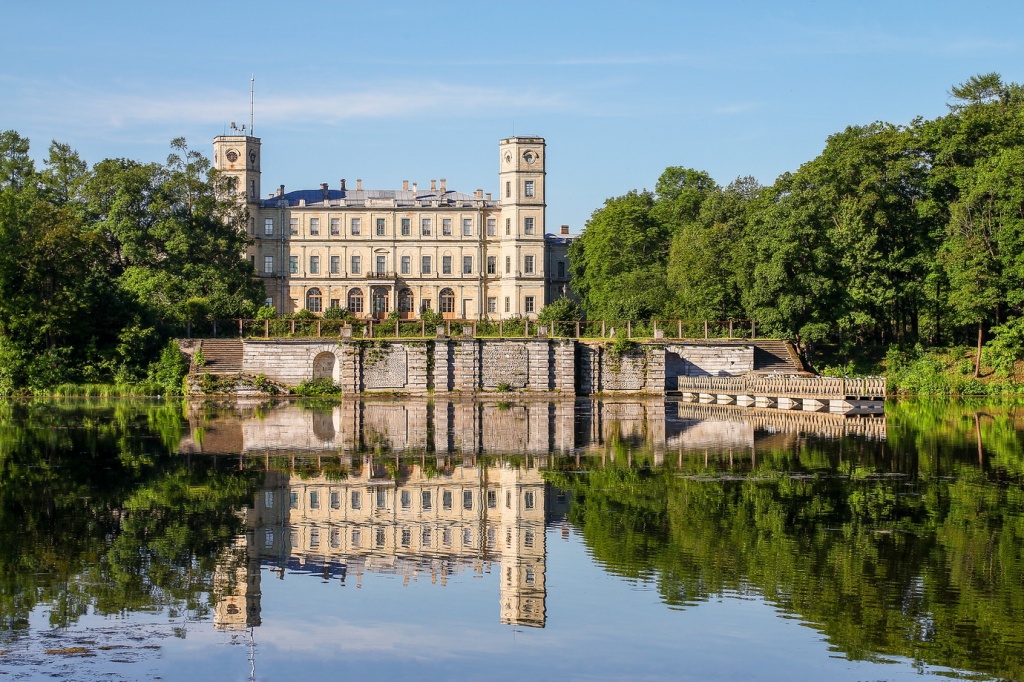
One of the main attractions of the city of Gatchina is the landscape park ensemble, the Palace Park, created at the end of the 18th century. It is the oldest of the Gatchina park complex, covering an area of 143 hectares. It is located in the central part of the city. It borders closely on urban developments to the west and east. To the south, the boundary separates the Palace Park from the Priory Park; to the north, it borders the Menagerie; to the northwest lies the regular Sylvia Park, whose territory used to be part of the Palace Park. The main structure of the park ensemble is the Grand Gatchina Palace, located in its southwestern part.

Admiralty or "Holland"

Beloe Lake, Gatchina, Leningrad Region, Russia, 188304

The Admiralty (or "Holland") is a park structure in the Palace Park of the city of Gatchina. The exact date of the Admiralty's construction is unknown; most likely, it was built in the early 1790s. The building harmoniously blended into the park landscape while simultaneously serving practical functions.

Admiralty Gate

25th October Ave., 1, Gatchina, Leningrad Region, Russia, 188304

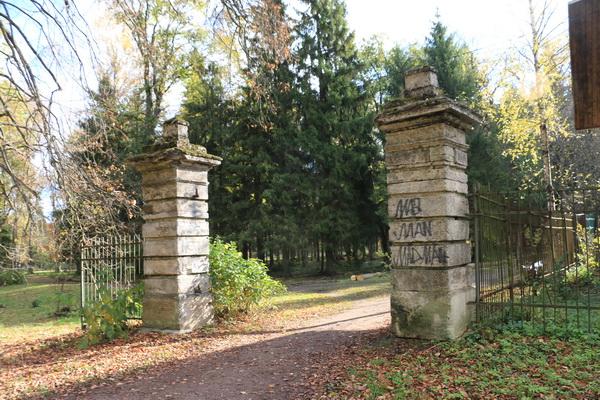
The Admiralty Gate is a gate located at the border of the Gatchina Palace Park, facing 25 October Avenue. In the 18th century, it had a different name — the Gate made of Pudost stone near the harbor. The gate was built between 1794 and 1796, and the architect of the project is believed to be Vincenzo Brenna. The name comes from the nearby Admiralty building. During the war, the gate suffered minor damage, and in 1970 it underwent restoration.

Amphitheater or Cockfighting

Nesterova St., 10, Gatchina, Leningrad Region, Russia, 188307

One of the most interesting park structures is the Amphitheater. Circular in plan, it reaches sixty-five meters in diameter, and the height of the earthen embankment is more than three and a half meters.

Large greenhouse

Krasnoarmeyskiy Ave, 9, Gatchina, Leningrad Region, Russia, 188307

Fresh vegetables, fruits, and greens were supposed to be on the royal table at any time of the year, and the apartments of the empress and her daughters were to be decorated with bouquets of flowers. The greenhouses appeared in Gatchina in the mid-18th century under the first owner of the estate – Count Grigory Orlov. They were built on the territory of the Palace Park, behind the Kitchen Quarter. By the end of the 19th century, the Palace Greenhouse complex consisted of 10 buildings spread over nearly 10 hectares, where flowers were grown to decorate the living rooms of the Gatchina Palace, ornamental plants for the design of park flower beds, tree seedlings, vegetables, and fruits.

Large terrace - pier

Gatchina Palace Park, Krasnoarmeyskiy Ave., 1, Gatchina, Leningrad Region, Russia, 188307

The large terrace on Long Island in the 18th-19th centuries served as a pier where the ships of the "Gatchina flotilla" docked. It was adorned with marble sculptures of the muses and stone vases. To this day, two lion statues carved from local limestone have been preserved at the historic site. The solemn stone pier on the White Lake, one of the largest structures in the Palace Park, was built from 1792 to 1795.

Large stone bridge

H4C3+RC Gatchina, Leningrad Oblast, Russia

The large stone bridge with three arched spans was built in the 1790s. The architect is presumably Brenna. The attribution to him was indicated by characteristic decorative details used by the architect in his other constructions. The three-span bridge was adorned with a balustrade. From here, there was a beautiful view of the White Lake and the park.

Birch House and the "Mask" Portal

2 K. Podryadchikova St., Gatchina, Leningrad Region, Russia, 188308

The birch house, built according to the project of the Swiss artist and architect of the small court François Viollier, appeared in the mid-1780s and externally resembled a modest stack of birch firewood prepared for a long winter. It was a kind of joke, a pastoral whim of the 18th century, behind whose simple facades luxury and splendor were hidden.

Birch Gates

2 K. Podryadchikova St., Gatchina, Leningrad Region, Russia, 188308

The Birch Gates were built between 1795 and 1798 according to a design by architect Vincenzo Brenna. The construction of the gates was carried out by master stonemason Giovanni Visconti. The contract for the construction of the "gates made of Pud stone in the English garden near the Birch House" was signed on January 24, 1795, with local merchant Martyan Vorobyov (according to other sources — Mokey Fyodorovich Vorobyov).

Botanical Garden

pr. 25 Oktyabrya, 3, Gatchina, Leningrad Region, Russia, 188304

Along the park alleys are elms, yews, beech trees, and exotic plants. Medicinal herbs and spices grow in the garden beds, and rare fish splash in the ponds. On a sunny clearing, amazing flowers grow in pots. Visitors who find themselves in this part of the park feel as if they are in the hot south, not in gloomy and overcast Petersburg. In 1792-1793, on the site of the old manor of the first owners of Gatchina, grand construction begins. Friedrich Helmholtz plans to create Botanical Gardens here with numerous paths, exotic plants, ponds, a greenhouse, and a three-tiered flower hill.

Upper and Lower Dutch Gardens

H476+36 Gatchina, Leningrad Oblast, Russia

The Upper and Lower Dutch Gardens, featuring a regular layout, were created in 1794-1795. They are separated from the Palace Park by the Karpin Pond with a canal. They are called Dutch because flower beds were planted in this part of the park, and Holland was perceived by contemporaries of the 18th century as the trendsetter in the art of flower cultivation.

Octagonal well

Private garden, Krasnoarmeyskiy Ave., 1, Gatchina, Leningrad Region, Russia, 188307

The octagonal well is one of those amazing architectural works that, despite its relatively small size (about seven meters in diameter and more than two meters deep), impresses and remains memorable for its simplicity, elegance, and perfection.

Deaf gates

H3CW+RQ Gatchina, Leningrad Oblast, Russia

"The Deaf Gate" — a gate between the Zverinets and Palace parks in the city of Gatchina, Leningrad Oblast. It is located near the Cold Bath. The structure was built at the end of the 18th century.

Grotto "Echo"

Dvortsovaya Sq., 1, Gatchina, Leningrad Region, Russia, 188307

The "Echo" Grotto with an underground passage is a complex of structures located within the territory of the Gatchina Museum-Reserve. It consists of a grotto on the shore of Silver Lake in the Palace Park and an underground passage that connects the grotto with the cellars of the Grand Gatchina Palace. The underground gallery is the only such object among all palace and park ensembles in the suburbs of Saint Petersburg. The entire complex was created in the 1770s by architect Rinaldi simultaneously with the construction of the palace for the then owner of Gatchina, Prince Orlov.

Beast Gate

H4F3+3V Gatchina, Leningrad Oblast, Russia

The Zverinsky Gates, also known by several other names (the Great Iron Gates, or the First Gates, stone gates to the Orlova Grove), built near the Great Stone Bridge, connect the Palace Park with the Zverinets Park. They are constructed as two stone pillars made of Pudozh stone, topped with stone spheres.

Jordanian Well

Plotinka, Dvortsovaya Square, 1, Gatchina, Leningrad Region, Russia, 188307

A large number of the purest springs, rivers, and lakes give the territory of Gatchina Park a unique charm. The piers, bridges, and pavilions located on the shores and numerous islands blend perfectly into the landscape, complementing and enriching it. But one architectural structure stands somewhat apart here. On the shore of the White Lake, a pure spring still gushes from the ground. The water in this spring has never dried up during the hottest time of the year nor frozen during the harshest Epiphany frosts. The spring was perfectly suited for the symbolic washing of the imperial family on the holy feast of the Baptism of the Lord.

Cascadian Gates

Palace Park, Leningrad Region, Gatchina, Leningrad Region, Russia, 188307

At the border of the English Garden and Sylvia, southeast of the now non-existent Cascade with a lock, which was located on the Kolpanka River near the Aviary, the Cascade Gates were built.

Admiralty Bridge or Bridge with Guardhouses

Admiralty Bridge (Bridge with Guardhouses), 25 Oktyabrya Ave, 1, Gatchina, Leningrad Region, Russia, 188304

The Admiralty Bridge in Gatchina, also known as the Bridge with the Guardhouses, is a beautiful example of architecture that adorns Gatchina. From the bridge, there are stunning picturesque views of the White Lake in the Palace Park and the magnificent palace in the Priory Park.

Water Maze

H487+GG Gatchina, Leningrad Oblast, Russia

On the eastern shore of the White Lake, north of the Admiralty, there is a unique section of the Palace Park. This area, covering more than four hectares, features two landscape labyrinths that are perceived as two parts of a single whole. In the 18th century, it was very fashionable to construct ground labyrinths in parks. Many European landscape gardens could boast such a structure. However, there was no equivalent to the water labyrinth arranged in Gatchina. Created during the reign of Paul I, the relatively small labyrinth consisted of an archipelago of artificially created islets and channels between them near the White Lake. The shores of the labyrinth were reinforced, and wooden bridges were thrown between the islets.

Karpen Bridge

Karpin Bridge, Palace Square, Gatchina, Leningrad Region, Russia, 188307

Karbin Bridge is a pedestrian arched bridge over an artificial cascade between Karbin Pond and White Lake, connecting two parts of Long Island in the Palace Park of the Gatchina Museum-Reserve. The stone arched bridge over the artificial cascade on Karbin Pond at its confluence with White Lake was built in 1792 according to the design of architect Brenna. It got its name from Karbin Pond, where silver carp were bred for the table of Paul I, and later for other royal persons living in the Gatchina Palace and their guests. Previously, the cascade of Karbin Pond at its confluence with White Lake was located under the bridge.

Eagle Column

Palace Park, Leningrad Region, Gatchina, Leningrad Region, Russia, 188307

The Eagle Column is an architectural structure in the Palace Park of Gatchina. One of the earliest objects in the park, it was erected according to a design, presumably by the Italian architect Rinaldi, in the early 1770s, during the period when Gatchina belonged to Count (later Serene Prince) Grigory Orlov. It is a marble column on a high quadrangular pedestal, decorated in accordance with the canons of classicism. Its top is crowned with a sculpture of an eagle. The column forms a unified ensemble with the Eagle Pavilion, built in the years when Gatchina was owned by the heir to the throne, Grand Duke Pavel Petrovich. The monument has been restored multiple times. Various explanations are proposed for the eagle symbolism of this structure.

Pavilion of the Eagle or Temple

H493+PP Gatchina, Leningrad Oblast, Russia

The Eagle Pavilion (or the Temple, from *temple* — temple), also known as the Round Gazebo, but later the commonly used name became the Eagle Pavilion, is considered a kind of sanctuary dedicated to the emperor. It is possible that the interpretation of this structure as a temple was due to the fact that Paul I was the Grand Master of the Maltese Order, or the pavilion was originally conceived as a temple of the arts under the patronage of the emperor, but its decoration was never completed. The author of the pavilion project was presumably Vincenzo Brenna. The date of the pavilion’s construction is unknown; it is first mentioned in 1792 as an already existing structure.

Forest Greenhouse

Krasnoarmeyskiy Ave., 11, Gatchina, Leningrad Region, Russia, 188307

The Forest Orangery is a building in the Palace Park in Gatchina, constructed at the end of the 18th century. Vincenzo Brenna designed the building project for the winter storage of southern plants in wooden tubs, which were displayed during the summer period along the paths. At the beginning of 1794, a contract was signed with the contractor Kiryan Plastinin. The work was carried out under the supervision of the stone master Visconti. It was planned to complete the construction by the end of the same year, but the work was delayed and only finished by the end of 1796.

Linden Garden

Krasnoarmeyskiy Ave, 2, Gatchina, Leningrad Region, Russia, 188307

The Linden Garden is an independent section of the Gatchina Palace Park and is located in its southern part. This small formal garden is masterfully integrated into an unevenly wide, extremely inconvenient peripheral area of the park from the standpoint of regularity. Covering less than one hectare, the garden stretches in a narrow strip along Krasnoarmeysky Avenue from Connetable Square to the Arsenal block of the Gatchina Palace.

Orlovsky Oak

Dvortsovaya Sq., 1, Gatchina, Leningrad Region, Russia, 188307

The solitaire oak was planted in the Silver Meadow during the time of Count Grigory Orlov. Apparently, it was several seedlings grafted into one tree – following the fashion of the 18th century. Therefore, even at a relatively young age, the Orlov oak looked large and mighty.

Pavilion of Venus or Treillage on the Island of Love

H495+9P Gatchina, Leningrad Oblast, Russia

The Pavilion of Venus, or Treillage, is a pavilion in the Palace Park of Gatchina, located at the tip of the Isle of Love, on the shore of the White Lake. The idea to build the pavilion arose in the late 1780s after Pavel Petrovich’s trip abroad. In Chantilly, he saw a pavilion on the Isle of Love, and later its images were used in designing the Gatchina pavilion. The project for the Pavilion of Venus was developed in 1791. The pavilion’s construction dates to 1792–1793. The pavilion consists of two equally sized parts: an elongated rectangular large hall with chamfered corners and a small rectangular antechamber (vestibule) with semicircular niches on the short end walls.

Sylvia Park

Palace Park, Leningrad Region, Gatchina, Leningrad Region, Russia, 188307

The name "Sylvia" originates from the Latin "silvia" — forest, and is also connected to the journey of Grand Duke Pavel Petrovich and his wife abroad, during which they visited the French estate of Chantilly on June 10–12, 1782. At that time, there was already a park named "Sylvie" there (this was the poetic name of Marie-Félix des Ursins, wife of Henry II de Montmorency). Sylvia in Gatchina was created from 1792 to 1800 by architect Brenna and landscape gardener Hekket.

Monument to Paul I

Krasnoarmeyskiy Ave, 1, Gatchina, Leningrad Region, Russia, 188307

The sculpture of Paul I is installed on a four-sided polished shaped pedestal made of Finnish granite. The emperor is depicted in a ceremonial uniform and tricorne hat, leaning on a cane. The emperor’s pose, the tilt of his head, and the expression on his face give the monument an air of dignity and grandeur. In Gatchina, the statue is placed on the parade ground in front of the Grand Gatchina Palace, near the parapet, facing the palace and the parade ground, as if the emperor were reviewing a parade. In Pavlovsk, the statue stands in the center of the Parade Ground in front of the Pavlovsk Palace, with the emperor turned toward the entrance alley, “welcoming guests” to his summer residence.

Pavilion "Birdhouse"

Krasnoarmeyskiy Ave, 21A, Gatchina, Leningrad Region, Russia, 188307

"Ptichnik" is a building on the bank of the Kolpanka River on the southern border of Zverinets Park in the city of Gatchina, Leningrad Region. The structure was built at the end of the 18th century based on a design by A. D. Zakharov.

Silvian Gates

Palace Park, Leningrad Region, Gatchina, Leningrad Region, Russia, 188307

The Silvian Gates are the main entrance to Sylvia Park from the Palace Park side in the city of Gatchina, Leningrad Oblast. The gates were built at the end of the 18th century, and the project was designed by Brenna.

Three-arch Carp (Lion) Bridge

Lion Bridge, 25 October Ave., Gatchina, Leningrad Region, Russia, 188304

To the south of the Balcony Terrace, located in the Palace Park of Gatchina, lies the three-arched Karpichny (Lion) Bridge. The bridge spans an unfinished construction channel that was supposed to connect Karpin Pond with Black Lake.

Palace Farm

Krasnoarmeyskiy Ave., 21A, Gatchina, Leningrad Region, Russia, 188307

On the southern bank of the winding Pilnaya River, during the time of Grigory Orlov, a cattle yard and dairy farm were built. Fresh meat, cream, and cottage cheese were supplied to the master's table. Following the European fashion, which proclaimed life in harmony with nature, Paul I gave the order to rebuild the old building.

Cold bath

H3CX+M9 Gatchina, Leningrad Oblast, Russia

An amazingly interesting structure, whose construction began at the end of the 18th century and was never completed, is still used for its intended purpose: during the hot season, the residents of Gatchina gladly bathe in the stone Cold Bath.

Black Gates

Krasnoarmeyskiy Ave., 25, Gatchina, Leningrad Region, Russia, 188301

"The Black Gates" — gates in the wall of Sylvia Park, built at the end of the 19th century. The exit gates from Sylvia Park towards Yegerskaya Sloboda. The structure was created during the construction of the Sylvia Park wall along Ekaterinverdersky Avenue (today's Krasnoarmeysky Avenue) in the 1880s.

Chesme Obelisk

H483+RW Gatchina, Leningrad Oblast, Russia

The Chesme Obelisk is a monument in the Palace Park of Gatchina, erected in honor of the Russian fleet's victory over the Turkish fleet in the Chesme Battle on June 24–26 (July 5–7), 1770, during the Russo-Turkish War of 1768–1774. It is a simple marble obelisk built on the shore of the White Lake according to the design of the Italian architect Antonio Rinaldi in the 1770s, at a time when Gatchina belonged to Prince Grigory Orlov. It is one of a series of memorials dedicated to the victory in the Chesme Battle, alongside other monuments, buildings, and palace interiors in the suburbs of Saint Petersburg.

Priory Palace or Castle

Krasnoarmeysky Ave., 1, Gatchina, Leningrad Region, Russia, 188304

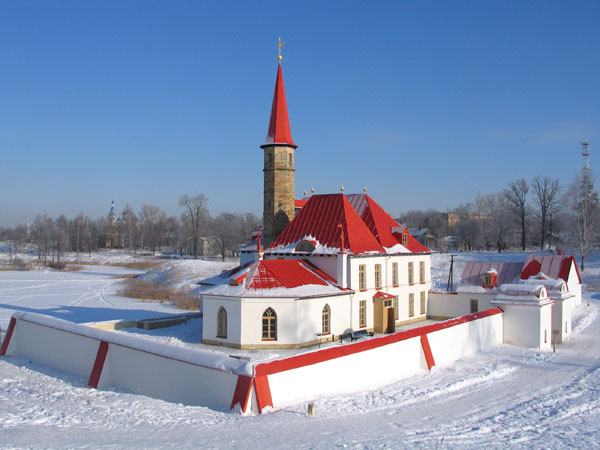
The Priory Palace or Castle is an original palace in Gatchina. It is often called the Priory (from the French *prieuré* — "a small monastery, monastic estate"). It was built in 1799 by the architect Lvov. The name "Priory Palace" became associated with the Priory in the 20th century. The Priory Palace is not as luxurious as other palaces in the suburbs of Saint Petersburg. Its fame is determined by the unusual construction technology, original appearance, and the remarkable combination of the palace and the surrounding landscape.

Priory Park

H43C+F4 Gatchina, Leningrad Oblast, Russia

Priory Park is a landscape park located in the southern part of the city. To the north, it borders the Palace Park; on the eastern and southern sides, the park is bordered by Soytu Street, which runs along the railway tracks. To the southeast, it is bounded by Parkovaya Street, which also runs along the railway line. The eastern boundary of the park is Chkalov Street. The main area of the park is occupied by a forested area. Within its territory, there are three lakes — Black, Pike, and Filkino.

Grand Gatchina Palace

Krasnoarmeysky Ave., 1, Gatchina, Leningrad Region, Russia, 188307

The Great Gatchina Palace was built between 1766 and 1781 in Gatchina according to the design of the Italian architect Antonio Rinaldi in the neoclassical style for Catherine II’s favorite, Count Grigory Grigoryevich Orlov. Situated on a hill above Silver Lake, the palace combines themes of a medieval castle and a country residence. The palace interiors are an example of Russian neoclassicism at the turn of the 18th and 19th centuries. The palace was one of the favorite retreats of the royal family.

Lower Garden

WQ84+93 Petrodvortsovy District, Saint Petersburg, Russia

In front of the northern facade of the Grand Palace stretches the formal Lower Garden. It is located on a slope formed by a high ridge of the coastal part of the Gulf of Finland, occupying an area of 4.8 hectares. This is one of the first formal gardens in Russia, established two years after the construction of the Grand Palace began.