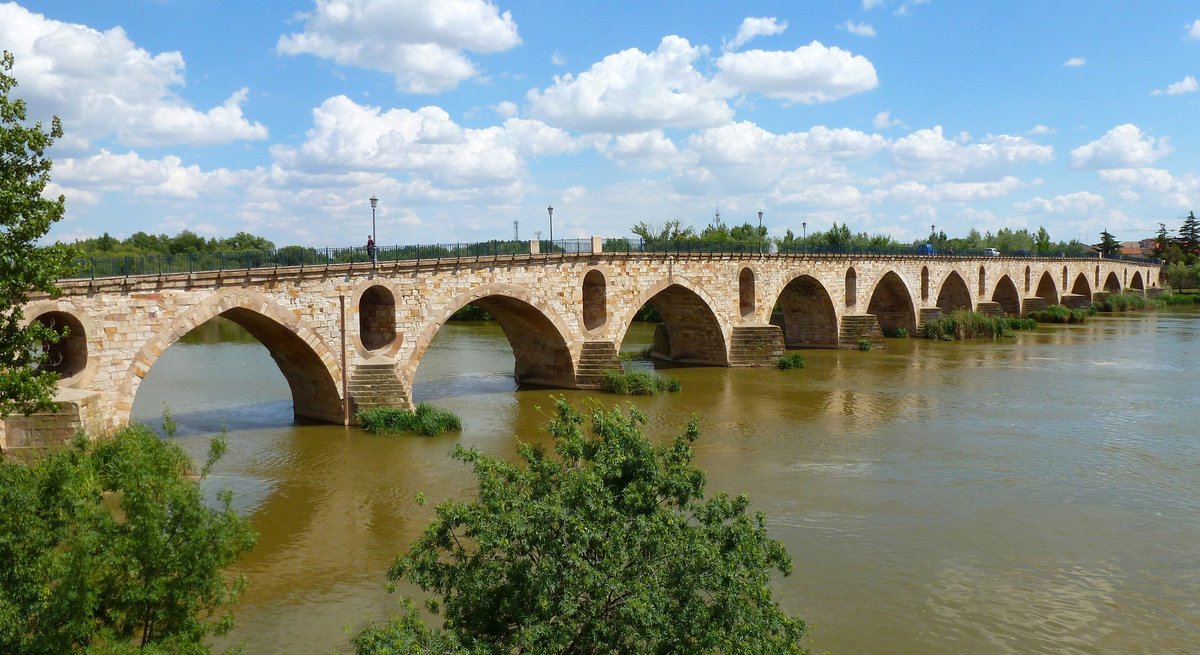

A bridge in Spain, el Puente de Piedra, is among the five bridges crossing the River Duero as it flows through Zamora, the capital of Castilla y León. For centuries, it was the only river crossing in the city, linking the arrabal with the city's historic center. In the present day, it functions as a connection between the Avenida de Vigo (right bank) and the Plaza de Belén (left bank). During the Middle Ages, it was known as Puente Nuevo de Zamora. As a crucial location along the Vía de la Plata, el Puente de Piedra was an essential passage for people, goods, and livestock traversing the River Duero. Constructed in the early 13th century, it has been renovated multiple times and currently stands as one of Zamora's most representative symbols.
For almost a thousand years, el Puente de Piedra has stood as a symbol of Zamora, dividing and connecting the city. It has withstood numerous challenges, from the medieval era to the present day. Its official name, Puente de Piedra, was adopted in 1167, replacing a destroyed Roman bridge. Over the centuries, it has been known by various names, but the original name, 'Puente de Piedra', is now the most commonly used. The source (Wikidata description) only refers to the bridge with this name. In the present day, the bridge serves as a pedestrian bridge.
The bridge showcases exceptional examples of Gothic architecture, characterized by pointed arches and intricate detailing. Two tower-like structures are shown on each side of the bridge in a 16th-century painting by Anton Van den Wyngaerde, but it is unclear if they were designed by Juan Antonio Texada or another architect. These towers served as defensive measures, control of goods, and tax collection. A doorway in the form of an arch, the ‘Puerta de Tajamar’, existed on the bridge. The oblique section of the bridge was designed for defense.
Over the years, the bridge has faced several challenges, including floods that caused damage to some eyes of the bridge. Floods occurred again in 1719, damaging nearby mills of Olivares. Constant remodeling of the bridge became necessary due to heavy traffic, and the bridge was closed to traffic due to its deteriorated state at the end of the 19th century.
Today, el Puente de Piedra stands as a testament to Zamora's history and the city's resilience. Though it has undergone various changes and renovations throughout the centuries, it continues to be one of Zamora's most representative symbols. The bridge is part of the Jacobean Way of the Silver Road and is a key figure in the miracle of San Atilano, the first bishop of the Diocese of Zamora.
Sources: Wikipedia, OpenStreetMap, Wikidata, Wikimedia Commons
Written by Nik Frost
Discuss this with the author and others
No comments yet. Be the first to start the conversation.