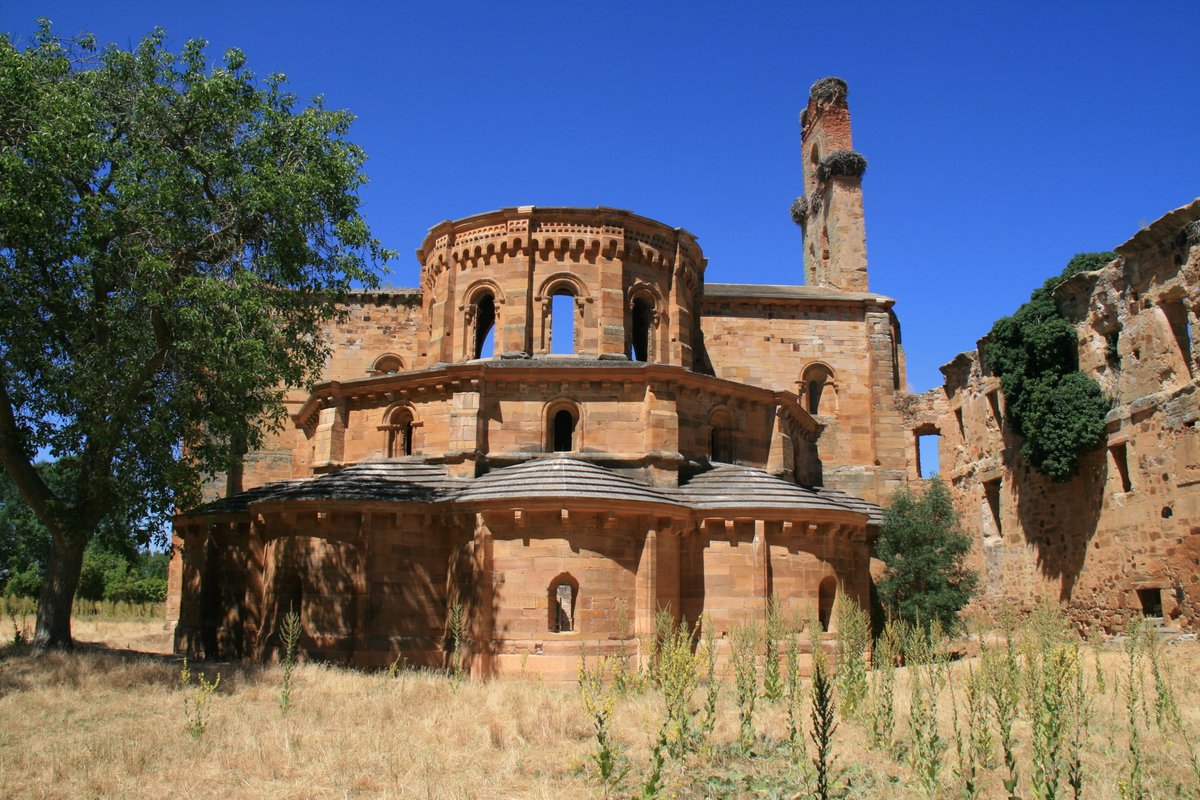

Moreruela Abbey, also known as Monasterio de Santa María de Moreruela, is a former Cistercian monastery in the province of Zamora in Castile and León, Spain. The abbey is situated to the west of Granja de Moreruela, about 35 kilometres north of the town of Zamora close to the left bank of the Esla, a tributary of the Duero. The abbey was declared a national monument in 1931.
Before the Cistercians, a Benedictine monastery stood on the site, founded either by the Asturian King Alfonso III or by Saint Froilan. Under the patronage of Alfonso VII, the Cistercians took over the site, with the takeover often dated to 1131/1133 or 1143. This makes Moreruela the earliest Cistercian foundation in Spain. Moreruela was a daughter house of Clairvaux and served as the mother house of Nogales Abbey in 1164 and Aguiar Abbey in Portugal in 1165.
Many remains of the abbey survive as ruins, particularly the Romanesque abbey church. Constructed in the shape of a Latin cross, building began around 1170 and was finished in the second quarter of the 13th century. The apse at the east end is completely preserved and features a vaulted ambulatory round a rectangular choir with seven chapels, similar to Clairvaux. Also preserved are the walls of the 27-metre wide transept and of the northern aisle, as well as parts of the nave, which once comprised three aisles and nine bays.
To the north of the church, several conventual buildings remain, including the chapter house, which has been partly reconstructed. The site stands as a significant example of Cistercian architecture in Spain.
Sources: Wikipedia, OpenStreetMap, Wikidata, Wikimedia Commons
Written by Nicolo Ciampini
Discuss this with the author and others
No comments yet. Be the first to start the conversation.