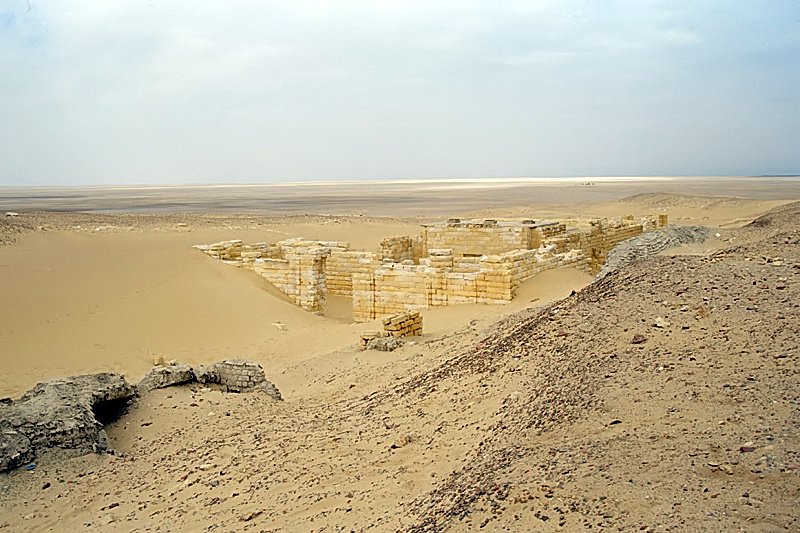

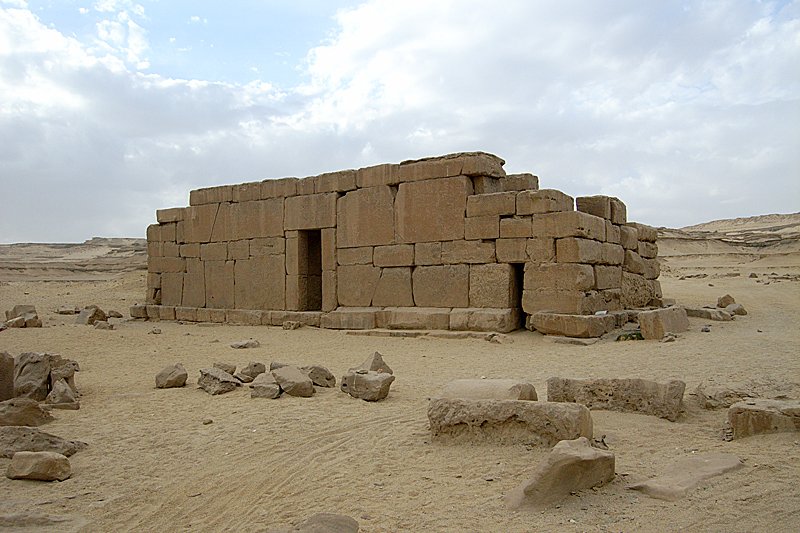
In the southwestern Faiyum region of Egypt lies Medinet Madi, a site containing the remains of a Greco-Roman town. It features a temple founded during the reigns of Amenemhat III and Amenemhat IV (1855–1799 BC) for the cobra-goddess Renenutet, a deity of the harvest. During the Middle Kingdom, the town was known as Dja, and the inscriptions in the temple refer to the goddess as the living Renenutet of Dja.
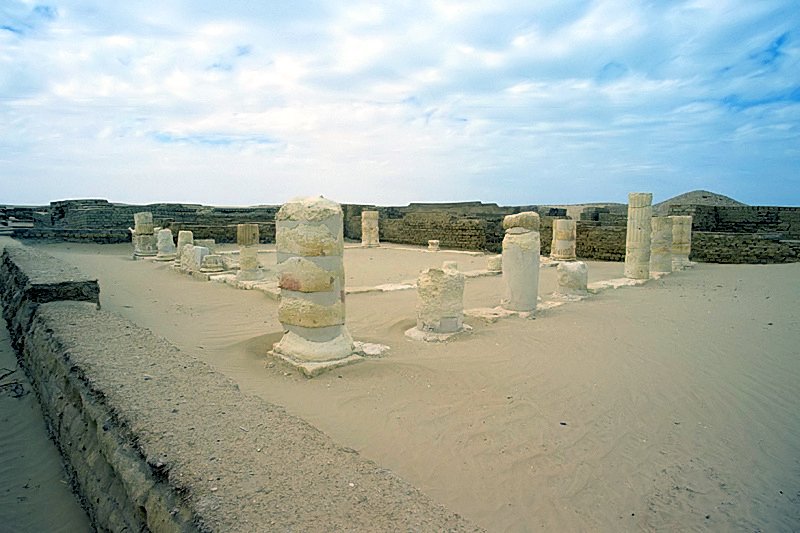
The dark sandstone inner part of the temple consists of a small papyrus-columned hall leading to a sanctuary with three chapels. In the central chapel, a large statue of Renenutet stands between statues of Amenemhat III and Amenemhat IV. The reliefs include scenes showing a king and the goddess Seshat founding the temple, as well as depictions of Renenutet with a snake head. While the town was abandoned after the New Kingdom, people returned in Ptolemaic times, laying out a town of about 1000 by 600 meters on a grid pattern.
Ptolemaic additions include a paved processional way passing through an eight-columned kiosk. Nearby, a Ptolemaic temple dedicated to the cult of two crocodile mummies was also well preserved. In a vaulted chamber north of this temple, archaeologists found a basin containing more than thirty crocodile eggs, suggesting the room may have served as a nursery. The site remained occupied until the ninth century, with a fortress built under Emperor Diocletian to house the Cohors IV Numidarum.
Sources: Wikipedia, OpenStreetMap, Wikidata, Wikimedia Commons
Written by Mutabor
Discuss this with the author and others
No comments yet. Be the first to start the conversation.