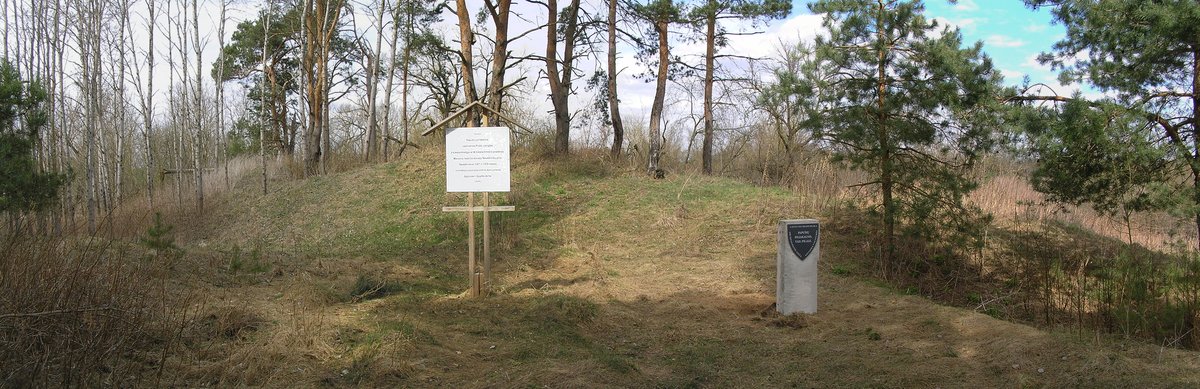
Nestled in the secluded forest of Panevėžys, Lithuania, lies a well-preserved archaeological site named Papušių piliakalnis, or the 'Hill of the Kryptes'. This hillfort, dating back to the Iron Age, presents a unique and intriguing history that captivates those who come upon it. First discovered and studied in the 1930s, the hillfort still remains a mystery for archaeologists. The site, measuring approximately 36.5m long and 45m wide, follows a rectangular shape, oriented towards the north-west and south-east.
The fortification walls were estimated to have been 48m long, with the northern and southern walls reinforced by the branches of the nearby Nociagalos river. The eastern and western walls are only 0.6m high, yet twice as wide. Excavations in 1994 unearth that the wall was built in two stages, with the first wall being 1m high and 10m wide, constructed with wood and stones, followed by a clay wall.
Archaeological evidence suggests that the hillfort was inhabited during the Iron Age and continued to be used until the Middle Ages. This historical site lies within the protected cultural monument area of Papušių piliakalnis, covering an area of 3000 square meters. Protected by the decision of the Minister of Culture of the Republic of Lithuania, this site is a valuable piece of Lithuanian history.
Sources: Wikipedia, OpenStreetMap, Wikidata, Wikimedia Commons
Written by Nicolo Ciampini
Discuss this with the author and others
No comments yet. Be the first to start the conversation.