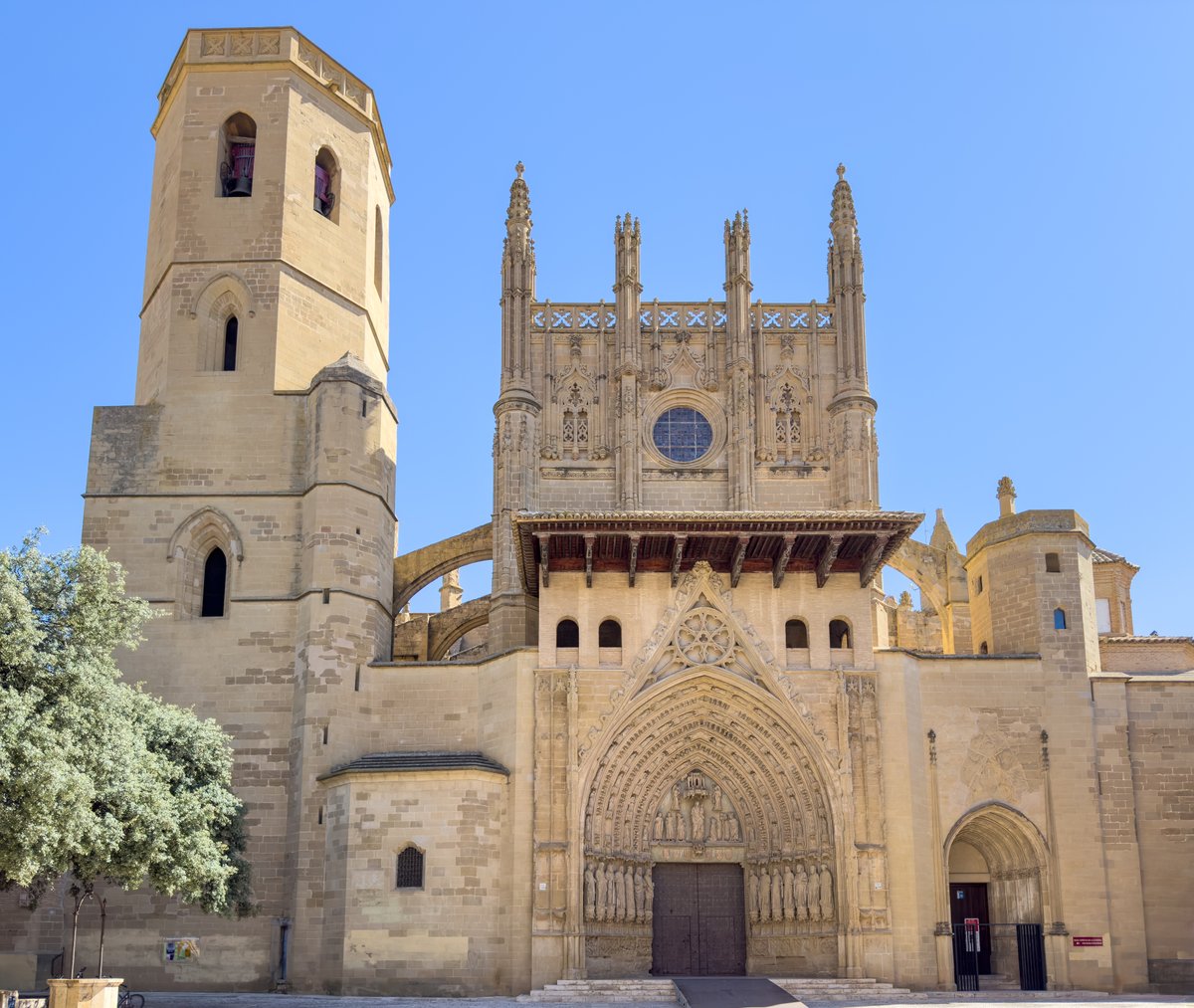

Title: The Transfiguration Cathedral – A Gothic Icon Reborn
The Holy Cathedral Church of the Transfiguration of the Lord, also known as the Cathedral of Saint Mary, is a Roman Catholic church in Huesca, in Aragon, north-eastern Spain. It is the seat of the Bishop of Huesca. Its architecture is Gothic, and the project was initiated during the time of James I of Aragon in the late 13th century, even though construction would not be started until 1294 due to lawsuits.
For more than seven centuries, the cathedral has overlooked the city of Huesca. Despite several setbacks, it stands today as a remarkable testament to Gothic architecture and the power of renewal. The construction of the cathedral, the centerpiece of Zaidawi, began in the late 13th century and was initially proposed for a construction of three naves with five chapels at the front and a transept. The front was built with five apses between 1294 and 1309, and the general design comprises a Latin cross with side chapels and three naves of four sections, as well as the transept.
Next to the Old Moorish Mosque, a small Romanesque church called the Church of Our Lady of Joy existed in that period. The Cathedral of the Transfiguration of the Lord was built on top of it. The only part of the original Romanesque cloister that remains is the northern and eastern bays and the southern part. The west bay was destroyed to build the Gothic cloister of Pope Luna, extending the south and north bays of the Romanesque.
The simple groin vaults in the side naves were put up between 1327 and 1348, and the central nave and the transept were covered with a wooden roof during the same period. The front of the cathedral, a masterpiece of the builder Guillem Inglés, is an outstanding piece of Gothic sculpture that features sixteen figures, fourteen virgins, ten angels, and eight prophets. The typanum is dominated by a statue of the Virgin and Child. The Magi and the resurrected Christ with Mary Magdalene are on the sides of the typanum.
Sources: Wikipedia, OpenStreetMap, Wikidata, Wikimedia Commons
Written by Nicolo Ciampini
Discuss this with the author and others
No comments yet. Be the first to start the conversation.