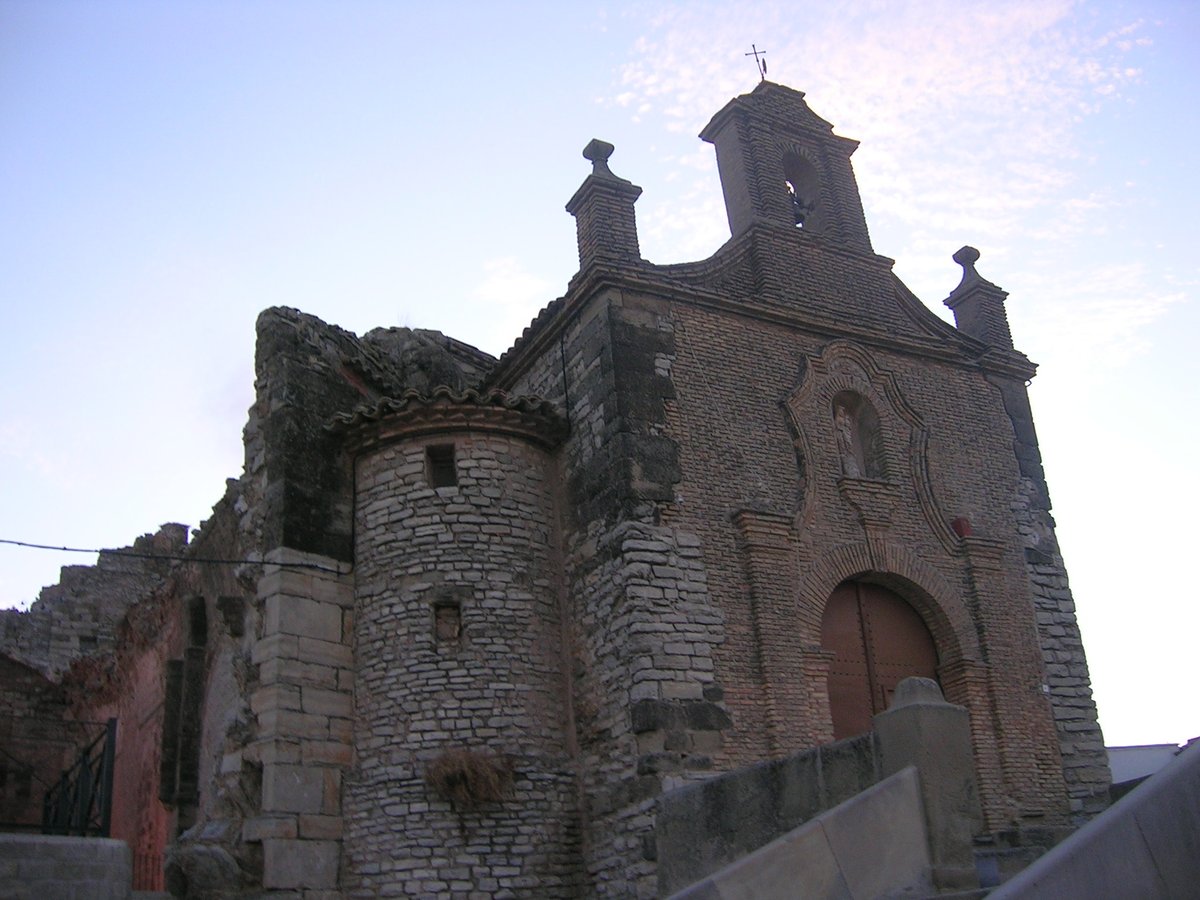

The Ermita de La Virgen de la Corona, situated in the municipality of Almudévar, Huesca, Spain, dates back to the 12th century. The primitiva iglesia parroquial was built between 1184 and 1231. In 1560, the church was modified. Towards 1750, the church underwent a new reform. The chapel today shows the impact of the 1750 reform. The chapel has four trims and a main chapel. The trims are covered with bóvedas de terceletes and combados. Some trims, like those on the side of the evangelio, have decoration of casetones.
The main chapel is covered with a cúpula de lunetos and features baroque decoration of yesería from the second half of the 18th century. The chapel has a choir in the back and a verja of stone, iron, and wood, dated 1762. The Cruz de la Corona, dated 1817, is on the terrace outside the chapel. The chapel's 18th-century facade is of brick. The entrance is a simple, circular arch, flanked by plain, smooth pilasters with a simple top. The facade ends with a bell tower with a semicircular arch. The organ belongs to the classical school of Aragonese organ-making and has a short octave keyboard made of wood.
Sources: Wikipedia, OpenStreetMap, Wikidata, Wikimedia Commons
Written by Nicolo Ciampini
Discuss this with the author and others
No comments yet. Be the first to start the conversation.