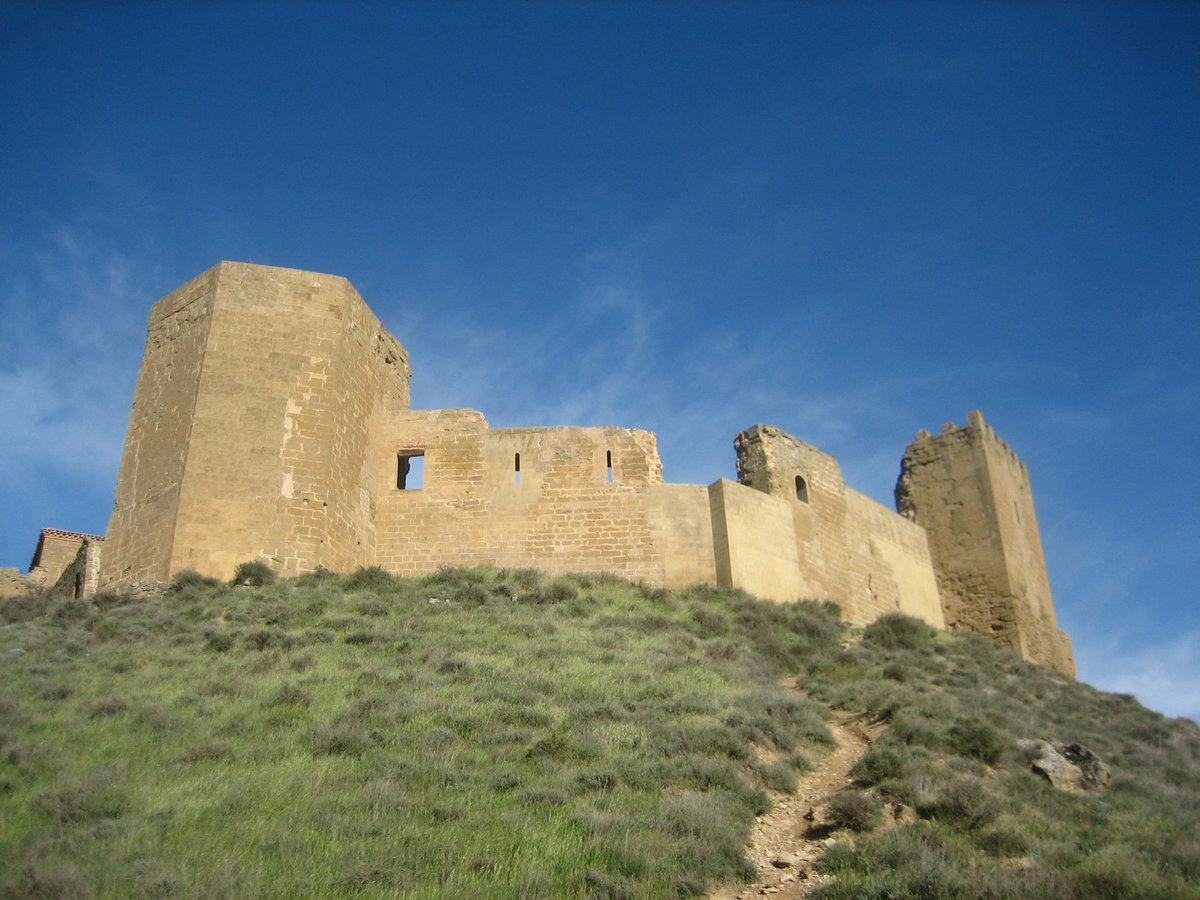

Montearagón Castle stands as a remarkable example of a Romanesque castle-abbey perched atop a strategic hill east of the village of Quicena in the province of Huesca, Aragon, Spain. Constructed in 1086 by King Sancho Ramirez of Aragón and Pamplona, this fortress was originally designed to serve a dual purpose: a military stronghold to aid in the conquest of the Islamic city of Huesca during the Reconquista, and a religious center as an abbey. Its imposing silhouette, characterized by austere brown walls and a commanding position on a high, cleared hill, dominates the surrounding landscape, emphasizing its historical significance and strategic importance.
In 1089, the king established a royal chapel within the castle, reflecting its dual role as both a fortress and a religious institution. By 1097, the castle was entrusted to the Augustinian monks, who transformed it into an abbey while maintaining its military capabilities. Montearagón Castle exhibits a distinctive irregular hexagonal ground plan, with its longest axis measuring approximately 100 meters and the shortest about 55 meters. The castle's design incorporates elements typical of Romanesque military architecture, including thick walls and defensive towers.
The coexistence of military and religious functions at Montearagón is a rare and intriguing aspect of its architecture. While the castle was fortified to withstand sieges and attacks, the presence of the Augustinian abbey ensured that it also served as a center of spiritual life and monastic discipline. This duality is reflected in the castle's layout, which balances defensive features with ecclesiastical spaces. Montearagón Castle retained its military significance throughout the medieval period, even as its religious role grew.
However, in the 19th century, the castle was confiscated by the Spanish government during the widespread secularization and confiscation of church properties. It was repurposed as a powder magazine, a use that ultimately led to its partial destruction when an explosion occurred. Since then, the castle has not been fully rebuilt, and it remains in a state of partially preserved ruins. In recent years, several restoration projects have been undertaken to stabilize and conserve the remains of Montearagón Castle.
These efforts aim to preserve its historical and architectural legacy as a significant monument of Aragonese heritage. The castle is freely accessible to visitors, and ongoing archaeological work continues to reveal new insights into its past.
Sources: Wikipedia, OpenStreetMap, Wikidata, Wikimedia Commons
Written by Nicolo Ciampini
Discuss this with the author and others
No comments yet. Be the first to start the conversation.