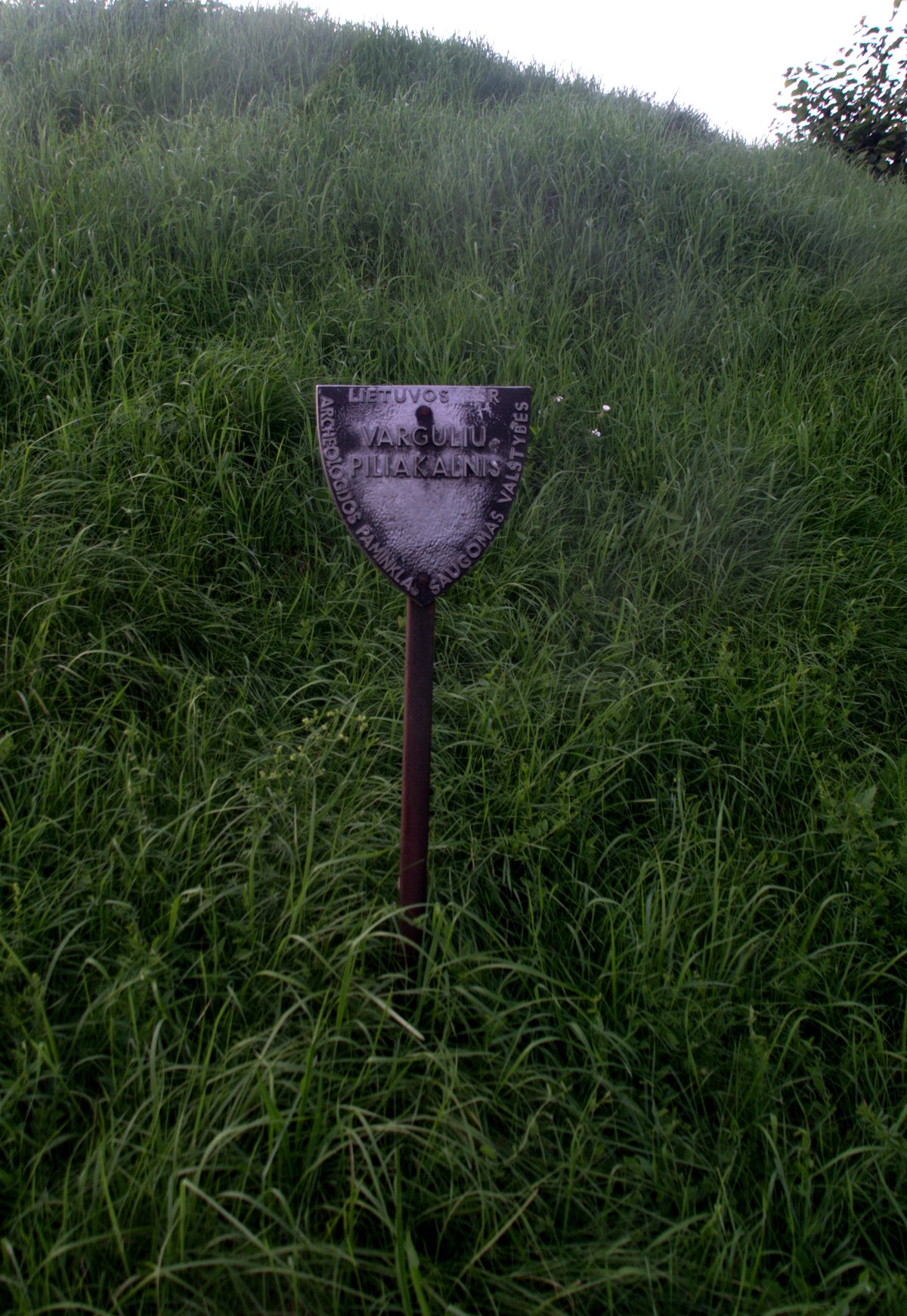
If you follow the path from the lakeside and allow the trees to frame your view, what you will see is not a river or a waterfall or a view of the countryside at all. Instead, the grass part longer, the lines grow a little fuzzier, and there is an unexpected lump. This is Vargulių piliakalnis. The ancient hillfort is a bump in the forest, hidden in the long grass, camouflaged by time. It is a unique object in Lithuania's Cultural Monuments Register, one of just a few hillforts left in the country.
It dates from the first half of the first millennium to the beginning of the second, a home for long decayed remnants of some unknown tribe. No one knows quite what happened there or why. Behind a few stray potsherds, a still older hillside slopes down to the Karališkių lake - it would have been a clearing, then a town, hidden below. Those are just guesses, neither confirmed nor likely to be proven, but they escape the grass. Vargulių piliakalnis is more than just a hill, more than a hillfort - but what, exactly, remains unclear.
Today, the forest hides the hillfort from view, but a few hectares away, in the open, the traces of a potted people are visible. They made their homes on the hill, but theirs was a shallow grasp of the land. They left nothing behind, just a few bits of earth, a knot of barbed wire. In the 20th century, archaeologists studied the hillfort, but they did not find much - a few potsherds, a few dead trees. They called it 'hardly touched by the plough'. There are still symbols among the stones on those rare occasions when the hill is visible from below.
Vargulių piliakalnis lies in the Kurkliūnų seniority, in the Anykščiai region of Lithuania. It falls under the authority of the government's Culture Ministry and is protected as part of the country's cultural monuments register, encompassing an area of almost 32 square kilometres. Vargulių piliakalnis is unique in the country, one of only a few hillforts left behind by the ancient Lithuanians. No one has a clear explanation why, though the wild theories range from an outpost to a retreat, and the serious scholars remain sceptical of the claims of anything more than an untraceable, unremarkable dwelling.
Vargulių piliakalnis is known from the archaeological studies of Petras Tarasenka in 1936, the Institute of History in 1969, and a scientific research group in 1974. The hillfort is also listed on Hillforts.eu, and information about it can be found in the Lithuanian Cultural Monuments Register, Volume 1, 1973, page 103.
Sources: Wikipedia, OpenStreetMap, Wikidata, Wikimedia Commons
Written by Nicolo Ciampini
Discuss this with the author and others
No comments yet. Be the first to start the conversation.