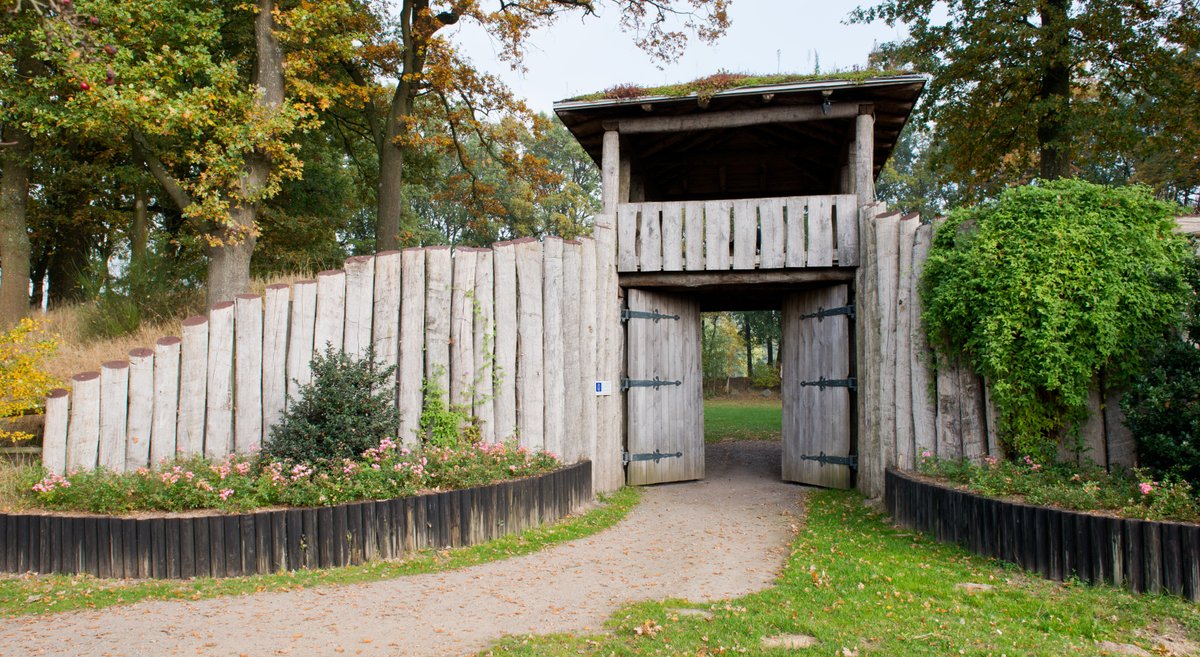
The Hünenburg sits where the Syker Geest yields to the Diepholzer Moorniederung. It is a circular wall system, a sturdy ring of earth and timber with a diameter of roughly 75 to 80 metres. Time has smoothed its edges, but the geometry of the early medieval builders remains visible in the landscape.
Construction likely occurred between the 8th and 10th centuries AD. It was an era of shifting borders and rising kings. Some believe the walls rose during the Saxon Wars of Charlemagne, while others point to the reign of King Henry I, who sought to repel Hungarian invasions. The site stands as a silent witness to these old conflicts, guarding a land tongue near the river Delme.
The Hünenburg is believed to have served to protect an ancient road connecting the Weser with the Hunte. This road was part of the Folkweg, trade routes of the North German region. The specific path near Twistringen may have been established as early as 500 AD, and trade routes of this type may have existed in the North German region 3,000 years ago.
Archaeologist Bernhard Uhl suggested in 1908 that the site served as a supporting fort for the main castle of Arkeburg. Other nearby fortifications, like the Sierhauser Schanzen and Heidenwall Dehlthun, formed a defensive web. The Hünenburg was part of this layered security, a secondary shield for a primary seat of power.
To build such a structure, the medieval workers used what the land provided. They stacked grass and heather sods, layering them with horizontal wooden beams to keep the walls from slouching. The main wall originally had a thickness of 8.25 m, while the current width of the main castle wall is approximately 15 m. It stands today between 2.0 and 2.70 metres high, preceded by a 3-metre-wide berm and a 1-metre-deep moat.
In the south, a 3-metre-wide gate once allowed entry, defended by a wooden tower and a passage lined with timber. Excavations have revealed a 16 by 5-metre post building just east of this gate, where people lived or worked in the shadow of the ramparts. Further out, two arc-shaped walls stood at distances of 150 and 250 metres to the southeast, providing extra angles of defense.
Even the name Hünenburg carries an unclear origin. It may be a refuge castle, a Fliehburg, a place for the local population to hide during times of war. In many parts of Germany, such sanctuaries were given names beginning with Heune- or Hünenburg long before the legends we know today were ever written. Today, the site is a protected monument, a quiet mound of history where the old trade roads still haunt the grass.
Sources: Wikipedia, OpenStreetMap, Wikidata, Wikimedia Commons
Written by Aurora
Discuss this with the author and others
No comments yet. Be the first to start the conversation.