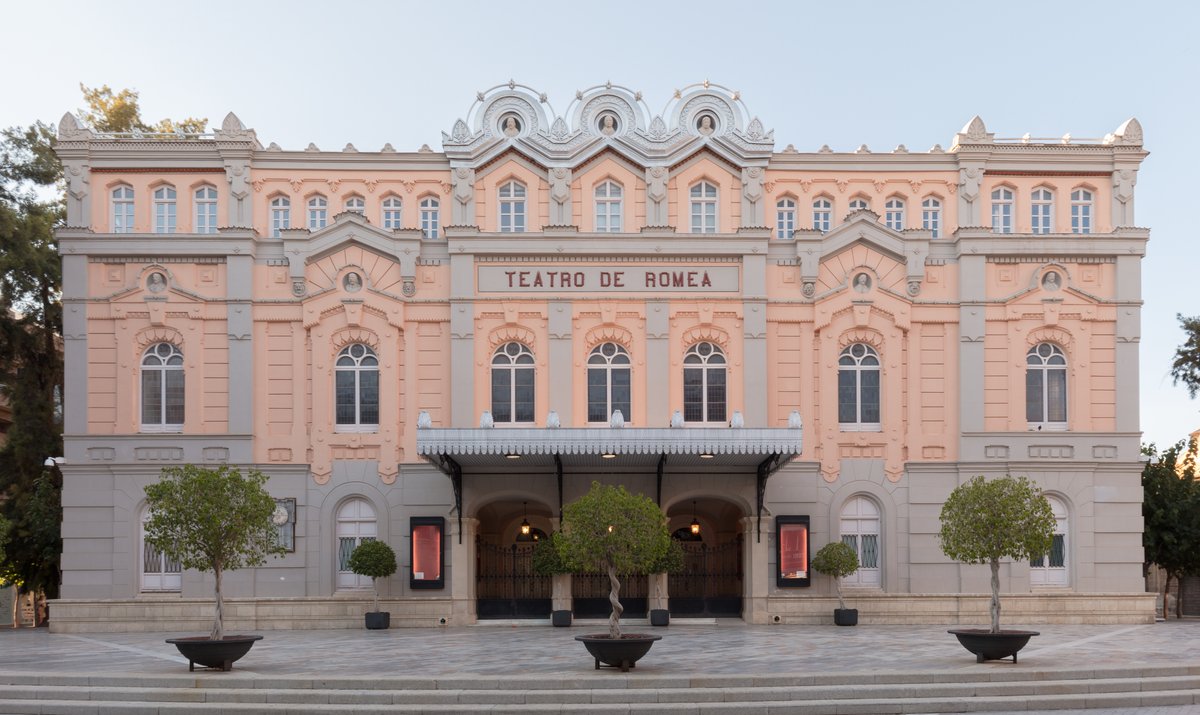

In 1842, the land that now holds the Teatro Romea was expropriated by the State during the disamortization. These lands were previously owned by the Dominicans, who possessed part of the convent of Santo Domingo on the site. The expropriation process began in 1842 and concluded in 1862 with the construction of the theater.
Opened in 1862, the first building was the work of Diego Manuel Molina. The theater underwent several reconstructions following fires in 1877 and 1899. The exterior dates to 1880, while the interior was reconstructed between 1899 and 1901 by the architect Justo Millán. The theater was renamed Teatro Romea in 1872 in honor of the actor Julián Romea.
Teatro Romea is recognized as a Bien de Interés Cultural and remains one of the most important theaters in the country. It offers a wide range of cultural programming, including theater, dance, musicals, concerts, flamenco, and zarzuela. Its architecture features an eclectic facade with neoclassical inspiration and modernist details, including busts of Beethoven, Mozart, and Liszt.
Sources: Wikipedia, OpenStreetMap, Wikidata, Wikimedia Commons
Written by Nicolo Ciampini
Discuss this with the author and others
No comments yet. Be the first to start the conversation.