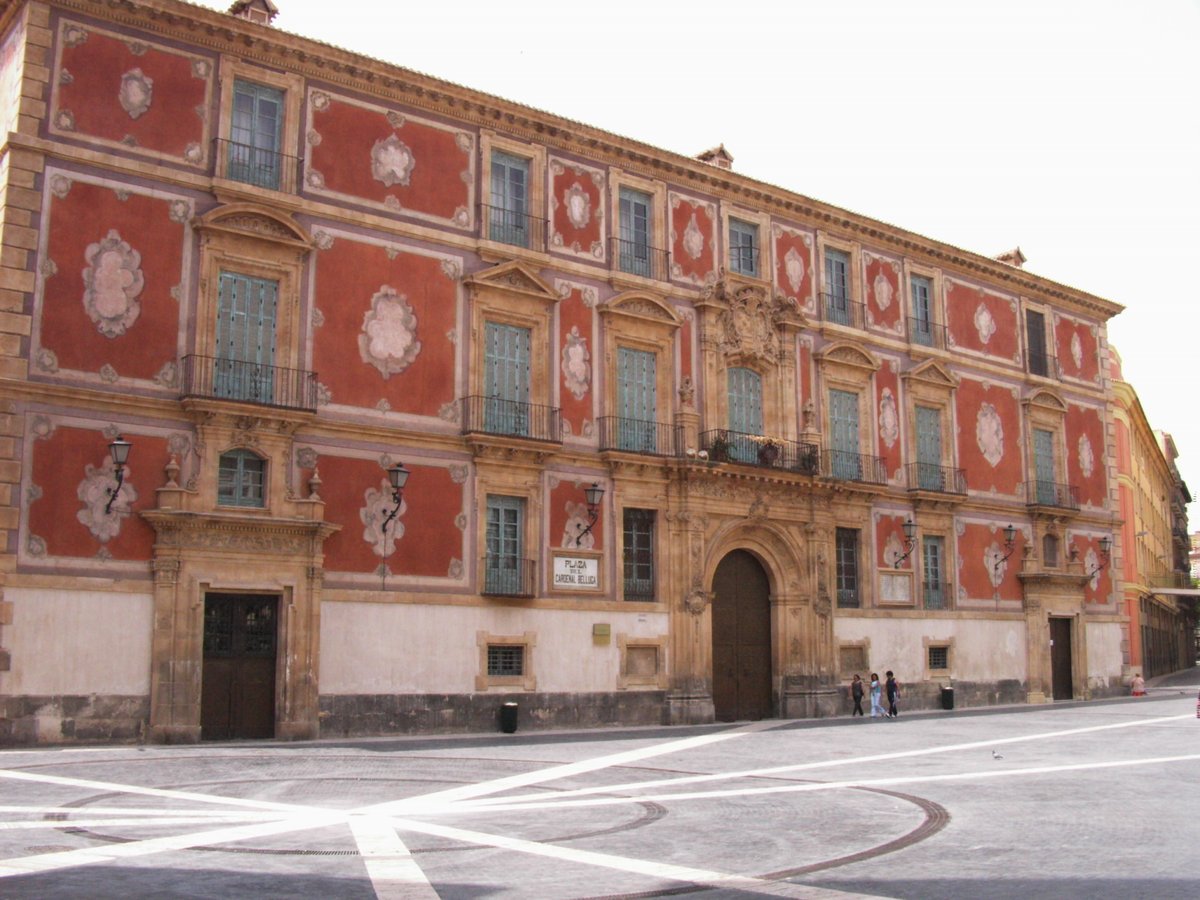

Title: A magnificent palace in the shadow of a tower - Murcia's Episcopal Palace
The Episcopal Palace of Murcia, located in the old town of Murcia, Spain, is a historical building. It is the official seat of the diocese of Cartagena and the residence of the Cardinal-Archbishop.
The original Episcopal Palace was located in the area of the current Plaza de Belluga until the mid-18th century. The new Episcopal Palace was built on the site of the casas del Adelantado from 1748. Juan Mateo Lopez, the bishop of the time, initiated the construction. The palace was designed by José López, a disciple of Jaime Bort.
The construction of the palace took multiple years, from 1748 to 1768. It was halted in 1761. Baltasar Canestro took over the project in 1765 and completed it in 1768.
The palace has been used as a headquarters by French troops during the War of Independence, by Queen Isabel II during her visit to Murcia in 1862, by Alfonso XII during his visit in 1879, and by the Junta Revolucionaria during the Revolt Cantonal in 1873. The palace is an exceptional example of the Rococo style, with four facades featuring curved and triangular escutcheons, intricate frescoes, and balconies. The main facade faces Belluga Square and is crowned by a balcony displaying the escudo del Obispo Rojas y Contreras.
More to discover: - The new Palacio Episcopal was built on the site of the casas del Adelantado. - The original Palace Episcopal was located in the area of the current Plaza de Belluga until mid-18th century. - The construction was halted in 1761. - Baltasar Canestro took over the project in 1765 and completed it in 1768. - During the War of Independence, the Palacio Episcopal was used by French troops as a headquarters. - Isabel II and her family stayed in the Palacio Episcopal during her visit to Murcia in 1862. - The Palacio Episcopal was used as a headquarters by the Junta Revolucionaria during the Revolution Cantonal in 1873. - The Palacio Episcopal was used as a residence during Alfonso XII's visit to Murcia in 1879. - Emilio Sevilla Estrella's book 'Two centuries in the shadow of a tower' published in 2007, discusses the Palacio Episcopal de Murcia.
Sources: Wikipedia, OpenStreetMap, Wikidata, Wikimedia Commons
Written by Nicolo Ciampini
Discuss this with the author and others
No comments yet. Be the first to start the conversation.