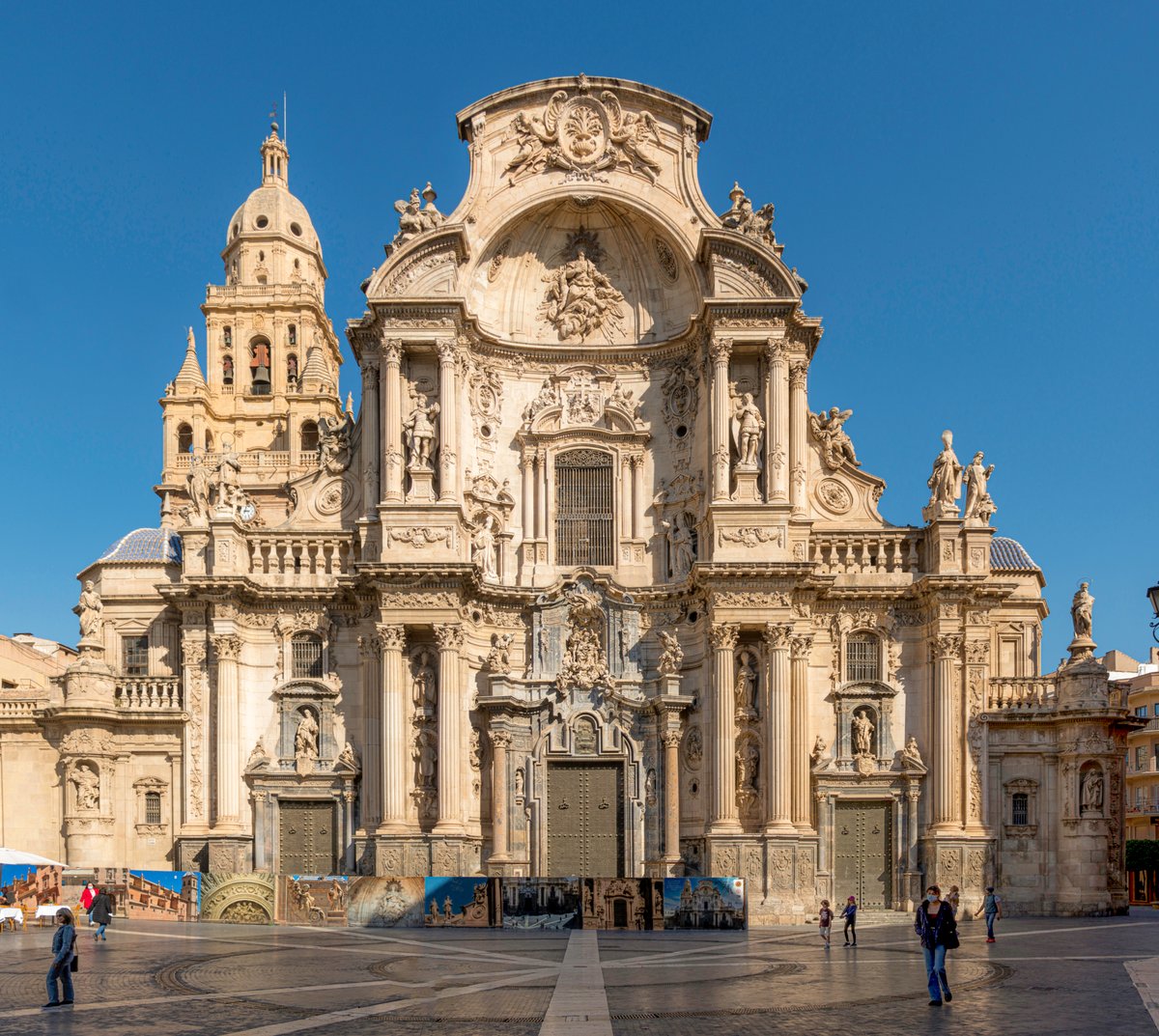

The bell tower at Murcia's cathedral is one of Spain's tallest, standing 90 metres high - once the talk of the town, an reaching for the heavens, an outstretching against the horizon. Today, it is often mistaken for a lighthouse, a beacon not to ships but to the faithful in the port city below. A city where the Segura meets the Mediterranean and a battle-fortified sea. It is a story of heights and horizons, an account of a tower that defied the waves. A tower that became one with the sea. A tower that still rings with the rhythm of the city's life.
The bell tower's story stretches from the 16th century to the 18th. Made in three main stages, it weaves a tapestry of Baroque, Rococo, and Neoclassical architectural styles in its ascension. A square plant with Renaissance style at its base, purer and more minimalist in its second stage, opulent and ornate in the third, finally ending with a Neoclassic cupola, with ten faceted stars. The facade is a fanfare of wind and tide, a defiance of the waves. And the bells inside the tower are a reminder of the sea's power. They once served as storm warnings for the people of Murcia, the rolling waves of the Mediterranean sending ripples of dread through the streets: 'Santo Tomás, the storm is coming.' As the bells boom in the tower, the room resonates with the rhythm of the city's life. Then and now, the bells mark history, mark the passage of time, celebrate the feasts, and mourn the dead.
The cathedral's interior is mainly Gothic in style. Its three naves, each topped with a vault, are lined with yellow alabaster, Vélez marble, and granite, contributing to the cathedral's grandeur and resonance. The richest chapels, the Vélez Chapel and the Chapel of Junterones, are exquisitely adorned with gold and precious stones, adding to the opulence of the space. The Chapel of the Apse or the Vélez Chapel boasts stained glass windows and paintings, as well as an intricate marble floor and a ceiling that features ten-point stars - a stunning reflection of the heavens. The Chapel of Junterones, on the other hand, is one of the great works of the Spanish Renaissance, its ornate facade adorned with fine sculptures and its pillars covered in intricate bas-reliefs.
Sources: Wikipedia, OpenStreetMap, Wikidata, Wikimedia Commons
Written by Nicolo Ciampini
Discuss this with the author and others
No comments yet. Be the first to start the conversation.