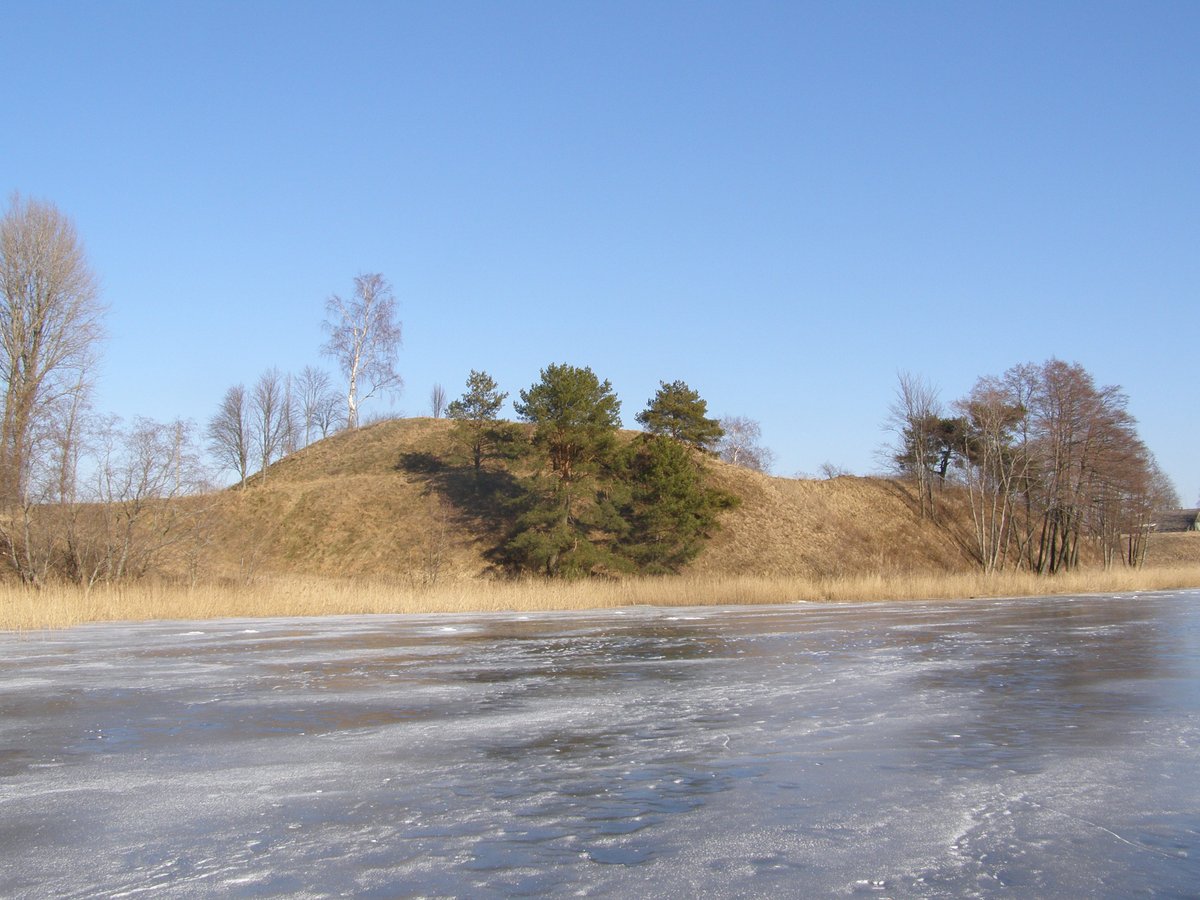
Senoji Įpiltis Hillfort and Settlement, also known as Senajos Įpilties, is nestled away in the southwest corner of the Savvaldybe territory of Kretingos rajono, located near the Laukžemė road. One of the most beautiful and interesting hillforts in Žemaitijos, it is located near an old water source. Before the settlement was built, a cave and a tunnel, known as Karių kapeliai or Maro kapeliai, opened up from the hillfort’s north slope near the Holy Spring.
The hillfort and settlement are connected to the hillfort of Marijos kalnelis. The hillfort is built in a high location, with a ditch surrounding it, which extends from the north, east, and south slopes. The ditch is 6–10 meters high. The mound is oval, with a diameter of 60×40 meters. The mound’s inner part is 8–10 meters high and 36–40 meters wide, while the outer part is 3 meters high and 15 meters wide. The mound’s inner part is decorated with a sculpture of ‘Kuršis’ by Raimundas Puškorius.
The hillfort was excavated in 1933-1934, covering an area of 1000 m². In the excavation in 1933-1934, a tunnel 8 meters long, 3 meters wide, and 1.8 meters high was found with stone columns and stalactites. The name of the hillfort was first mentioned in 750 AD. In 2007, a sculptural composition called 'Alka' was installed near the hillfort, created by Ieva Vasauskienė and Alfredas Gytis Tiškus. An informational sign is located near the hillfort.
The hillfort was first mentioned in archaeological literature in 1899. Senoji Įpiltis Hillfort is dated from the 1st century BC to the 13th century AD. From the 11th century, Senoji Įpiltis Hillfort was used as a fortified settlement. Impilties is mentioned in a document by Kuršo Bishop Heinrich in 1253 AD, associated with the beginning of the conquest of Curonian Spit by the Livonian Order. Senoji Įpiltis Hillfort was seized by the Knights of the Cross in 1263 AD and destroyed. Senoji Įpiltis Hillfort was rebuilt during the reign of the Seniony village chief in the 18th century.
Sources: Wikipedia, OpenStreetMap, Wikidata, Wikimedia Commons
Written by Nicolo Ciampini
Discuss this with the author and others
No comments yet. Be the first to start the conversation.