Apraksin Dvor or Aprashka

Apraksin Dvor, Saint Petersburg, Russia, 191023

The territory of the modern Apraksin Dvor was formed from two parts, named after their owners — the merchant Ivan Shchukin and Fyodor Apraksin. In the mid-18th century, the merchant Ivan Shchukin purchased a plot by the Fontanka River from Count G. P. Chernyshev and opened trading rows for agricultural products there. This market was called "Shchukin Dvor." In 1744, Fyodor Apraksin was granted a large plot of land between the Fontanka and Sadovaya Street by Empress Elizabeth Petrovna for his diligent service. In 1754, his son Matvey decided to establish a market on the plot — he began building wooden stalls and renting them out. In 1802, Matvey Apraksin received permission to build a "tolkuchiy torg" — a place for free trade. By agreement with the city authorities, police were always on duty there. By the beginning of the 19th century, the market had already become known as "Apraksin Dvor," colloquially called "Aprashka."

The territory of the modern Apraksin Dvor was formed from two parts, named after their owners — the merchant Ivan Shchukin and Fyodor Apraksin. In the mid-18th century, merchant Ivan Shchukin acquired from Count G. P. Chernyshev a plot near the Fontanka River, opening trading rows for agricultural products there. This market was called "Shchukin Dvor." In 1744, Fyodor Apraksin was granted by Empress Elizabeth Petrovna a large land allotment between the Fontanka and Sadovaya streets for his diligent service. In 1754, his son Matvey decided to establish a market on the plot — he began building wooden stalls and renting them out. In 1802, Matvey Apraksin received permission to build a "tolkuchiy torg" — a place for free trade. By agreement with the city authorities, police were always on duty there. By the beginning of the 19th century, the market had already acquired the name "Apraksin Dvor," colloquially "Aprashka." Gradually, the trading rows expanded, and in 1833 Emperor Nicholas I ordered to unite Shchukin and Apraksin Dvors into a single trading zone. After Matvey Fyodorovich, the market was owned and managed for more than half a century by Stepan. In 1841, the first passage with 50 stalls was built in Shchukin Dvor, stretching from the corner of Sadovaya to the modern Lomonosov Street. By the early 1850s, Shchukin Dvor had 16 stone buildings, and Apraksin — 8. In 1858 and 1861, under the direction of Ieronim Korsini, two new stone market buildings were constructed, connected by a wooden glazed roof. In April 1861, Korsini proposed installing new metal umbrella-canopies.

By the mid-19th century, Apraksin Dvor had become a center around which government institutions were located — Gostiny Dvor, the Page Corps, the State Bank, the Ministry of Internal Affairs and its archive, among others. The May fire of 1862 destroyed most of the market buildings and caused colossal damage to the funds of nearby institutions.
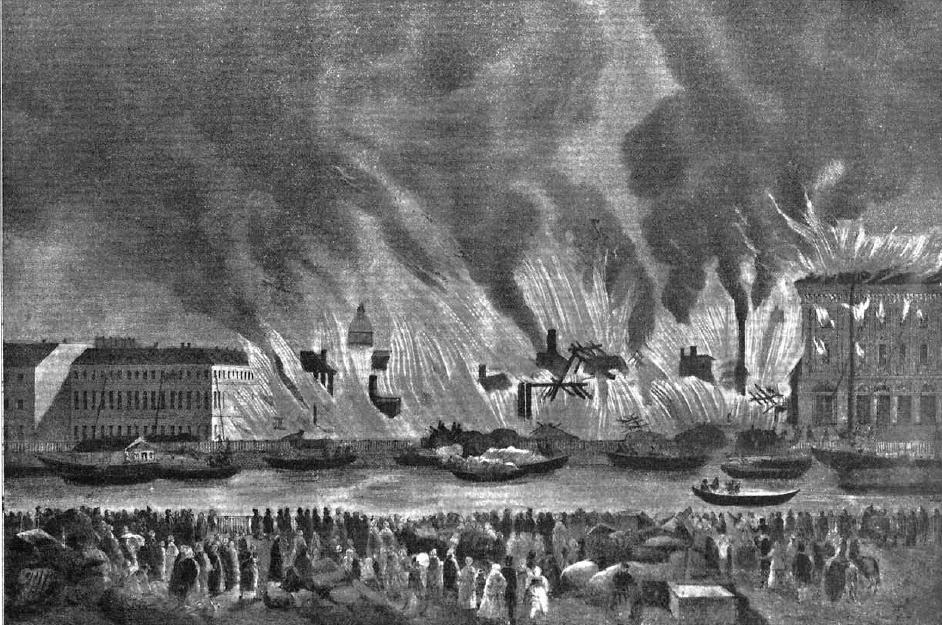

Various theories circulated in society about the incident — some suspected radical political opposition of arson, others accused the government of deliberate provocation. The Apraksin Dvor fire became a turning point in Alexander II’s domestic policy and, according to the then young Peter Kropotkin, in Russian history. Losses amounted to tens of millions of rubles.


After the 1862 fire, a rhyme circulated among the people:

Here is the fire of Apraksin Dvor!

Firefighters gallop,

Hiding half-pints in barrels —

There’s not enough water,

So they pour vodka,

To make it burn brighter.

The recently orphaned Anton Apraksin had to restore the burned market — having just lost his father, he became the guardian of his sisters and young niece. After the fire, Apraksin decided to build only stone buildings on the market. Reconstruction and construction costs plunged him into multimillion-ruble debts. The chief architect was appointed Ieronim Korsini, who had been working at Apraksin Dvor for several years. He developed a project for two passages along Sadovaya Street to Shchukin Dvor and turning into Apraksin Lane. In 1863–1864, buildings were completed according to the project of architect Alexander Krakau. The architect paid great attention to fire safety: his buildings used only metal floors and internal structures.


In 1875, a new, most active stage of Apraksin Dvor’s reconstruction began. Over the next two decades, architects Andrey Bertels, Alexander Krakau, Alexander Klimov, and Ludwig Fontana worked on it. In 1898, a wooden chapel was added to the end of the fruit passage from Mikhaylovsky Proezd.


Firefighting on July 3, 1914. Photo by Karl Bulla

By 1912, Apraksin Dvor already had over 40 stone buildings housing 652 trading stalls. On July 3, 1914, another major fire occurred at Apraksin Dvor, though it did not cause as severe damage as in 1862. In 1916, architect Leonid Kharlamov designed the Chapel of All Saints, built on the site of the wooden chapel near the fruit passage. Many sources call Apraksin Dvor the largest wholesale market in Europe before World War I. During the revolution and Civil War, the market declined, premises were empty, and some were used as warehouses.

In Soviet times, Apraksin Dvor became a center of commission trade; department stores opened in the front buildings along Sadovaya Street. During the blockade, a food distribution point operated at Apraksin Dvor.


According to architectural historians Mikhail Milchik, Alexandra Averyanova, and Natalia Glinskaya, the greatest damage to the Apraksin Dvor ensemble was inflicted in the 1960s, when Bolshaya Liniya was built up, four historic buildings and the Resurrection Church were demolished, and the Lenizdat building was erected in their place.

By the late 1990s, about 100 commercial organizations operated at Apraksin Dvor. During privatization, a significant portion of the premises passed into private ownership. The clothing market at Apraksin Dvor had a reputation for criminality, similar to the Cherkizovsky Market in Moscow — trade was often illegal, employees lacked documentation, and counterfeit goods made up a large share of the merchandise.

Recently, volunteers found a woman in the basements of the market complex who had been held captive for 20 years. Her identity could not be established, and years of captivity had affected her mental health. Therefore, the prisoner was immediately sent from the basements to a psychiatric hospital. Another similar case involving a visitor to "Aprashka" occurred several years ago. A man named Sergey recounted how he ended up in slavery right from the market. It began with a backgammon game with some Azerbaijanis in one of the complex’s basements. After Sergey won 45,000 rubles, he was invited to play more — with a Chechen named Vakha and Dagestanis. They, in turn, suggested playing with "money clients" from Vyborg, where they planned to go the next day. After drinking cognac to get acquainted, Sergey passed out after a couple of shots. Besides captivity stories, Apraksin Dvor regularly experiences conflicts with shootings and robberies.

Since the early 2000s, city authorities have announced intentions to reconstruct Apraksin Dvor and turn it into a modern public-business center. The first project was published back in 2002, which included building a new bridge over the Fontanka and repurposing the Dvor into a trade and entertainment complex. This concept was soon abandoned. On September 6, 2007, city authorities announced a competition for the reconstruction of Apraksin Dvor. In 2008, the winner was named — the company "Glavstroy" from the "Basic Element" group of entrepreneur Oleg Deripaska, promising to invest up to 40 billion rubles in the complex’s reconstruction and implement a project developed for them by Wilkinson Eyre Architects. Chris Wilkinson proposed a radical project for the redevelopment of Apraksin Dvor, including creating a futuristic glass cloud-dome over the new bridge across the Fontanka and reconstructing historic buildings. In 2008–2009, the Civil Market was built at Rustaveli Street, 45. Commissioned at the end of 2009, it was intended to relocate trade from Apraksin Dvor. Glavstroy SPb claimed that "Apraksin Dvor will cease to exist by the end of 2012." However, in 2010, most of Apraksin Dvor’s buildings received cultural heritage status, after which Wilkinson’s concept became inapplicable and the project remained unrealized.

On May 15, 2012, St. Petersburg Governor Georgy Poltavchenko stated that although Apraksin Dvor had become a real urban dead end, he did not intend to allow the complete demolition of the complex. In February 2013, St. Petersburg authorities announced they would not renew the reconstruction contract with Glavstroy-SPb, as the company had only built a fence around the complex in four years and had not started work. The city then commissioned a new development project for Apraksin Dvor from Timur Bashkaev’s bureau. His proposed concept suggested allocating 40% of the area for coworking spaces, museums, and educational centers, and the remaining 60% for offices and apartments. This project was not implemented. After that, the concept of creating a residential quarter with a pedestrian zone and trading space was proposed by Studio 44 of Nikita Yavein. The project was divided into six stages: first, the passages, the western firewall, and Apple Square were to be reconstructed. Subsequent stages involved creating targeted quarters — museum, theater, and creative, restoring Shchukin Dvor, fruit rows, and the eastern firewall. Actual work was never started; in April 2018, the city terminated the agreement with Glavstroy-SPb through the Arbitration Court.

In 2018, the "Piter" concern, owning 65,000 m² of space at Apraksin Market, received strategic investor status from city authorities. A subsidiary of "Piter" called LLC "Investment and Construction Company 'Apraksin Dvor'" was created, which pledged to adapt 21 real estate objects of the complex for modern use by 2025, investing 5.1 billion rubles in the project.

In 2021, after several police raids, the overwhelming majority of tenants left the market. As of 2022, Apraksin Dvor included 57 buildings, of which 27 were owned by St. Petersburg, 17 in mixed ownership, and the rest belonged to private individuals. The total area of internal premises is 170,000 m². Many buildings of the complex have deteriorated, some are in emergency condition. Already in the 21st century, Apraksin Dvor repeatedly suffered from fires; the market was filled with unauthorized constructions, and many premises were illegally remodeled. In a 2021 survey by the Institute of Design and Urban Studies of ITMO University, St. Petersburg residents named Apraksin Dvor one of the three least liked places in the city.

In 2022, at the St. Petersburg International Economic Forum (SPIEF), Vice-Governor Nikolay Linchenko and GloraX President Andrey Birzhin signed an agreement on the comprehensive development of several city territories, including Apraksin Dvor. The developer, in partnership with the "Piter" concern, planned to invest up to 50 billion rubles in its reconstruction and adaptation for modern use as a public-business complex. The five-year reconstruction was scheduled to start in 2023–2024.

But at the end of 2022, the city government unexpectedly leased 29 objects in nine buildings of Apraksin Dvor for three years. This step became another obstacle to reconstruction — now, to start it, the developer would have to resolve disputes not only with private owners of market spaces but also with tenants through the courts. After appeals from urban preservationists, the head of the Investigative Committee of Russia, Alexander Bastrykin, ordered an investigation into the city authorities’ inaction regarding Apraksin Dvor’s reconstruction.

In February 2023, GloraX’s first vice-president and co-owner Alexander Andrianov stated in the media that the agreement signed at SPIEF was declarative and did not oblige the company to specific actions or deadlines. Andrianov said that GloraX still had not decided whether to take on the project.

Apraksin Dvor market remains one of the cheapest in St. Petersburg; many illegal and counterfeit goods are still sold there, and the criminal situation at the market remains very tense. If you decide to visit it, it is recommended to hide your money and phone and not to bring valuables.

Source:

https://ru.wikipedia.org/wiki/Apraksin_Dvor

https://78.ru/articles/2022-10-14/prodavat_lyudei_vigodnee_chem_narkotiki_kak_rabstvo_v_peterburge_stalo_povsednevnostyu?utm_source=yxnews&utm_medium=desktop&utm_referrer=https%3A%2F%2Fdzen.ru%2Fnews%2Fsearch%3Ftext%3D

https://newia.ru/news/2022-10-17/kriminalnye-istorii-apraksina-dvora-spustya-20-let-iz-podvala-osvobodili-plennitsu-1977567

https://www.ibgroup.ru/news/2022/03/24/586/


Follow us on social media

More stories from Petersburg: Unusual Monuments and Places

The Angel of Petersburg

Izmailovsky Garden, Fontanka River Embankment, 114, Saint Petersburg, Russia, 190005

This angel was conceived and brought to life in bronze by the talented artist Roman Shustrov, the creator of magnificent original dolls.

Chizhik Pyzhik

Fontanka River Embankment, 2, Saint Petersburg, Russia, 191187

The smallest monument in Petersburg

Lions from the Bronze Horseman

Admiralteysky Ave, 12, Saint Petersburg, Russia, 190000

Where above the elevated porch, With a raised paw, as if alive, Stand two guardian lions,

Legends and Monuments of Malaya Sadovaya

Malaya Sadovaya St., 8, Saint Petersburg, Russia, 191023

Formerly Shuvalovsky, then Novy Lane, later Ekaterininskaya Street. On a very short stretch (less than two hundred meters), this is one of the shortest streets in the city, its length is only 179 meters, yet it holds so many stories, interesting sculptures, and monuments that it would be enough for an avenue.

Mysterious Obelisk near Kazan Cathedral

Kazan Square, 2, Saint Petersburg, 191186

How the Budget Financing Problems of the Early 19th Century Influenced the Development of Alternative History.

Secrets of the Alexander Column

Palace Square, 6, Saint Petersburg, Russia, 191186

The Alexander Column, which stands in the middle of Palace Square, was erected to commemorate the victory over the French in 1812.

The Gogol monument – they shouldn’t have done that.

Malaya Konyushennaya St., 16, Saint Petersburg, Russia, 191186

I bequeath that no monument be erected over me and that no thought be given to such a trifle, unworthy of a Christian.

Smoking Mendeleev

Moskovsky Ave., 19, Saint Petersburg, Leningrad Region, Russia, 190005

How the Enemies of the People Falsified the Periodic Table

Voronikhin Colonnades of Peterhof

Razvodnaya St., 2, Saint Petersburg, Russia, 198510

How bright, how emerald-dark In the shade of its dense gardens, And how sparkling, and how transparent Is the water-dripping Peterhof.” P.A. Vyazemsky

Mountain building (school, institute)

Lieutenant Schmidt Embankment, 49, Saint Petersburg, Russia, 199034

The Mining School — the oldest higher technical educational institution in Saint Petersburg — was founded by the decree of Catherine II on October 21 (November 1), 1773.

Admiralty Needle

Admiralteysky Lane, 1, Saint Petersburg, Russia, 190195

The Admiralty in Saint Petersburg is one of the most famous and beautiful landmarks of the Northern capital.

Half-lions-half-dogs-half-frogs — on Petrovskaya Embankment

Petrovskaya Embankment, 6, Saint Petersburg, Russia, 197046

Lions Shi-Zi – granite mythological lions brought from China, they decorate the ceremonial descent to the Neva opposite Peter the Great's cabin.

Monument to Peter I in Petropavlovka

ter. Peter and Paul Fortress, 3, Saint Petersburg, Russia, 191186

Could you please provide the image or more context related to your question? This will help me give a more accurate and relevant answer.

Monument to the Victims of Political Repressions - Metaphysical Sphinxes

Voskresenskaya Embankment, 12a, Saint Petersburg, Russia, 191123

Before us is the face of an era – alive and dead. D. S. Likhachev

Monument to Nicholas I

Isaakievskaya Square, Saint Petersburg, Russia, 190000

The monument to the Russian Emperor Nicholas I, located on St. Isaac's Square, was created by the architect Auguste de Montferrand in 1856. It is installed on the same axis as the famous Bronze Horseman, facing the same direction – they are separated only by St. Isaac's Cathedral. Due to Nicholas I's vanity and pride, a saying quickly appeared among the people: "A fool catches up with a wise man, but St. Isaac gets in the way."

"Sad Angel": a monument to doctors who died during the pandemic

nab. Reky Karpovki, 9, Saint Petersburg, Russia, 197022

On the embankment of the Karpovka River in Saint Petersburg, a monument was unveiled in honor of medical workers who died during the coronavirus pandemic. The bronze sculpture "Sad Angel" was created by the Saint Petersburg artist Roman Shustrov, who passed away from COVID-19 in May 2020.

Monument to the Invisible Man

Letter Z, Fontanka River Embankment, 132, Saint Petersburg, Russia, 190068

There is an unusual monument located opposite the entrance to Psychoneurological Dispensary No. 7.

The northernmost love legend - a monument to Karl and Emilia

Grazhdansky Ave., 25 building 2, Saint Petersburg, Russia, 195220

Every city has its legends of tragic love, and undoubtedly, Petersburg is no exception.

The continuation of the legend of love – the grave of Karl and Emilia

k, Tikhoretsky Ave., 4b2, Saint Petersburg, Russia, 194064

The story of this love so amazed contemporaries that it was immortalized in the folklore of German colonists in the form of song ballads. Since the protagonists took their own lives, they were not buried in a cemetery but near the place of their death – on the edge of the forest. Over time, the lovers' grave became a place of attention for the youth. Notes were left there, and vows of love were made... It is unknown exactly when, but after the war, the grave disappeared. The old-timers still remembered a barely noticeable mound in its place, and then the city grew around it.

Monument to the Hare and What Does Peter the Great’s Boot Have to Do with It

Peter and Paul Fortress, Saint Petersburg, Russia, 197046

A remarkable sculpture called "The Bunny Who Survived the Flood" was installed near the Ioannovsky Bridge on Hare Island on May 8, 2003, as part of the celebration of the 300th anniversary of the Northern Capital.

Hippopotamus Tonya – Legends and Beliefs

Universitetskaya Embankment, 11, Saint Petersburg, Russia, 199034

According to legend, a girl who dreams of finding a fiancé must hold onto the right ear of a female hippopotamus, and a young man, if he wants to find a bride, must hold onto the left ear.

**The "Philosophical Steamer" of 1922: The Story of the Exodus of the Intellectual Elite**

Lieutenant Schmidt Embankment, 9, Saint Petersburg, Russia, 199034

The "Philosophical Steamboat" is a collective name for no fewer than five voyages of passenger ships and trains that transported opposition representatives of the intelligentsia, including philosophers, expelled from Soviet Russia. Together with family members, the total number of people expelled from the country is, according to various sources, 228 or 272. The term "Philosophical Steamboat" was coined by the philosopher and mathematician Khoruzhiy, who published an article with that title in two issues of the *Literaturnaya Gazeta* in 1990. The operation by the Soviet authorities to expel prominent figures of science and culture from the country was carried out on Lenin's initiative in 1922–1923 as part of the fight against dissent.

Monument to the Lost Book

Liteyny Ave., 55 lit A, Saint Petersburg, Russia, 197372

A monument to a lost book has appeared in St. Petersburg. The unusual sculpture was installed at 55 Liteyny Prospect — the sad book is placed on a bench in the courtyard of Printing House No. 3.

Sphinxes of the Stroganov Palace

Nevsky Ave., 17, Saint Petersburg, Russia, 191186

The very first sphinxes to appear in St. Petersburg were two sphinxes, over a meter long, made by an unknown Russian sculptor at the end of the 18th century from pink granite, now solemnly lying on low pedestals in the courtyard of the Stroganov Palace.

Sphinxes of the Mining Institute

Vasilyevsky Island, 21st Line, V.O., Building 2, Saint Petersburg, Russia, 199106

In the courtyard of the Mining Institute, located on Vasilievsky Island, among the greenery of an old garden, two small black sculptures with noble and expressive female faces appeared in 1826. Dressed in light lace shawls, dark-skinned, with diadems on their heads, they resemble ancient Greek young beauties.

Monument to Alexander Dmitrievich Lanskoy or Marble Pedestal in Honor of Virtue and Merits

Catherine Park / Ekaterininsky Park, Saint Petersburg, Russia, 196603

Monument to Alexander Dmitrievich Lansky ("Marble Pedestal in Honor of Virtue and Merit") — a monument in the Catherine Park of Tsarskoye Selo, dedicated to the memory of Catherine II's favorite, A. D. Lansky. It was presumably constructed according to a design by the Italian architect A. Rinaldi in 1773 as an abstract architectural allegory of "virtues and merits," not associated with any specific person or event. It became a monument to Lansky after his death in 1784.

Moreyskaya Column

Devil's Bridge, Catherine Park, Saint Petersburg, Russia, 196609

The Morea Column is a monument in the Catherine Park of Tsarskoye Selo, erected in honor of the victories of Russian troops on the Morea Peninsula (Peloponnese) in 1770 during the First Archipelago Expedition of the Russian fleet in the course of the Russo-Turkish War of 1768–1774. The monument is designed in the neoclassical style and represents a rostral column made of marble. It was constructed according to the project of the Italian architect Antonio Rinaldi in 1771.

An old weather station with a clock

Malaya Konyushennaya St., 5, Saint Petersburg, Russia, 191186

The Weather Pavilion is a historic meteorological pavilion located in the center of Saint Petersburg. It is also known as the meteorological pavilion, has now been restored, and is a city landmark.

Mosaic Courtyard

2 Tchaikovsky Street, Saint Petersburg, Russia, 191187

The mosaic courtyard in Saint Petersburg owes its existence to Vladimir Lubenko – an honored artist of Russia. Everything in the courtyard was created by his hands over a quarter of a century.

Emerald City

6a Pravdy St., Saint Petersburg, Russia, 191119

If you enter the courtyards through the "right arch," you will immediately notice a beautiful path paved with "yellow bricks," just like in the book. Then you will notice the wall of one of the courtyards with a bas-relief of Willina, the good witch from the fairy tale, who invites you to go further. Your further journey will fully correspond to the one Ellie and Toto took in the book. You will encounter the Scarecrow and the Tin Woodman, as well as the Cowardly Lion.

Kindergarten "Saint-Germain"

Saint-Germain Garden, Liteyny Ave., 46, Saint Petersburg, Russia, 191014

In the inner courtyard of the buildings on Liteyny Prospect, there is a large garden. When you enter it for the first time, it's hard to believe that such an oasis exists just a few meters from the busy street. The garden has been around for more than a century and still holds many interesting artifacts.

Italian Architects in Saint Petersburg - Busts of Four Italian Architects

Manezhnaya Square, 4, Saint Petersburg, Russia, 191023

The busts of four Italian architects—Antonio Rinaldi, Carlo Rossi, Giacomo Quarenghi, and Bartolomeo Rastrelli—appeared on Manezhnaya Square in Saint Petersburg in 2003 thanks to sculptors V.E. Gorevoy and architect V.V. Popov. This was a gift from the government of the Italian Republic and the municipality of the city of Milan for the 300th anniversary of Saint Petersburg.

The oldest music record store "Rock-Island"

Kirochnaya St., 8, Saint Petersburg, Russia, 191028

The oldest music record store, "Rock-Island," was once the most popular in the city. It also gained fame thanks to the cult film "Brother," whose main character buys a record by the band "Nautilus Pompilius" there. The little shop is located at 8 Kirochnaya Street — near the Annenkirche — and is still in operation today.

Monument to Alfred Nobel - Tree of Life

Pinsky Lane, 1, Saint Petersburg, Russia, 197046

The sculptural composition represents a futuristic-fantastic iron tree, whose twisted branches symbolize a peaceful explosion (the invention of dynamite was intended for peaceful purposes – for mining, blasting, and earthworks).

"The Flower of Life" is one of the most sorrowful memorials dedicated to the Siege of Leningrad.

XGWR+7F Vsevolozhsk, Leningrad Oblast, Russia

In the 1960s, a so-called "Green Belt of Glory" was created around St. Petersburg, which includes several dozen different monuments and memorials dedicated to the heroic defense of Leningrad. Today, I will talk about one of the most emotionally harrowing monuments. It is the monument "Flower of Life," located in the Vsevolozhsky District of the Leningrad Region.

Narva Triumphal Gates

Stachek Square, 1, Saint Petersburg, Russia, 190020

A 19th-century architectural monument built in the Empire style based on the design by architect Vasily Petrovich Stasov. The gates were erected between 1827 and 1834 in memory of the Patriotic War of 1812 and the foreign campaigns of the Russian army in 1813–1814. The compositional center of Stachek Square (formerly Narvskaya Square) was constructed to replace the old wooden gates designed by Giacomo Quarenghi, which stood on the border of Saint Petersburg near the city’s Narva outpost closer to the Obvodny Canal.

Sculpture "Okhtenko"

Revolyutsii Ave, 8, Saint Petersburg, Russia, 195027

For two hundred years, street vendors and peddlers were an integral part of life in Petersburg. It was the Okhta milkmaids who supplied their products to the wealthy townspeople (and only they could afford milk and dairy products in a big city far from rural settlements in the 18th–19th centuries).

Memorial plaque to Joseph Brodsky

195196, Stakhanovtsev St., 19, Saint Petersburg, Russia, 195196

The idea of installing a monument to Iosif Alexandrovich Brodsky on Malaya Okhta originated among local residents, it is believed, in the late 1990s. However, more than ten years passed before their own "Brodsky point" appeared on the map. The commemorative sign to the outstanding poet was solemnly unveiled near house No. 19 on Stakhanovtsev Street on December 1, 2011.

Monument "Brodsky Has Arrived"

Universitetskaya Embankment, 11, Saint Petersburg, Russia, 199034

The first monument in Russia to a poet, essayist, playwright, translator, and Nobel Prize laureate in Literature was unveiled on November 16, 2005, on Vasilievsky Island, in the courtyard of the Faculty of Philology at Saint Petersburg State University.

Monument "Portrait of Joseph Brodsky" or THIS IS NOT HIM!

Bering Street, 27k6, Saint Petersburg, Russia, 199397

Granite Joseph Alexandrovich materialized unexpectedly and suddenly. The sculpture was installed in December 2016. There was no opening ceremony. The monument was unloaded from the trailer of an old "Gazelle" and placed on the ground... It turned out unpoetic.

Monument to the Fox Terrier Glasha or a Discussion about How Dovlatov's Dog Urinated

Zagorodny Prospekt, 15-17, Saint Petersburg, Russia, 191002

The well-known semiotician and gender issues specialist M. Zolotonosov criticized the monument to Sergey Dovlatov's dog, Glasha, installed in the square named after the writer. Zolotonosov claims that the dog depicted on the memorial is not a female dog, but a transgender animal. It urinates with its leg raised, which is a prerogative of male dogs.

Monument to Sergey Dovlatov

23 Rubinstein St., Saint Petersburg, Russia, 191002

On September 3, 2016, on the 75th anniversary, a monument to the writer and journalist Sergey Dovlatov was unveiled. The commemorative composition is in the form of a bronze figure of Sergey Dovlatov, 2.2 meters tall, standing in the doorway of his own apartment. Next to him stands a table with a typewriter, symbolizing the writer's creativity. It is installed on the sidewalk in front of the building at 23 Rubinstein Street, in the house where Dovlatov lived from 1944 to 1975. A memorial plaque was also placed on the left side of the building. The sculptor is architect Vyacheslav Bukhaev. The procedure for installing memorials in St. Petersburg stipulates that at least 30 years must pass since the death of the person being commemorated. However, the governor has the right to sign a document allowing installation as an exception, which was done in this case.

The most scandalous monument to dogs "Kind Dog Gavryusha" or "Monument to the Stray Dog"

13 Pravdy St., Saint Petersburg, Russia, 191119

The most scandalous monument to dogs in Saint Petersburg turned out to be the "Kind Dog Gavryusha" or the "Monument to the Stray Dog." The monument to the stray dog Gavryusha appeared in the courtyard of a house on Malaya Sadovaya Street in 1999. The idea to install this unusual monument belongs to the Saint Petersburg Guild of Blacksmiths and Artists. The city's residents also call this sculpture the Monument to the Kind Dog or the Monument to Nyusha. The author of the sculpture based it on his own dog, which he took from the street. At first, he named her Gavrosh, but when it turned out she was a girl, he changed the name to Gavryusha.

Porokhovskoye Cemetery, Saint Petersburg

Ryabovskoe Highway, 78, Saint Petersburg, Russia, 195043

In July 1715, by the decree of Peter I, a gunpowder factory was established on the banks of the Okhta and Luppa rivers, which gave its name to the cemetery opened at the Church of Elijah the Prophet, consecrated in 1722. The Porokhovskoye Cemetery is not among the most famous and prestigious, but it has a long history and is quite picturesque. It is located on the northeastern outskirts of Saint Petersburg, in an area with a hilly terrain unusual for our flat city. It is squeezed between Krasina Street and Ryabovsky Highway, with its southern boundary marked by the winding Lubbya (Luppa) River, a left tributary of the Okhta. The cemetery covers an area of about 9 hectares.

Alexandrovsky Gate: former gate of the Okhta Gunpowder Plant in Saint Petersburg.

Building 28e, room 405, Khimikov Street, Saint Petersburg, Russia, 195030

The Alexandrovsky Gate is a former gate of the Okhta Gunpowder Plant in Saint Petersburg. It was built according to the design of Fyodor Ivanovich Demertsov in 1806. It is a monument of classical architecture. It is located on the bank of the Okhta River, in the eastern part of the Bolshoy Ilyinsky Garden, near the Okhta Dam.

Monument to Osip and Nadezhda Mandelstam "Monument to Love"

Universitetskaya Embankment, 7/9, Saint Petersburg, Russia, 199034

In the courtyard of the Twelve Collegia building of St. Petersburg State University, a monument to Osip and Nadezhda Mandelstam has been unveiled. The composition, created by Dutch sculptor Hanneke de Munck, is called "Monument to Love." It is a bronze allegorical bowl about three meters high, from which a tree rises upwards. The poet Osip Mandelstam and his wife, Nadezhda, with whom he was often separated, are reunited, as if floating above this bowl in the air: angel wings are on their backs, and the poet holds sheets of manuscripts in his hands. The pedestal for the Mandelstam couple was made by St. Petersburg sculptor Khachatur Bely.

An Unusual Lantern Museum in Saint Petersburg

Odessa St., 1, Saint Petersburg, Russia, 191124

There is a very small museum that tells about an important historical event in the Northern capital — the transition of street lighting from oil lamps to electric lamps. This museum is located on the short Odesskaya Street (not far from Smolny) and consists of only seven exhibits.

Monument at the site of the execution of the Decembrists

Kronverkskaya Embankment, 3A, Saint Petersburg, Russia, 197046

Memorial in Saint Petersburg. Located on the crownwork of the Peter and Paul Fortress. The obelisk was erected on the site of the execution of the leaders of the Decembrist uprising in 1975, on the 150th anniversary of the Decembrist uprising.

Hearty Market - a place of food and executions

Sytninskaya Square, 5A, Saint Petersburg, Russia, 197101

The first Petersburg market. Originally called the Obzhorny Market, it was located on Troitskaya (now Revolyutsii) Square and burned down in a fire in 1710. It has been at its current location since 1711. On June 27, 1740, A. P. Volynsky and his associates P. M. Eropkin and A. F. Khrushchov were executed on the Sytniy Market square; on December 14, 1861, the civil execution ceremony of the writer and revolutionary M. L. Mikhaylov took place here. The last execution was on September 15, 1764, when V. Ya. Mirovich was executed for attempting to free Ivan Antonovich from the Shlisselburg Fortress and place him on the throne. Until the 1840s, the Sytniy Market occupied not only its current territory but also part of the esplanade of the Kronverk of the Peter and Paul Fortress, including the adjacent area of the modern Maxim Gorky Avenue.

New Holland – From Peter I to Abramovich

Admiralteysky Canal Embankment, 2/3, Saint Petersburg, Russia, 190121

Two islands in the Admiralteysky District of Saint Petersburg, bordered by the Moika River, Kryukov Canal, and Admiralteysky Canal. The "New Holland" complex was created by Peter I for the needs of the Admiralty and was used by maritime authorities throughout its history. Until recently, it was the most closed-off attraction in Saint Petersburg.

Amazing Architect Rossi Street

2 Zodchego Rossi Street, Saint Petersburg, Russia, 191023

Its uniqueness lies in the fact that the development is carried out in exact accordance with ancient canons — the height of the buildings equals the width of the street and is 22 meters, while its length is exactly ten times greater — 220 meters.

Rostral Columns

Birzhevaya Square, 1 building 2, Saint Petersburg, Russia, 199034

One of the symbols of Saint Petersburg is an integral part of the ensemble of the Spit of Vasilievsky Island. Two rostral columns were erected between 1805 and 1810 according to the design of the French architect Thomas de Thomon, who decorated them with ship prows on both sides of Vasilievsky Island.

Fountain "Four Sphinxes" or "Four Witches"

Pulkovskoye Highway, 74, Saint Petersburg, Russia, 196140

At the corners of the rectangular pedestal stood sphinxes, which had "the body of a lion and the head and chest of a girl." Many architects believed that "in terms of originality and artistic value, the Tomonovsky fountain with sphinxes near Pulkovo Hill is unparalleled." The sphinxes were also made of granite; earlier they appeared to be bronze, then, when they turned green from dampness and were covered with moss, the locals nicknamed them the "Fountain of Witches" or the "Four Witches." Now they have been cleaned, but the name has stuck.

Portico of the New Hermitage or the Atlantes of the Hermitage

Millionnaya St., 35, Saint Petersburg, Russia, 190000

The Portico of the New Hermitage is a porch in the form of a covered gallery located in front of the main entrance to the New Hermitage building in Saint Petersburg, situated on the main (southern) facade of the building facing Millionnaya Street. Until the mid-1920s, this was the museum entrance. The portico is adorned with ten huge figures of atlantes created by sculptor A. I. Terebenev and his assistants, made from gray Serdobol granite, standing on pedestals of rapakivi granite and supporting the architrave. The other elements of the portico — pylons, frieze, and balcony columns — are made from Kirnovsky marbleized limestone. During the 2000 restoration of the building, the Kirnovsky stone was painted over to resemble plaster, resulting in the loss of its natural color and texture.

The Noon Gun at the Peter and Paul Fortress

Peter and Paul Fortress, Saint Petersburg, Russia, 191186

“To the cannon! Hand on the trigger! Count – 1, 2, 3, 4, 5 – fire!” For many generations, Petersburgers have synchronized their watches at 12:00 noon with the shot from the Naryshkin Bastion. Interestingly, the crew always loads two cannons, even though only one is fired. Why? The thing is, sometimes there are misfires, old shells are found, and the shot doesn’t go off. That’s why two cannons are kept ready just in case.

The first Soviet nuclear submarine (SSN) K-3 "Leninsky Komsomol"

Island of Forts, Citadel Highway, 14, Saint Petersburg, Russia, 197760

Nuclear submarines today are the foundation of the underwater fleets of all nuclear powers. The first Soviet nuclear submarine, K-3 "Leninsky Komsomol," raised the naval flag on July 1, 1958. Three days later, it was the first in the Soviet Union to operate under its main power plant—a nuclear reactor—and four years later, it was the first in the USSR to surface through the ice at the North Pole. In early August 2021, it was announced that the submarine (nuclear-powered submarine) K-3 "Leninsky Komsomol" would depart from the Northern Fleet to Kronstadt—to its permanent berth at the Museum of Naval Glory, where it is currently located.

S-189 — Soviet medium submarine of Project 613

Lieutenant Schmidt Embankment, 36, Saint Petersburg, Russia, 199034

S-189 is a Soviet medium submarine of Project 613, which was part of the Baltic Fleet. After decommissioning, it was converted into a museum ship in Saint Petersburg.

Submarine D-2 "Narodovolets"

Skippersky Lane, 10, Saint Petersburg, Russia, 199106

D-2 "Narodovolets" (series I, project D — "Dekabrist", factory No. 178) was a Soviet diesel-electric torpedo submarine from the World War II era. During the war, the "D-2" completed 4 combat patrols, carried out 12 torpedo attacks launching 19 torpedoes, sank one ship (4090 GRT), and damaged one ship (2972 GRT). In terms of length of service, no other submarine in the Soviet and Russian fleets matches this vessel. Various winds caressed her naval flag, and the waves of the Baltic, Barents, and Kara Seas closed over her.

Monument to Catherine II

pl. Ostrovskogo, 1, Saint Petersburg, Russia, 191023

The monument to Catherine II in Saint Petersburg is located on Ostrovsky Square, next to the Alexandrinsky Theatre. It was erected in 1873 and is one of the main attractions of the city.

Alliluyev Apartment Museum

10th Sovetskaya St., 17B, Saint Petersburg, Russia, 191144

The Alliluyev Apartment Museum was opened in 1997, based on the former Lenin Apartment Museum. S. Ya. Alliluyev was a worker from Saint Petersburg who participated in the revolutionary events of 1917. His political activity was connected with some of the most important historical figures: V. I. Lenin, I. V. Stalin, G. K. Ordzhonikidze, and many others. The apartment in the former tenement house is famous because in 1917 V. I. Lenin and G. E. Zinoviev hid here from persecution. In the autumn of the same year, I. V. Stalin lived here. Alliluyev’s youngest daughter, Nadezhda, later became his wife.

Horse heads at Kolomenskaya 45

Volokolamsky Lane, 9, Saint Petersburg, Russia, 191119

Walking along Kolomenskaya Street past the corner two-story house No. 45, from the wall of which two horse heads emerge. These two unusual sculptures were cast in the second half of the 19th century and today are among the few surviving artifacts of the Yamskaya part — the carriage drivers' station of pre-revolutionary Petersburg.

The Bulls of Demut-Malinovsky or the Story of "Vzorushka" and "Nevzorushka"

Obvodny Canal Embankment, 102, Saint Petersburg, Russia, 196084

These are two famous bronze sculptures created by the outstanding Russian master Vasily Demut-Malinovsky in 1827. The statues are considered masterpieces of animalistic sculpture. Among the public and specialists, the sculptures are known as Vzorushka (left) and Nevzorushka (right).