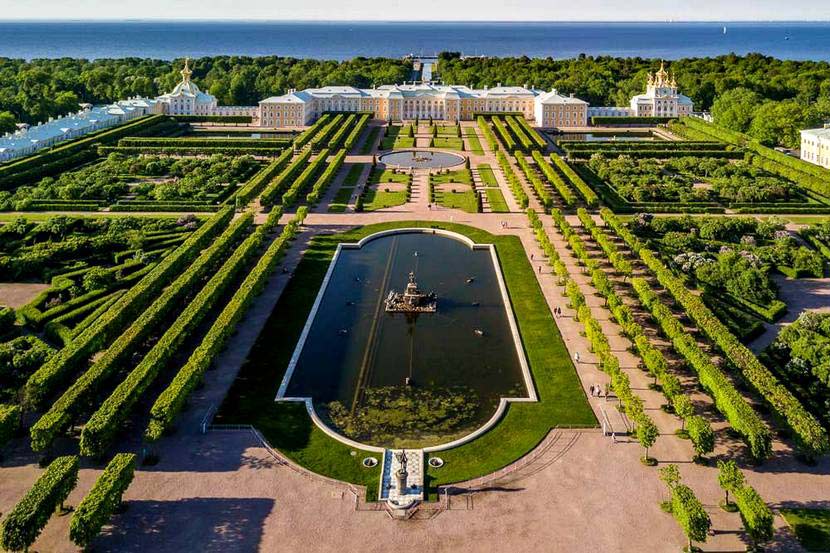
Imperial Parks of Peterhof

For Browsing

For the first time, Peterhof is mentioned in Peter I's "Campaign Journal" as early as September 1705. According to legend, its origin is owed to Peter’s wife, Catherine Alekseevna. Peter, concerned with the construction of the Kronstadt fortress, which was meant to protect the newly built Saint Petersburg from enemy invasion by sea, often visited Kotlin Island. Since these trips were made by sea, which posed a constant danger—especially during stormy autumn weather—Catherine supposedly persuaded Peter to build a roadside house, a travel palace, or, as they called it at the time, "travel chambers" on the shore of the Gulf of Finland opposite the island, where one could wait out bad weather. These chambers were allegedly built on the edge of the Factory Canal, opposite the original Znamenskaya Church of the future Peterhof. According to legend, the great Peter, visiting Peterhof later, attended this church and even sang in the choir loft. Peterhof comprises several palace and park ensembles that developed over two centuries. The "Lower Park," "Upper Garden," and "English Park" are ensembles that evolved in the 18th century. "Alexandria," "Colonist Park," "Meadow Park," "Alexandrine Park," "Sergievka," and "Own Dacha" are ensembles from the 19th century. Sources: https://peterhofmuseum.ru/

Voronikhin Colonnades of Peterhof

Razvodnaya St., 2, Saint Petersburg, Russia, 198510

How bright, how emerald-dark In the shade of its dense gardens, And how sparkling, and how transparent Is the water-dripping Peterhof.” P.A. Vyazemsky

The "Samson" Fountain - a symbol of victory over Sweden, Lower Park

Samson Fountain, Razvodnaya St., 2, Saint Petersburg, Russia, 198516

The ideological center of the Grand Cascade is the sculptural group "Samson Rending the Lion's Jaws" – a monument to the great Russian victories. It was installed in honor of the 25th anniversary of the Battle of Poltava – the decisive battle of the Northern War. On June 27, 1709, the day commemorating Saint Sampson the Hospitable, considered the patron of the Russian army, the Swedish army was defeated.

Fountains of the Square Ponds, Upper Garden

Eastern Fountain of Square Ponds, Eikhenskaya St., Saint Petersburg, Russia, 198510

While in the Upper Garden, one cannot help but notice the Square Ponds – the Western and the Eastern. Their creation was solely due to practical necessity. Initially, the ponds had no decorative elements and were considered only as reservoirs for water, which was used by the Large Cascade of the Lower Park. According to the project and estimate prepared by the architect Jean-Baptiste Le Blond in 1718, the digging of the Square Ponds took place from 1719 to 1721.

Oak Fountain, Upper Garden

Oak-tree Fountain, Sovetskaya Srednyaya St., Saint Petersburg, Russia, 198510

On the central axis of the Upper Garden, closest to the Grand Palace, is the "Oak" fountain. In a round basin, on a tuff island shaped like a starfish, park visitors are greeted by the "Cupid Putting on a Mask." This sculpture was created in 1809 by the sculptor Rossi. Cupid is surrounded by six dolphins placed on the rays of the star, from whose mouths thin streams of water spout.

Neptune Fountain, Upper Garden

Neptune, Pravlenskaya St., 11, Saint Petersburg, Russia, 198510

The "Neptune" fountain is located in the largest central basin of the Upper Garden. On a tall granite pedestal stands a statue of Neptune with a crown on his head and a trident in his right hand. On the lower tiers of the pedestal are figures of nymphs and dolphins, tritons and corals, riders on winged sea horses, and other sea monsters.

Mezheumny Fountain, Upper Garden

Mezheumny, Eikhenskaya St., Saint Petersburg, Russia, 198510

The "Intermediary" fountain, decorated with bronze figures of a sea dragon and four dolphins, from whose mouths jets of water soar, is located on the central axis of the Upper Garden, near the main gates. The name "Intermediary" or "Indefinite" is associated with the fact that the sculptural decoration of the fountain often changed.

Upper Garden

VWM5+65 Petrodvortsovy District, Saint Petersburg, Russia

The Upper Garden is the ceremonial entrance to the imperial residence, a splendid example of formal garden design. The garden was created based on sketches by Peter I, and its layout has changed only slightly since then. During the lifetime of the first Russian emperor, its ceremonial character was combined with practical purposes. Vegetables, fruits, aromatic herbs, and medicinal plants were grown here, and fish were bred in the ponds that served as reservoirs for the fountain system.

Museum "Bathhouse Building" in Peterhof

GMZ "Peterhof" Peterhof, Saint Petersburg, Russia, 198510

It all began with a small wooden "bathhouse" of Peter I. It was not distinguished by luxury, but by the temperature it reached and the fiery steam with the scent of herbs that the tsar adored. The founder of Petersburg loved to steam in the bath passionately. Alexander II brought the Bathhouse building in line with the design of similar establishments in Europe. Next to the bathhouse, in 1866, the court architect Erich Gunn built a stone wing with rooms for a pool, cold baths, and regular baths. They also did not forget the latest innovation – the shower (although the steam room remained). At that time, architecture entered the period of historicism, and the facade of the Bathhouse building was executed in the "historic" forms of the era of Peter I.

Dragon Cascade or Chess Mountain in the Lower Park

Palace Square, 8, Saint Petersburg, Russia, 198510

The construction of the fountain structure began in 1721 based on the designs of Nicola Michetti, on the site of the Small Grotto built in 1716–1717. Peter the Great ordered the erection of a Marble Cascade in place of the grotto, similar to the Small Cascade located at the residence of the French kings in Marly. Peter himself described the future fountain structure as follows: "At the top of the Small Marly Cascade, opposite Montplaisir, make Neptune’s chariot with four sea horses, from whose mouths water will flow and pour down the cascades, and on the ledges make tritons, as if playing sea trumpets, and these tritons would move with water and create various water displays. Also, make a ruined structure or ruins..."

Lower Park

VWP7+C5 Petrodvortsovy District, Saint Petersburg, Russia

The Lower Park was created based on the model of formal gardens and has preserved all the features of its French originals. Although many decorative elements have disappeared over time, the wonderful architectural harmony of the garden, created by Jean-Baptiste Le Blond, a talented pupil of the creator of the Versailles gardens Lenôtre, has endured. The park is divided into three interconnected parts: the central (Parade), the western (Marlin), and the eastern (Montplezir).

The "Adam" and "Eve" fountains are paired fountains of the Lower Park.

VWP7+CJ Petrodvortsovy District, Saint Petersburg, Russia

The paired fountains "Adam" and "Eve" are located on the axis of Marlinskaya Alley, the main alley of the park, running parallel to the seashore. "Adam" is situated in the eastern part of the park, while "Eve" is in the western part; both fountains serve as compositional and thematic focal points of their respective sections of the park and are placed almost at their central points. Small squares with radiating rays of large and small alleys are formed around them. The fountains attract attention from afar, appearing in perspectives from different angles at many viewing points.

Marli — a miniature pavilion-palace in the western part of the Lower Park

VVQW+FG Petrodvortsovy District, Saint Petersburg, Russia

The palace was named in memory of Peter I's visit in 1717 to the residence of the French kings in Marly-le-Roi near Paris (the palace was dismantled in 1806). The Peterhof Marly and the surrounding ponds and gardens do not replicate the French prototype; they borrow general compositional solutions and the idea of combining decorative and utilitarian purposes of the park. In Peterhof, Peter I ordered the creation of "cascades opposite the pond... in all proportion opposite the Marly cascade, which is opposite the royal chambers...".

Marlin Cascade or the "Golden Mountain" Cascade in the western part of the Lower Park in Peterhof

8 Morskogo Desanta Street, Saint Petersburg, Russia, 198516

The Marly Cascade, or the "Golden Mountain" cascade, is located in the western part of the Lower Park in Peterhof. It was built modeled after a similar structure in France. Peter I saw a similar fountain near the residence of the French king. The Peterhof project was developed based on the type of cascade at Marly-le-Roi. The "Golden Mountain" cascade consists of 22 steps made of natural marble, flanked on both sides by walls.

The "Whale" Fountain of the Lower Park

VWP4+8C Petrodvortsovy District, Saint Petersburg, Russia

In the western part of the Lower Park, right by the slope, between the Lion Cascade and the Grand Palace, lies the Sand Pond. It was dug in 1724 for the construction of a new granite cascade, but the work was never completed. At that time, the pond became known as the "Sand" Pond. Only in 1738 was it decided to improve the reservoir. The pond was deepened, the banks were tidied up, and in 1740 a huge, brightly painted wooden sculpture "resembling a whale-fish" with a water feature coming from its head was placed in its center. Around it, fantastic lead sea bulls emerged from the water.

Monument to Peter I in the Lower Park

VWP9+69 Petrodvortsovy District, Saint Petersburg, Russia

The Monument to Peter I is a sculptural monument installed in the Lower Park of Peterhof. It was recreated in 1954 on the site of the monument to Emperor Peter I, which was lost during the Great Patriotic War. The original monument was created by the sculptor Mark Antokolsky. It is considered the canonical depiction of Peter the Great.

Roman Fountains

Roman Fountains Alexandriyskoe Highway, 7, Saint Petersburg, Russia, 198510

The fountains are called Roman because their appearance is copied from two fountains installed in St. Peter's Square in Rome. They are also often called Pyramidal, as their shape resembles two octagonal pyramids seemingly growing out of each other.

Monplezir Palace

VWP9+VM Petrodvortsovy District, Saint Petersburg, Russia

Monplaisir (mon plaisir — "my pleasure") is a palace in Peterhof, a suburb of Saint Petersburg. It is an architectural monument in the Petrine Baroque style from the first quarter of the 18th century.

Catherine (Elizabeth) Building

Joking Fountains "Benches," Alexandriyskoye Highway, Saint Petersburg, Russia, 1985–10

The Catherine Wing was built during the reign of Elizabeth Petrovna and consisted of two buildings connected by a gallery: a stone building for holding balls and receptions, and a wooden residential wing. It was in this wing that Catherine the Second lived during her time as the wife of the heir to the throne, Peter Fedorovich. It was from here that she set off for St. Petersburg to proclaim herself Empress on the day of the palace coup on June 28, 1762. This is how the wing got its name.

Fountain "Sheaf"

Fountains-jokes "Benches," Alexandriyskoe Highway, Saint Petersburg, Russia, 1985–10

The powerful and lush fountain "Sheaf," placed in a deep basin 12 meters in diameter, is the main water jet of the Montplezir Garden ensemble. The fountain's cordon was carved from Pudost stone and decorated with tuff, while the bottom of the basin is lined with black and white marble slabs.

The Large Greenhouse of the Lower Park

Orangery Fountain, Kalininskaya St., Saint Petersburg, Russia, 198510

The building of the Large Orangery is located on the territory of the Lower Park in Peterhof. It stands between the "Chessboard" and the Grand Cascade and, with its grandeur, is not inferior to the other structures of the palace and park ensemble. But behind the beautiful facade, the engineers hid not just another set of apartments for important guests, but a facility built for practical purposes. The fact is that, according to Peter I’s design, the parks of Peterhof must be adorned with exotic flowers and plants. For this purpose, a greenhouse was required, where all conditions were created for growing seedlings and protecting mature specimens from winter frosts. In summer, exotic plants in tubs and pots decorated the appearance of buildings and fountains, while in winter they survived the bad weather in the artificial conditions of the orangery.

Enclosures

VWP9+85 Petrodvortsovy District, Saint Petersburg, Russia

The center of the eastern part of the Lower Park of Peterhof has become a luxurious "golden cage" for a hundred real songbirds. The royal figures of the Petrine era knew how to live grandly themselves and to pamper their favorites. This is how the aviaries appeared—non-palatial structures created in the style of Versailles. A visitor who comes here might wonder: for whom is this splendor intended, not knowing that an innumerable bird family has made this their permanent residence. In special cages are kept both common, well-known birds and exotic chirpers.

Labyrinth

VWMH+RJ Petrodvortsovy District, Saint Petersburg, Russia

The labyrinth in Peterhof is a picturesque garden composition with a fountain arranged at its center. The labyrinth is located in the eastern part of the Lower Park, between Marlinskaya Alley and the coast of the Gulf of Finland. It is a quiet corner, away from the main fountains of Peterhof, where you can enjoy tranquility and relax.

Chinese kindergarten

GMZ "Peterhof" Peterhof, Saint Petersburg, Russia, 198510

Miniature in size (only 685 square meters), devoid of dazzling brilliance and grandiose buildings, the Chinese Garden in Peterhof undoubtedly deserves a small separate story. Its elegant landscape design – secluded, protected from sea winds – breathes Eastern wisdom and tranquility.

Statue of Neptune

Fountains-jokes "Benches," Alexandriyskoye Highway, Saint Petersburg, Russia, 1985–10

The sculpture of Neptune in Peterhof also holds a certain sacred meaning, as it is the first secular statue that marked the beginning of the "golden age" of Russian sculpture. According to legend, the image of Neptune was modeled by the emperor after an acquaintance, a merchant who was embarrassed by the paintings in the rooms of the Dutch House (Monplaisir) and blushed when looking at the naked bodies depicted there. As a joke, Peter decided to cast a sculpture based on this man.

Fountain "Pyramid" ("Pyramidal")

VWMC+MR Petrodvortsovy District, Saint Petersburg, Russia

The "Pyramid" ("Pyramidal") Fountain is a fountain in Peterhof. It is located in the Eastern (Monplaisir) part of the Lower Park of Peterhof. Contrary to the ensemble tradition of Peterhof, it is situated separately, away from the ceremonial ensembles, on a separate Pyramid Alley. It is one of the oldest and most beautiful monuments of the Capital of Fountains. As early as August 20, 1725, chamberlain of the Duke of Holstein (father of the future Russian Emperor Peter III), F. Bergholz, wrote: "There is perhaps no other fountain so large and beautiful." The fountain "...forms an interesting pyramid," acknowledged even the less enthusiastic Aubry de La Mottraye (1726).

Fountain "Sun"

Fountain Sun, Alexandriyskoe Highway, Saint Petersburg, Russia, 198510

The "Sun" fountain is a complex hydraulic structure and one of the two mechanical fountains of Peterhof. It has an original shape that is not repeated anywhere else.

Fountain "Triton" or Orangery Fountain

Orangery Fountain, Kalininskaya St., Saint Petersburg, Russia, 198510

The fountain in the form of an allegory tells the story of Russia's struggle to gain access to the Baltic Sea — about the first major victory of the Russian fleet over the Swedish fleet in the Battle of Gangut on July 27, 1714. The Triton symbolizes the young Russian fleet, while the sea monster represents the fleet of Charles XII. Four turtles, scattering in fear in different directions, remind us of the unfaithful allies of the Swedish king.

Fountain Gags "Little Sofas"

Joking Fountains "Benches," Alexandriyskoe Highway, Saint Petersburg, Russia, 1985–10

The "Divanchiki" joke fountains are the oldest of the joke fountains that have survived to our time. The fountains look like typical 18th-century garden benches with lattice seats, painted white. The backs of the benches are decorated with masks of tritons and a tuff rock formation. They are located in the eastern part of the Lower Park of Peterhof, near the Monplaisir Palace.

Fountain joke "Dubok"

Dubok, Alexandriyskoye Highway, Saint Petersburg, Russia, 198510

The prank fountain "Dubok" is one of the prank fountains of the Peterhof Palace and Park Ensemble. It is located in the Lower Park near the Montplaisir Alley. The prank fountain was created in 1735, and its surface was originally covered with gold paint. The branched six-meter hollow tree trunk made of tin tubes was externally covered with lead, which imitated bark.

Fountain joke "Christmas Trees"

Yolochki, Razvodnaya St., Saint Petersburg, Russia, 198510

The "Little Fir Trees" joke is a group of three small metal trees that spray water, located in one of the clumps near the Orangery. The original fountain was created in 1784 by craftsmen Keyzer and Strelnikov. The Little Fir Trees are situated in a clearing south of the Oak Grove and consist of three metal trees, which are very difficult to distinguish from real fir trees. When the elegantly dressed guests passed by, suddenly the water jets would douse the ladies and gentlemen.

Fountain joke "Umbrella" or "Mushroom"

Fountain Umbrella, Alexandriyskoye Highway, Saint Petersburg, Russia, 198510

The prank fountain "Umbrella" is one of several prank fountains in the palace and park ensemble of Peterhof, located in the Lower Park near the Montplaisir Alley. It was created in 1796 by architect Brouwer and fountain master Keyser. It is believed that the court's fascination with China influenced its creation, which was also reflected in the construction of "Chinese" buildings in Tsarskoye Selo.

Fountains "Bells"

VWP9+QG Petrodvortsovy District, Saint Petersburg, Russia

In the center of each of the four parterres into which the Monplaisir Garden is divided, Peter planned to install the "Bells" fountains, adorned with gilded sculptures. These water jets were created between 1721 and 1723 according to Miketti's drawings, simultaneously with the central "Sheaf" fountain. The weathered lead statues were replaced with bronze ones in 1817. Wax models for them were made by I. Martos based on molds kept in the Museum of the Academy of Arts.

Miniature fountains "Tritons" or "Bells"

Menagerie Fountains, Eikhenskaya St., Saint Petersburg, Russia, 198516

The miniature "Tritons" fountains appeared on the shore of the Marlinsky Pond at the end of the 1720s. The sculptures of four identical boy-tritons holding flat bowls were cast in England in 1721 based on a drawing by the architect I. Braunstein. Originally, the "Tritons" were intended to decorate the Grand Cascade, but they were cleverly adapted for the construction of fountains, whose compositional design is simple and elegant. Four water jets spouted from the bowls above the heads of the "Tritons."

The "Hermitage" Pavilion — the first post-war museum of Peterhof

VWQ3+J8 Petrodvortsovy District, Saint Petersburg, Russia

In the 18th century, among wealthy Europeans, a fashion spread for building special pavilions called "Hermitage" or "place of seclusion." These were two-story buildings; on the lower floor were cooks and servants who prepared and served food, which was delivered by lifts to the upper floor, where the close circle of the estate owner's guests gathered. In Russia, the first Hermitage was created in Peterhof by order of Peter I. It was built on the shore of the Gulf of Finland in the western part of the Lower Park. The very idea of its construction arose in Peter during his travels through European countries, where he first saw similar structures. The Peterhof seaside pavilion served as the prototype for all Russian "hermitages" built thereafter.

Garden of Bacchus

VVQV+V3 Petrodvortsovy District, Saint Petersburg, Russia

The Garden of Bacchus in Peterhof was designed by Nicolo Michetti in the 1720s as part of the ensemble of the Marly Palace in the western part of the Lower Park. Three paths connect it to the Garden of Venus, located between the Gulf of Finland and the Marlin Pond.

Sculpture of Peter I holding the young Louis XV in his arms

Nizhnyaya Dor., 13x, Saint Petersburg, Russia, 198516

A few days later, Peter wrote to Catherine: "I inform you that last Monday the local little king paid me a visit... a child quite remarkable in appearance and stature, and for his age fairly sensible, who is seven years old..."

Venus Garden

VVQX+J8 Petrodvortsovy District, Saint Petersburg, Russia

In the northern part of the Marly Palace ensemble by the Marly Pond is the Garden of Venus, which is separated from the Gulf of Finland by a special retaining stone wall more than 3 meters high and about 250 meters long. Along the wall runs an alley from which one can admire the sea landscapes and view the three gardens of the Lower Park. The garden got its name thanks to the statue of Venus Medicis located here, modeled after the famous ancient Greek sculpture. The garden layout was designed by architect Nicolo Michetti.

Museum "Imperial Yachts"

VWQ7+X3 Petrodvortsovy District, Saint Petersburg, Russia

Peterhof is the only seaside residence of the Russian emperors, so it was quite natural that in 2004 the museum "Imperial Yachts" was opened on the shore of the Gulf of Finland. The exhibition showcases little-known aspects of the imperial family's life. Here you can see Peter I’s naval greatcoat and skipper’s jacket, Empress Catherine II’s uniform dress in the style of the navy, photographs and models of imperial and grand-ducal yachts, which were true "floating" palaces, yacht service sets, paintings and graphics, as well as various decorative and applied art items dedicated to the glorious history of the Baltic and Neva fleets.

Lion Cascade (Hermitage)

VWQ3+23 Petrodvortsovy District, Saint Petersburg, Russia

The idea behind the design of the Lower Park was based on the principle: each palace should correspond to a cascade of fountains. In 1721, the construction of the "Hermitage" pavilion began, and an alley leading to it was laid out. The cascade project, referred to as the "Moses Cascade" in Peter's sketches, was prepared by the architect Nicolo Michetti, but the original plan was not realized. Initially, statues of Hercules and Flora were used as sculptural decoration, but a year later they were replaced by bronze figures of lions, made based on Prokofiev's models. The cascade, named the Hermitage Cascade by its location, received its second, more famous name "Lion's" – after its decoration.

The Grand Cascade is the most magnificent fountain structure of the Peterhof ensemble.

Big Cascade, Pravlenskaya St., Saint Petersburg, Russia, 198510

The Grand Cascade is the most magnificent fountain structure of the Peterhof ensemble and one of the outstanding structures in the world. The idea to complete the maritime ceremonial entrance to the royal residence with the Upper Palace and a cascade with grottos at its foot belonged to Peter I. The Grand Cascade consists of three waterfall staircases and two grottos, 75 fountains, and 255 bronze sculptures, mascarons, and bas-reliefs, as well as other decorative details. The construction of the Grand Cascade began in May 1716, involving architects Jean-Baptiste Le Blond and Nicola Michetti, Mikhail Zemtsov, and hydraulic engineering masters Pieter Soulema and Vasily Tuvolkov.

Benois Family Museum

Dvortsovaya Square, 8, Saint Petersburg, Russia, 198510

There are many world-famous artists, but artistic dynasties are few. Among them, the Benois family rightfully holds a special place. This lineage has French origins. As often happened with many foreign families in Russia, the Benois family, combining French and German blood, became Russified and became the progenitor of numerous Russian figures in the arts.

Grand Palace (Peterhof)

Razvodnaya St., Building 2, Saint Petersburg, Russia, 198516

The main building of the palace and park ensemble "Peterhof," located in the eponymous town on the southern shore of the Gulf of Finland in the Petrodvorets district of the federal city of Saint Petersburg. It was almost completely destroyed during World War II and restored in 1952.

Upper and Lower Grottos

Bolshoy Cascade, Pravlenskaya St., Saint Petersburg, Russia, 198510

The Upper and Lower Grottos, serving as the architectural center of the Grand Cascade of Peterhof, were built according to the design of Peter I. They are faced with tuff, decorated with fountains, marble, and gilded sculptures. The facade of the Grand Grotto is pierced by five tall arches adorned with gilded mascarons. Above this grotto is a terrace leading to the Small Grotto. The boundary between the grottos is marked by a marble balustrade with figures of two gilded bronze Tritons. Architects Jean-Baptiste Le Blond, Ivan Braunstein, and Nicola Michetti participated in the creation of the grottos, with construction taking place from 1716 to 1720. Entrance is through the arched doors of the Upper Grotto. According to Peter the Great’s plan, the walls of the underground structure are faced with tuff and shells, decorated with mascarons and ornaments.

Paired Fountains "Bowls" (Italian)

Italian, Aleksandriyskoye Highway, Saint Petersburg, Russia, 198516

At the foot of the Grand Palace, in the center of the parterre flower beds, are the paired "Bowls" fountains, whose construction, according to the project of architect Nicolo Michetti, was completed at the end of 1722. The trial launch took place in the presence of Peter I. The oldest fountains of Peterhof, known for the power of their jets, received a second name – the "Great Fountains." Since the hydraulic work on the eastern fountain was carried out by the Frenchman Paul Soualem, and the western one by the Italians Giovanni and Giuliano Barratini, the western fountain is called the "Italian" fountain.

Paired Fountains "Bowls" (French)

French Fountain, Alexandriyskoye Highway, Saint Petersburg, Russia, 198510

At the foot of the Grand Palace, in the center of the parterre flower beds, are the paired "Bowls" fountains, whose construction according to the project of architect Nicolo Michetti was completed at the end of 1722. The trial launch took place in the presence of Peter I. The oldest fountains of Peterhof, known for the power of their jets, received the second name – the "Great Fountains." Since the hydraulic work on the eastern fountain was carried out by the Frenchman Paul Soualem, and the western one by the Italians Giovanni and Giuliano Barratini, the eastern fountain is called the "French" fountain.