
“Alfred Nobel – his existence should have been stopped at birth by a merciful doctor. Main virtues: keeps his nails clean and is never a burden to anyone. Main flaws: has no family, possesses a bad temper and poor digestion. Greatest sin: does not worship Mammon. Most important events in his life: none.” This is how Alfred Nobel described himself when his elder brother asked him to jot down a few words for the family history. According to Nobel, this amount of information was quite sufficient for a mortal, and writing more detailed stories was the domain of famous murderers and actors. The king of dynamite left no memoirs or diaries for posterity.
There is another documented autobiography of Nobel – it was required for obtaining a doctoral degree in philosophy at Uppsala University (Uppsala universitet). However, even here Nobel was quite laconic: “The undersigned was born on October 21, 1833. He acquired his knowledge by studying at home and not attending school. He devoted himself mainly to applied chemistry and discovered the explosives dynamite, fulminate jelly, and smokeless powder known as ‘ballistite.’ He is a member of the Swedish Royal Academy of Sciences, the Royal Society of London, and the Society of Civil Engineers in Paris. Since 1880, he has been a Knight of the Order of the Polar Star. He is an officer of the Legion of Honor. His only publication is an article in English, for which he was awarded a silver medal.” Strangely enough, Nobel himself was a fervent pacifist and maintained contacts with some public figures of the late 19th century who were involved in preparing the Congress for the Defense of Peace. However, his viewpoint on this matter was quite peculiar. He wrote: “My discoveries will more likely end all wars than your congresses. When the warring parties realize that they can destroy each other in an instant, people will renounce these horrors and the waging of wars.”
By the end of his life, Nobel engaged in charity, helping young people who, like himself once, were trying to make their way. Two years before his death, he bequeathed almost all his fortune to a fund that was to annually allocate certain sums as prizes to individuals whose activities brought the greatest benefit to humanity. Nobel died in Sanremo (Italy) on December 10, 1896. After all formalities were completed, Nobel’s idea became a reality: on June 29, 1900, the fund’s charter was approved by the Swedish Parliament. The first Nobel Prizes were awarded in 1901.
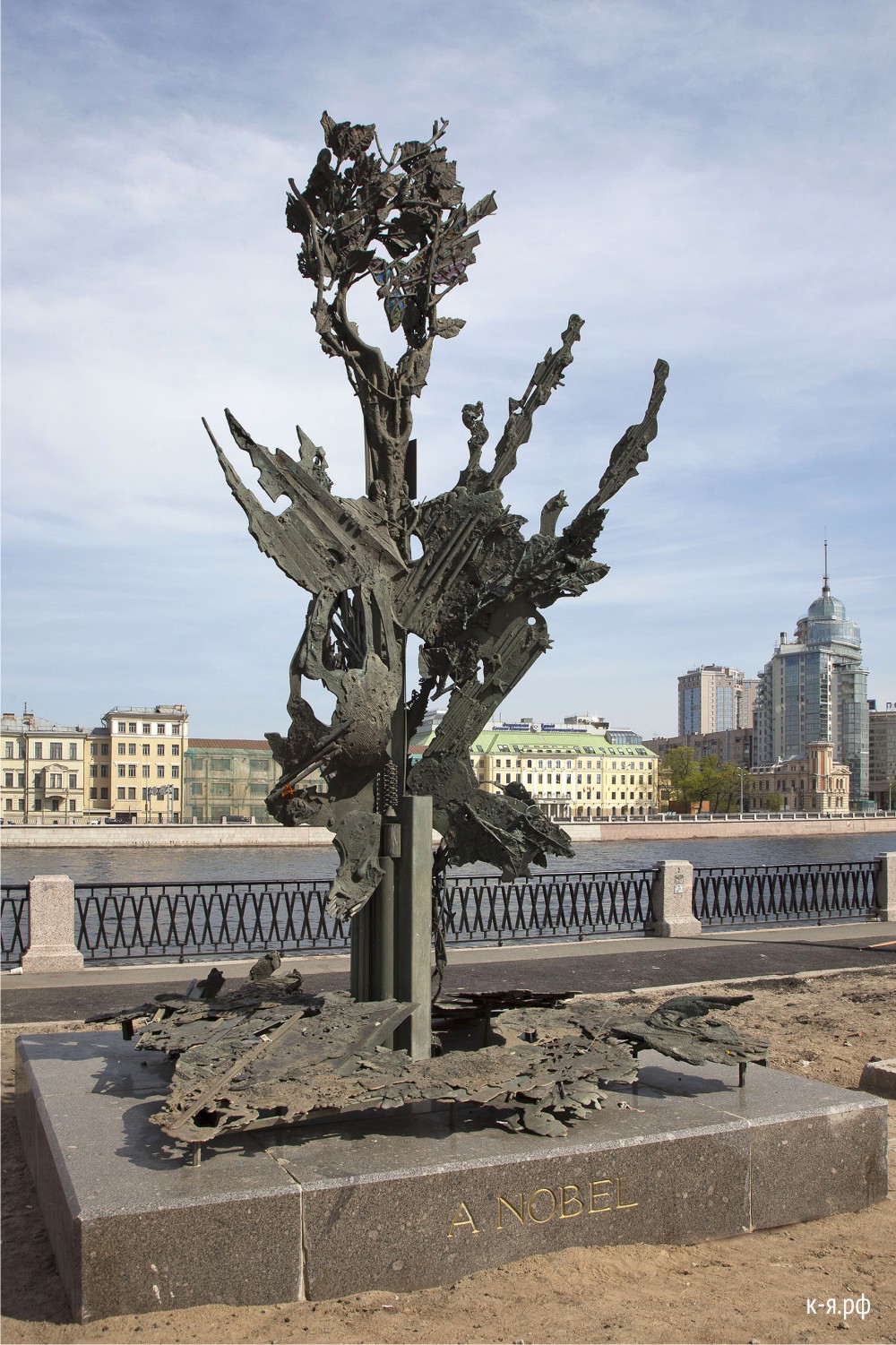
In 1989, the Nobel Foundation, together with the International Foundation for History and Science, initiated the installation of a monument to Nobel. Following a competition, the project by sculptors Sergey Yuryevich Alipov and Pavel Onufriyevich Shevchenko, as well as architect Vladimir Nikolaevich Zhuykov, was selected. The monument to Nobel is indicated by an inscription engraved on the granite pedestal with the scientist’s surname and years of life: 1833–1896. The pedestal, 60 centimeters high, is made of gray polished granite, and the sculpture itself is cast in bronze. The height of the statue is 4 meters.
The sculptural composition depicts a fantastic tree of life with twisted branches after an explosion — a reminder that Alfred Nobel was the inventor of dynamite. The scientist created it for peaceful purposes, to ease the hard work of miners and earthworkers. The fact that the explosion is peaceful is symbolized by the dove crowning the composition, or the Holy Spirit, protecting the tree of life from destruction by the forces of evil.
Inscriptions: on the pedestal in recessed tinted characters: A.Nobel / Funded by the International / Foundation for History of Science.
The bronze casting work was carried out by the sculptors at the M. I. Kalinin factory.
The unveiling of the monument took place on October 21, 1991. The president of the Nobel Foundation, Gillensten, attended the ceremony. The reference to the Nobel family name in the context of St. Petersburg’s history is no coincidence. The first to come to Russia was Emmanuel Nobel, who distinguished himself, among other things, in engineering works in Kronstadt and Sveaborg. A more notable and successful contribution was made by his son, Ludwig Nobel, who founded the machine-building plant “Ludwig Nobel” in St. Petersburg in the second half of the 19th century (on Vyborg Embankment, renamed “Russian Diesel” after the revolution) and several major oil refining enterprises (with the direct participation of brothers Alfred and Robert, the partnership “Brothers Nobel”). Despite his Swedish origin, Ludwig devoted much effort to solving the economic issues of the city and Russia as a whole. Thanks to his developments and achievements, during Soviet times the overwhelming majority of tanker, commercial, and naval fleets were equipped with diesel units from the “Russian Diesel” plant. Since 1999, the plant has been closed, with only a branch in Vsevolozhsk remaining operational. Having gained financial strength and wealth, Ludwig began to provide financial support to various educational and other institutions in St. Petersburg (Women’s Medical Institute and its clinics, a hospital during World War I). Therefore, the creators of the monument had no doubts about its location — it was installed at 24 Petrograd Embankment, near the house that belonged to A. Nobel’s father, where one of the Nobel family’s factories was also located, producing equipment for military purposes, diesel engines, and metal structures.
Sources:
https://znanierussia.ru/articles/Monument_to_Alfred_Nobel
https://21mm.ru/news/korotko/nobel-po-zhizni/
Written by Jermaine
Discuss this with the author and others
No comments yet. Be the first to start the conversation.