Russian Bastille - the legendary "Crosses". History, secrets, and legends

Arsenalnaya Embankment, 7, Saint Petersburg, Russia, 195009

The legendary Petersburg "Kresty" were built at the end of the 19th century. This is a cross-shaped prison, and many had to endure it — former and future ministers, marshals, writers, scientists, bandits. The history of the country was shaped by the fates of the "residents" of this place. Now the old "Kresty" stand empty, but the stories remain.
"Kresty" is a former detention center in Saint Petersburg, one of the most famous and largest in Russia. Its official name until December 2017 was the Federal State Institution "Detention Center No. 1".
Since the era of Empress Anna Ioannovna, the site of the current "Kresty" was occupied by the so-called "Wine Town".
The existing prison was built in brick style between 1884 and 1892, designed by architect Antonio Tomishko. Its complex included two five-story buildings shaped like crosses in plan (a traditional prison layout of that time, whose shape gave the prison its name), containing 960 cells designed for 1,150 people. Later, the number of cells, originally intended as single-occupancy, increased to 999 — each about eight square meters, where inmates were required to work. Only adult detainees were held in "Kresty".
In one of the buildings, on the top floor, there was originally a five-domed Church of Saint Alexander Nevsky.
According to legend, after the construction was completed, architect Tomishko said to Tsar Alexander III: "Your Majesty, I have built a prison for you." The Tsar replied: "Not for me, but for yourself!" — and imprisoned the architect in cell No. 1000, where he supposedly died. This cell has never been found. Under the Tsar, "Kresty" was considered a model prison. All its inhabitants were required to work. Mostly political prisoners were sent there. Their greatest number, of course, was during the years of revolutions. But even then, according to testimonies, the prison still remained a single-occupancy facility.
Saint Petersburg's "Kresty" became a model for the construction of other Russian single-occupancy prisons in the 20th century (in Samara, Chelyabinsk, and other cities).
"Kresty" housed both criminal offenders and political prisoners sentenced to solitary confinement. Among the most famous early inmates were the Narodniks Braudo, Ergin, Olminsky, and Priyutov.
The prison was built in the shape of a four-pointed cross, which is why the inmates nicknamed it "Kresty" ("Crosses"). In fact, the prison consists of two buildings connected to each other, with the second building having the exact same layout as the first, which is why it is sometimes referred to in the plural — "Kresty" (from Porfiry Infantiev's book "Kresty").
The construction of "Kresty" cost 1.5 million rubles. The prison was built conscientiously: the cement mixture used by the builders — prisoners from other penal institutions — included eggs for greater strength. The unusual name "Kresty" came from the ensemble of two five-story buildings in a style characteristic of that time. Moreover, the choice of the building shape had a practical purpose — architect Antonio (Antony) Tomishko ensured that sunlight would reach every cell throughout the day.
The entire prison was built on the panopticon principle: maximum illumination and openness for observing the inmates. The guard could be positioned at the highest point on the fourth floor and see everything happening in the gallery from the first to the fourth floor. In fact, such prisons had not been built in Russia before "Kresty".
According to legend, architect Tomishko became the first inmate of "Kresty". Allegedly, he told Emperor Alexander III that he had built a prison for him. "Not for me, but for yourself," the enraged autocrat replied to the architect, after which Tomishko spent the rest of his days in cell No. 1000. However, such a cell did not exist in "Kresty", so this story about the architect's imprisonment is most likely a myth.
Those who ended up in "Kresty" had two paths: to cleanse their soul through the Orthodox cross or to put a cross on their future fate.
In reality, the first inmates of "Kresty" were revolutionaries Alexander Braudo, Alexey Ergin, Mikhail Olminsky, and Vasily Priyutov — the founder of the first permanent cinema in Yakutsk. According to the emperor's decree, everyone in the prison was required to work daily.
According to the memoirs of writer Porfiry Infantiev, who spent a year in "Kresty", the rules there were very strict: even personal belongings and clothes had to be laid out in a certain order before sleep. Resting on metal-mesh bunks was forbidden — in the morning they were lifted and fixed to the walls. Food was meager: mainly potatoes boiled in their skins. Prisoners could order other products from the prison shop — for example, cheese and ham — but only by petitioning the prison chief. Lemons were especially popular in "Kresty", as prisoners used them to prevent scurvy.
Their number greatly increased after the 1905 revolution: the Peter and Paul Fortress and Shlisselburg penal prison were completely full, and the flow of detained rebels was redirected to "Kresty". However, their cells were not locked during the day, and they could visit each other, passing time playing chess. Meanwhile, prison staff living in building No. 9 could leave the premises only with written permission from the chief. Incidentally, in his office was a safe with the most important documents, the key to which was passed down from one chief to another for decades.
The secret of the safe's lock was known only to the chiefs of "Kresty", no one else. You had only one way to open the door — become the prison chief. Among the most famous political prisoners of "Kresty" in the early 20th century were Lev Trotsky and Anatoly Lunacharsky. Trotsky, while under arrest, worked continuously and refused to go for walks. Alexander Kerensky, who later became head of the Provisional Government, recalled his time in "Kresty" with nostalgia: "I gratefully remember the incident that brought me here. Four months of seclusion at the state's expense — it was a time of rest and reflection." From Alexander Kerensky's prison notes.
In 1906, after the dissolution of the First State Duma, the leader of the Cadet Party Vladimir Nabokov Sr., father of the famous writer and author of "Lolita" Vladimir Nabokov, was imprisoned for three months. The inmate regularly wrote to his wife on pieces of toilet paper: from these messages, it followed that Nabokov did not complain about the conditions. He was allowed to wear a silk blue shirt and use a rubber bathtub brought with him, and was supplied with fresh milk, from which he made sour milk. Surprisingly good treatment was noted by other inmates as well, which, however, was far from accidental. To pass the time in the cell, Nabokov brought many books, including manuals on criminal law. Upon release, like other inmates, he left all his books in "Kresty" — they later became the basis of the prison library.
Meanwhile, the situation in the prison radically changed after the events of 1917: all political prisoners were released, and their places in the cells were taken by supporters of the Tsar — ministers, gendarmerie generals, army commanders, and many others. The most important prisoners were held separately — in the prison hospital, under the strictest control of the All-Russian Extraordinary Commission for Combating Counter-Revolution and Sabotage (Cheka).
Members of the Provisional Government also spent time in "Kresty" — all except Kerensky, who prudently went into hiding after his first release. Trotsky, after the February Revolution, was imprisoned again: the revolutionary was so outraged by the new conditions and overcrowded cells that he wrote an article titled "Shame!".
The early 1920s brought "Kresty" a new status — the Second Special Purpose Forced Labor Camp. In 1922, the first and only successful escape in the prison's history occurred: with the help of guard Ivan Kondratyev of the 4th gallery, four bandits led by the famous robber Lenka Panteleev left the prison.
At that time, the prison chief and his deputy were dismissed — later, in 1937, they were executed. In 1923, "Kresty" was transformed again: it became the Petrograd District Isolation Prison.
During the "Yezhov purges" (1937-1938), up to 15-18 people were sometimes held in each solitary cell of "Kresty", barely fitting on three-tier bunks. It was under such conditions that, for example, poet Nikolay Zabolotsky, actor Georgy Zhzhyonov, and future Marshal of the Soviet Union Konstantin Rokossovsky survived.
During Rokossovsky's 30 months in "Kresty", his teeth were knocked out, toes broken, ribs fractured, and he was repeatedly led to a "shooting" for intimidation: the guards used blank cartridges, which the prisoner did not realize until the moment of the shots.
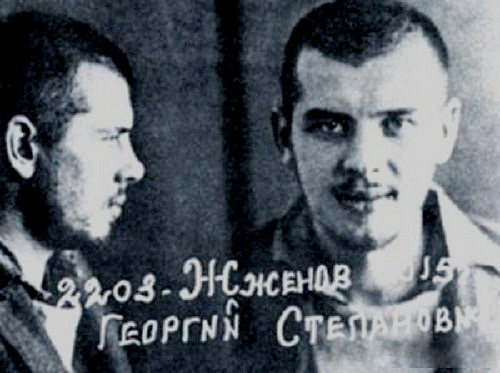
Georgy Zhzhyonov, in an overcrowded cell with 17 other people, had to stay for some time near the latrine. Incidentally, as soon as he was brought to "Kresty", the prison administration ordered his red sports pants to be taken away. "Apparently, they feared that during the anniversary of the Great October Revolution I might wave them through the muzzled barred window of the cell," recalled People's Artist of the USSR Georgy Zhzhyonov.
During the "Great Terror," Lev Gumilev — son of poet Anna Akhmatova — was also imprisoned in "Kresty". Her husband, Nikolay Gumilev, was imprisoned in the main prison of Petrograd in 1921. Akhmatova dedicated the poem "Requiem" to the terrible events connected with "Kresty" that affected her family, in which she bequeathed to erect a monument to her in the prison.
In the pre-war years, several special-purpose prisons were incorporated into the "Kresty" structure, whose inmates were scientists and military specialists. The most famous prisoner of one such prison was aircraft designer Andrey Tupolev. Interestingly, years later Tupolev, like Georgy Zhzhyonov, donated a significant amount of money for the improvement of "Kresty": thanks to them, the prison got sewage and water supply.
At the start of the war, about 400 "Kresty" staff went to the front — their places were taken by women and elderly, and all prisoners were placed in one building. On the Neva embankment, a wooden-earth firing point (DZOT) was built, which was used to defend the prison. During the terrible years of the Siege of Leningrad, many guards and prisoners died from hunger, cold, and bombings. For example, on November 7, 1941, a bomb hit the Northern Gate of the prison, killing two guards. But there was no one to bury them — the bodies of those who died on the territory of "Kresty" were stored in a utility room converted into a morgue.
The famous writer Daniil Kharms, who ended up in prison due to a false denunciation, did not survive the blockade either. In winter 1942, he died in the prison psychiatric ward, where he was placed after feigning madness in an attempt to avoid execution. The first post-war year in "Kresty" was marked by another — and quite unusual — escape attempt. A prisoner named Volkov spent many months removing bricks from the prison wall one by one and sinking them in the latrine, which was emptied daily.
Thus, Volkov made a decent hole in the "Kresty" wall, got out, and decided to start his life of freedom by visiting a bathhouse. But the prisoner managed to run into guards who came to steam on their day off and returned to the prison cell. In 1958, a school for inmates was opened on the territory of "Kresty" and a cardboard factory was launched — it quickly began to bring good income and provided work for prisoners. In 1964, the prison officially received the status of Leningrad Detention Center No. 1. In February of the same year, poet Joseph Brodsky, accused of parasitism, was imprisoned there. He spent about a year in cell No. 104, suffered a heart attack, and was then exiled to the Arkhangelsk region. In 1984, another escape attempt was made in "Kresty" — the inmates who prepared it showed remarkable ingenuity.
Two prisoners made fake IDs of senior investigators of the Main Directorate of Internal Affairs from cardboard and red threads. For photographs, they used printed images of employees cut out from magazines. The seals were taken from copies of sentences. In addition, the prisoners managed to sew white coats from sheets, under the guise of prison medics, and reached the checkpoint. Showing the guards the fake IDs, the escapees left the detention center and hid from the police for two days. After the prisoners were caught and returned to their cells, a special pass system was introduced in "Kresty". Now everyone entering had to surrender their documents and receive special tokens in return. Upon exit, these tokens were exchanged back for the documents. Meanwhile, in the turbulent 1990s, the single cells of "Kresty" were converted into six-person cells — the entire criminal elite of Petersburg passed through them. At times, the number of inmates reached 12,000 people.
From the memoirs of former "Kresty" chief Alexey Chergin: "Think about it: 12,000 — that's almost a city! I still don't know how we managed back then. No electricity, no food (we had to supply all the bakeries in Petersburg), no clothes. Prisoners wouldn't open the cell door when a new inmate was brought in — it was barely possible to shove him inside. It's scary to think: how did they survive back then?"
However, prisoners in "Kresty", despite such difficult conditions, resorted to many tricks to make life easier. For example, they made makeshift blowguns from newspapers, into which they "loaded" notes wrapped around bread balls. Prisoners with the strongest lungs could shoot these "bullets" up to 50 meters.
As a result, the notes ended up on Arsenal Embankment, where they were picked up either by addressees or couriers who delivered messages for a fee. Inside "Kresty", there was its own logistics: parcels were passed using sheets tied and thrown from cell to cell — this method was called "the horse" in prison slang.
Upon release, some former prisoners tattooed themselves with images of a ring with a cross and a crown — such tattoos were considered very honorable in the criminal world. However, some inmates sought to speed up their release: in the early 1990s, hardened criminal Sergey Maduev attempted to escape from "Kresty".

In criminal circles, Maduev was called Chervonets, and investigators dubbed him the last bandit of the USSR. The escape attempt he made was arguably the most scandalous in "Kresty" history. The cunning and charming Chervonets, who had killed ten people by that time, managed to win the affection of investigator Natalia Vorontsova. Former deputy chief of "Kresty" Yevgeny Bozhadze recalls: "Chervonets, that son of a bitch, insisted that Vorontsova be his investigator. Sometimes he would be taken out for interrogation and remain silent. Then he'd say: 'I'll tell her everything.' Vorontsova would cry, hysterical. Then she'd say: 'Oh, don't punish him, it's all my fault.' Apparently, he was already psychologically influencing her." Eventually, seizing the moment, the woman stole a Nagant revolver from her colleague investigator Leonid Proshkin's safe, smuggled it into "Kresty", and secretly handed it to her lover. The bandit used the weapon on May 3, 1991, during transfer to Moscow.
At the exit from "Kresty", Chervonets pulled out the revolver from under his coat and wounded Major Yermolov, who was escorting him. But the second guard managed to press the alarm button: the prisoner barely managed to dodge the hail of bullets from the prison guards and decided to surrender.
Memories of former investigator Leonid Proshkin: "In three days I turned gray. My heart got bad because the weapon from my safe ended up in 'Kresty'. One of the most serious detention centers in the country. And there the bandit started shooting from it."
For aiding Chervonets, former investigator Vorontsova received seven years in prison. Her lover tried to escape again: this time, a "Kresty" employee handed him a weapon, later claiming that the prisoner had allegedly hypnotized him. But this escape attempt also failed, and Chervonets was sentenced to death. Incidentally, "Kresty" was a so-called execution prison — in one of its buildings, prisoners sentenced to the highest penalty were executed.
Death sentences were carried out in this building. The executioner was a classified employee. Only the chief knew who he was. In the evening, the condemned was visited by an officer, the prosecutor of the Kalininsky district, a doctor, and two assistants. Handcuffs were put on, and the mouth could be tied. According to staff, only one out of a hundred could scream. Everyone knew what awaited them. But Chervonets ultimately avoided execution: his death sentence was commuted to life imprisonment, and in 2000 the 44-year-old prisoner died in the "Black Dolphin" colony. His story with investigator Vorontsova became the basis for the film script "Prison Romance".
A year after the story with Chervonets and Vorontsova, "Kresty" was shaken again by an escape attempt — but this time much larger and bloodier. It was led by hardened recidivist Yuri Perepelkin, who persuaded six of his cellmates to escape through a watchtower, from where they could climb onto the roof.
All conspirators were in building No. 9: originally the building was a dormitory for prison staff, then a place for female prisoners, and in the early 1990s it was converted into cells for patients with open tuberculosis. The escape day chosen by the inmates led by Perepelkin was February 23, 1992.
At first, everything went according to plan: they easily took the keys from their escort and locked him in the exercise yard cell. But the attempt to get to the watchtower failed — the duty officer noticed the prisoners, locked the door from inside, and pressed the alarm button.
The inmates then rushed back to building No. 9, where they took hostage instructor Valentina Avakumova and cynologist Alexander Yaremsky. Barricading themselves in one of the rooms, the prisoners demanded weapons and bulletproof vests, transfer to the airport, and then a flight to Sweden. The detention center chief Stepan Demchuk entered negotiations with them.
Former "Kresty" chief Stepan Demchuk recalls: "I offered them to disperse peacefully, promised that there would be no criminal prosecution, only disciplinary punishment." But the rebels refused to surrender peacefully: even the intervention of two influential criminal authorities from "Kresty" did not help. It ended with an assault, during which Perepelkin stabbed hostage Yaremsky, and three of his accomplices were killed. The remaining three surviving conspirators received from 6 to 15 years in prison.
As for their leader Perepelkin, he was sent to the Mordovian colony "Yedinichka" to serve a life sentence. Building No. 9, where the tragic events occurred, was closed some time later.
The further fate of the old "Kresty" was unclear until recently: cats and pigeons continued to live there, fed by inmates. "The pigeons come and sit under the windows, but there is no one to feed them," the guards sadly noted.
In 2016, Igor Potapenko, head of the Federal Penitentiary Service of Russia for Saint Petersburg and the Leningrad Region, announced that a museum would be established on the site of the legendary prison.
"Kresty" is a historical monument. The building will be given over to a museum, a filming location (the cells will be preserved in their original form). Part of the premises will be occupied by the Federal Penitentiary Service apparatus, there will be a citizen reception office, and much more."

Sources:
https://tass.ru/spec/kresty
https://www.mk.ru/social/2016/10/06/mistika-i-uzhasy-piterskikh-krestov-chto-tait-legendarnaya-tyurma.html
https://nvdaily.ru/info/157263.html

Follow us on social media

More stories from Petersburg: Stories, Legends, and Myths

The History of the Name of Vasilievsky Island

Unnamed Road, Saint Petersburg, Russia, 199178

Vasilyev Island had three names at once — Russian, Finno-Ugric, and Swedish. The Russian name remained the same: Vasilyev Island (in the Swedish cadastre book — Wassilie Ostroff); the Finnish name Hirvisaari — Moose Island (in the Swedish cadastre book — Hirfwisari); the Swedish name Dammarholm, meaning Pond Island, because fish traps were located there.

The Tear of Socialism. The House of Forgotten Writers

Rubinstein St., 7, Saint Petersburg, Russia, 191025

A symbol of an era that never happened and a new way of life that even those who promoted it did not want to live in. A house of joy that became the tear of its time.

The Church of the Savior on Spilled Blood — Legends and Myths

Griboedov Canal Embankment, 2B, Saint Petersburg, Russia, 191186

The Church of the Savior on Spilled Blood — an Orthodox church, whose full name is the Cathedral of the Resurrection of Christ, is located in the historic center of Saint Petersburg, on the embankment of the Griboedov Canal. It is a memorial to Tsar-Martyr Alexander II, who died at this site at the hands of terrorists.

Legends of the Mikhailovsky Castle

Sadovaya St., 2, Saint Petersburg, Russia, 191023

There is no place in Saint Petersburg more mysterious and mystical than the Mikhailovsky Castle. Everything is unusual—the very appearance of the fortress-like building, the color of its facade, and, of course, the tragic history of its owner, the Russian Emperor Paul I, who shared the fate of his father Peter III, dying as a result of a palace coup in his bedroom within the walls of his castle.

The House of the Queen of Spades

Malaya Morskaya St., 10-4, Saint Petersburg, Russia, 191186

In every corner stood porcelain shepherdesses, a dining clock made by the renowned Leroy, little boxes, tape measures, fans, and various ladies' toys invented at the end of the past century along with the Montgolfier balloon and Mesmer's magnetism. Hermann went behind the screens. Behind them stood a small iron bed; to the right was a door leading to the study; to the left, another — to the corridor. Hermann opened it and saw a narrow, winding staircase that led to the room of the poor ward... A. Pushkin. The Queen of Spades

Legends and Monuments of Malaya Sadovaya

Malaya Sadovaya St., 8, Saint Petersburg, Russia, 191023

Formerly Shuvalovsky, then Novy Lane, later Ekaterininskaya Street. On a very short stretch (less than two hundred meters), this is one of the shortest streets in the city, its length is only 179 meters, yet it holds so many stories, interesting sculptures, and monuments that it would be enough for an avenue.

Chizhik Pyzhik

Fontanka River Embankment, 2, Saint Petersburg, Russia, 191187

The smallest monument in Petersburg

Singer House or House of Books

Nevsky Ave., 28, Saint Petersburg, Russia, 191186

Not only today's entrepreneurs strive to immortalize their ambitions in the height of their office buildings. And the passions regarding the appearance and height regulations were intense.

Mysterious Obelisk near Kazan Cathedral

Kazan Square, 2, Saint Petersburg, 191186

How the Budget Financing Problems of the Early 19th Century Influenced the Development of Alternative History.

Lions from the Bronze Horseman

Admiralteysky Ave, 12, Saint Petersburg, Russia, 190000

Where above the elevated porch, With a raised paw, as if alive, Stand two guardian lions,

Secrets of the Alexander Column

Palace Square, 6, Saint Petersburg, Russia, 191186

The Alexander Column, which stands in the middle of Palace Square, was erected to commemorate the victory over the French in 1812.

Russian Tristan and Isolde – punishment for the "vile abomination"

Nevsky Ave., 16, Saint Petersburg, Russia, 191186

The story began on a May day in 1851, when a carriage pulled up to the "English Shop." Lavinia, who had flown out of the store, disappeared into it, and the horses galloped at full speed along Nevsky.

A Jew of Peter the Great or the First Bathhouse Scandal of Russia

Nevsky Ave., 39A, Saint Petersburg, Russia, 191023

The first "bathhouse scandal" in Russian history occurred in 1727, and its protagonist was Anton Devier, the General Police Master of Saint Petersburg, the first and highest-ranking official in law enforcement. The fact that he was also Jewish makes the situation even more intriguing.

Anichkov Palace is the oldest surviving building on Nevsky Prospect.

Nevsky Ave., 39, Saint Petersburg, Russia, 191023

The name of the palace and the nearby bridge comes from the **Anichkov Palace** and the **Anichkov Bridge** in Saint Petersburg, Russia. Both are named after Mikhail Anichkov, an engineer who supervised the construction of the first wooden bridge at this location in the early 18th century. The palace later took its name from the bridge and the area.

Burned alive

Nevsky Ave., 15, Saint Petersburg, Russia, 191186

About the Famous Case of Voznitsyn and Leibov in the 18th Century

The Empress's Doctor, the First Russian Jewish Academician

Dvortsovaya Square, 2, Saint Petersburg, Russia, 190000

About paired Russian banyas, since they contribute to the strengthening, preservation, and restoration of health

The Best Diplomat of Peter the Great

Bolshaya Morskaya St., 20, Saint Petersburg, Russia, 191186

For where do I need you! The career of Petr Pavlovich Shafirov seems utterly incredible. A baptized Jew finds his way to the court of Peter I, becomes a diplomat, heads the postal service, mining and metallurgy, oversees foreign trade, saves the tsar and tsarina from Turkish captivity, becomes one of the richest and most powerful people in the empire, and then, one fine day, loses everything.

Samoyed King

Dvortsovaya Embankment, 2E, Saint Petersburg, Leningrad Region, Russia, 191186

He helped Peter I shave the beards of the boyars, became a king, and was exiled.

Half-lions-half-dogs-half-frogs — on Petrovskaya Embankment

Petrovskaya Embankment, 6, Saint Petersburg, Russia, 197046

Lions Shi-Zi – granite mythological lions brought from China, they decorate the ceremonial descent to the Neva opposite Peter the Great's cabin.

Cathedral Mosque

Kronverksky Ave, 7, Saint Petersburg, Russia, 197046

Already in the early years of the existence of Saint Petersburg, a Tatar settlement appeared near the Peter and Paul Fortress. In 1798, more than five hundred Muslim servicemen submitted a petition requesting the granting of a prayer house and the allocation of land for a cemetery.

Where and how was Barmaley born?

Barmaleeva St., 5, Saint Petersburg, Russia, 197136

We will take Barmaley with us, We will carry him off to distant Leningrad! Korney Chukovsky. Barmaley

Sea prison or where they trapped in a bottle

Admiralteysky Canal Embankment, 2t, Saint Petersburg, Russia, 190121

The building of the maritime prison was called "the bottle," and according to one version, the colloquial expression "Don't get into the bottle" originated from this.

Doctor Pel's Pharmacy

7th Line V.O., 16-18, Saint Petersburg, Russia, 199034

Doctor Pel's Pharmacy is located in the historic center of Vasilievsky Island. The pharmacy building is over 300 years old. Since 1710, it has housed an operating pharmacy to this day. Not only in this building but throughout the island, there was a pharmacist quarter where, at one time, anyone interested engaged in alchemy. Originally, the building housed a pharmacy shop that frequently changed owners until it came into Pel's possession.

Moisey Nappelbaum – artist or photographer?

Nevsky Ave., 72, Saint Petersburg, Russia, 191025

Nappelbaum considered Rembrandt his spiritual inspiration, who, according to him, more than any other artist, brilliantly worked with light and shadow. “Our life is continuously enriched, renewed, and moves forward. And photographic art must develop, spiritually mature, otherwise it will wither, take on a frozen form, and lose everything that was so arduously gained. To prevent this from happening, it is necessary to learn not only the technique of photography, the laws of visual art, composition, and lighting – one must study life, people, human faces, characters in their movement. It is necessary to learn to creatively comprehend the subject.” M. S. Nappelbaum from the book *From Craft to Art*.

The Death of the Poet – Yesenin

Malaya Morskaya St., 24, Saint Petersburg, Russia, 190000

On December 28, 1925, at 10:30 AM in room number five of the "International" hotel (formerly "Angleterre," now the hotel has returned to its historical name), a man was found hanging from a central heating pipe. According to the presented documents, the man who hanged himself was Sergey Alexandrovich Yesenin, a writer... (from the "Incident Scene Inspection Report"). This is how the 30-year-old Russian poet ended his life.

Karl Skavronsky - servant, accidental Russian, and relative of the imperial family

Millionnaya St., 7, Saint Petersburg, Russia, 191186

The origin of Catherine I is unclear. Her relatives are named Skovorotsky in some documents, Skovorodsky in others, Skovoronsky, and even Ikavronsky. According to Relbig, the surname "Skavronsky" was adopted at the suggestion of Count Peter Sapieha.

Amazing Architect Rossi Street

2 Zodchego Rossi Street, Saint Petersburg, Russia, 191023

Its uniqueness lies in the fact that the development is carried out in exact accordance with ancient canons — the height of the buildings equals the width of the street and is 22 meters, while its length is exactly ten times greater — 220 meters.

Willem Mons: How Peter I Executed His Wife’s Lover

X83G+65 Petrogradsky District, Saint Petersburg, Russia

Despite the fact that Peter I changed many historically established traditions in Russia, in some circumstances he displayed seemingly senseless cruelty, more characteristic of medieval monarchs than an enlightened emperor. In particular, this refers to the execution of William Mons.

The Ghost of the Academy of Arts

Universitetskaya Embankment, 17, Saint Petersburg, Russia, 199034

The circumstances of the death of the first director and architect of the building of the Imperial Academy of Arts gave rise to one of the many Petersburg legends, known as the "Ghost of the Academy of Arts." It is said that the soul of the suicide, having found no rest in the Higher World, is doomed to wander forever within the walls he once created.

Were the lands of Petersburg "desolate and empty"?

WCV4+84 Krasnogvardeysky District, Saint Petersburg, Russia

The very foundation of Petersburg is surrounded by mysticism and legends. The most important one, perhaps, tells that the land on which the future capital of the Russian Empire arose was, to use biblical language, "formless and empty." But this is not true.

Kunstkamera - History and Legends

Universitetskaya Embankment, 3, Saint Petersburg, Russia, 199034

When Peter I set out on the Great Embassy to establish military-political and cultural-economic relations, he visited private collections and museums that were completely absent in Russia at that time. During his travels, he purchased entire collections and individual items: books, instruments, tools, weapons, natural rarities. When Peter I returned to Russia, he began to arrange his own "cabinet of curiosities" and the first museum in Russia – the Kunstkamera.

Aircraft carrier on the Neva

Angliyskaya Embankment, 76, Saint Petersburg, Russia, 199034

Few people know that in October 1955, the British aircraft carrier HMS Triumph arrived in Leningrad on a friendly visit. Many Leningrad residents gladly came to the Lieutenant Schmidt Embankment, where it was moored, and took photographs of it.

Yelagin Palace

1st Elagin Bridge, 1, Saint Petersburg, Russia, 197183

What brush, what chisel, Will depict the Yelagin Palace… Attributed to A.S. Pushkin

The Fateful Café in the History of Pushkin, Dostoevsky, and Tchaikovsky

Nevsky Ave., 18, Saint Petersburg, Russia, 191186

Fyodor Mikhailovich Dostoevsky loved to spend time here, and it was here that a fateful meeting in his life took place — a meeting with Mikhail Vasilyevich Butashevich-Petrashevsky. This happened in April-May 1846.

Osinovetsky Redoubt, Osinovaya Roshcha Fortress

Golitsynskaya St., 1x, Saint Petersburg, Russia, 194362

Osinovetsky Redoubt, Osinovaya Roshcha Fortress, 18th century — an earthen fortress (sternschanze — a fortification in the shape of a pentagonal star), a characteristic example of late 18th-century earthworks, built on the southern side of the fork in the roads to Yukki and Kexholm (Priozersk). It is located in the historic Osinovaya Roshcha district in the north of Saint Petersburg. It had stone entrance gates and ranger barracks.

The Summer Garden Grille is one of the wonders of the world.

1 Summer Garden St., Saint Petersburg, Leningrad Region, Russia, 191186

The poet K. N. Batyushkov wrote: "Look at the fence of the Summer Garden, which is reflected by the greenery of tall lindens, elms, and oaks! What lightness and what elegance in its design. In 1824, the scholar D. I. Sokolov noted that 'the embankments of Petersburg and the fence of the Summer Garden can be counted among the wonders of the world!'"

Church of the Holy Trinity (Trinity Church)

108 Lenin Ave, Saint Petersburg, Russia, 198320

The Church of the Holy Trinity (Trinity Church) is an Orthodox church in Krasnoye Selo, a monument of "Anna Baroque" architecture. It was the main church of the summer military capital of the Russian Empire. Here prayed the reigning members of the House of Romanov: from Empress Catherine I to Emperor Nicholas II.

The Courtyard of Spirits on Vasilievsky Island

4th Line V.O., 5, Saint Petersburg, Russia, 199034

A tiny courtyard-well on Vasilievsky Island can help fulfill the most cherished wishes, but it opens only to the chosen ones. To get into the miniature courtyard, which resembles the shape of a well, you need to visit Vasilievsky Island. It is worth noting: this place is not ordinary. It is shrouded in so many myths that some tourists are even afraid to look inside.

The House of the Emir of Bukhara

Kamennoostrovsky Ave., 44B, Saint Petersburg, Russia, 197101

A revenue house in Saint Petersburg, built in 1913–1914 by order of the Emir of Bukhara, Said Abdulahad Khan, for his son Said Alim Khan. The emir invited architect Stepan Krichinsky to design it, who had previously participated in the construction of the Cathedral Mosque. For the house project, the emir awarded the architect the Order of Noble Bukhara.

Hotel "Angleterre" (from the French Angleterre – England)

Malaya Morskaya St., 24, Saint Petersburg, Russia, 190000

The history of the "Angleterre" spans more than a century and a half. Located in the very heart of Saint Petersburg, the hotel has been and remains a witness and participant in the historical events not only of the city but also of the country.

An Unusual Lantern Museum in Saint Petersburg

Odessa St., 1, Saint Petersburg, Russia, 191124

There is a very small museum that tells about an important historical event in the Northern capital — the transition of street lighting from oil lamps to electric lamps. This museum is located on the short Odesskaya Street (not far from Smolny) and consists of only seven exhibits.

The market at Udelnaya is the most famous flea market in Russia.

Fermskoye Highway, Building 41, Block 8, Saint Petersburg, Russia, 197341

The Udelny Market (or simply "Udelka") is one of the unique spots in St. Petersburg. It is simultaneously a second-hand store, a flea market, and a bazaar where, like in Greece, you can find everything or almost everything.

Prostitution in Russia: "On the sending of guilty women and girls, who will not be subject to the death penalty, to the spinning workshop"

Fontanka River Embankment, 166, Saint Petersburg, Russia, 190020

KALINKINSKAYA HOSPITAL IN SAINT PETERSBURG: Where the Black River and the Fontanka entwined And at the mouth flowed into the mouth of the Neva River, At the mouths of these rivers, in that very place, Where the Kalinov forest once grew, stood a huge house; It was named after that forest and called a house, And specifically, this house was called Kalinkin; Into it were sent all the dissolute wives For their lustfulness...

"Drezdensha" or the First Brothel

Krasnogradsky Lane, Saint Petersburg, Russia, 190068

Decree of Elizabeth Petrovna: "Since, according to the investigations and testimonies of the caught pimps and prostitutes, some of the immoral women they reveal are hiding, and, as is known, around St. Petersburg on various islands and places, and some have retreated to Kronstadt, therefore Her Imperial Majesty has decreed: those hiding immoral women and girls, both foreigners and Russians, are to be searched for, caught, and brought to the main police station, and from there sent with a note to the Kalinin House."

“Chubarov Case”: The Loudest Criminal Trial in the History of Leningrad

San-Galli Garden, Ligovsky Ave., 64, Saint Petersburg, Russia, 191040

The indictment in the "Chubarov Lane case" presents the following picture of the crime. At 3:40 AM, Lyubov B. came to the police station and reported that around 11 PM, she was raped by about 30 hooligans in the San-Gali garden. B. was walking to visit her acquaintances in the evening. Near Chubarov Lane, she was grabbed by the arms by three unknown men and taken into the garden, where they began to rape her. Throughout the time, new groups kept coming into the garden and continued to rape her. The investigation revealed that the initiators of the crime were Kochergin P., Mikhailov P., and Osipov M. A total of 21 people are accused.

All gopniks are originally from Saint Petersburg.

Ligovsky Ave., 10, Saint Petersburg, Russia, 191036

The slang word "gopnik" does not originate from the gangster-filled 90s, as one might be tempted to assume. In Dahl's dictionary, for example, the word "gop" means a jump or a strike; in Ozhegov's dictionary, there is an example with the phrase "gop-company"; and in the large explanatory dictionary of the Russian language, "gopnik" is simply a person from the lower social strata or just a bum. So what does the word "gopnik" really mean, and where did it come from?

Elephants in Petersburg or How Indian Elephants Improved Russian Roads

Ligovsky Ave., 10/118, Saint Petersburg, Russia, 191036

For centuries, elephants remained a living embodiment of power and strength, which is why many rulers wanted to possess these visible symbols of might. Russian autocrats were no exception, having learned from personal experience that owning an elephant is not only very troublesome but sometimes quite profitable. For example, for the improvement of domestic transportation routes.

Pavilion with restrooms in Alexandrovsky Park

Gorkovskaya, Saint Petersburg, Russia, 197101

At the end of the 19th and the beginning of the 20th centuries, on Kronverksky Prospekt, near the Nikolaevsky Bridge (as the Lieutenant Schmidt Bridge was called until 1918) and the Tuchkov Bridges, three identical toilets were built by order of the wealthy merchant Alexandrov, who owned the market on Kronverkskaya Street. They were designed by architect A. I. Zazersky and resembled small mansions with towers, spires, and patterned brickwork—like miniature fairy-tale castles.

Smolny Cathedral (Resurrection Cathedral of All Educational Institutions, Smolny Cathedral, Cathedral of the Resurrection of the Word of All Educational Institutions, Resurrection of Christ Smolny Cathedral)

4 Kvarengi Lane, Saint Petersburg, Russia, 191060

Smolny Cathedral (Resurrection Cathedral of All Educational Institutions of Smolny, Cathedral of the Resurrection of the Word of All Educational Institutions, Resurrection of Christ Smolny Cathedral) is an Orthodox church in the Central District of Saint Petersburg. It is part of the architectural ensemble of the Smolny Monastery. Historically, the Resurrection Smolny Cathedral has been the church of educational institutions of Saint Petersburg, a church for students; therefore, the main focus of the clergy and laity of the church is the spiritual and moral education of youth. From 1990 to 2015, it served as a concert venue for classical music.

Stories of Sennaya Square – a place with a tragic and criminal past

Spasskaya, Saint Petersburg, Russia

Sennaya Square is a square in the center of Saint Petersburg, located at the intersection of Moskovsky Prospekt and Sadovaya Street. Since August 20, 1739, it was called Bolshaya Square. In the 18th century, the extensive territory of the square (stretching to the Fontanka River) was divided into separate sections, named after the goods sold there: Konnaya Square — near Grivtsov Lane; Sennaya Square — near Obukhovsky Bridge; Sennaya and Drovyanaya Square. Starting from 1764, the name Sennaya Square spread to the entire square. On December 15, 1952, the square was renamed Peace Square, and on July 1, 1992, its former name was restored.

Stories of Sennaya Square - Vyazemskaya Lavra

W8F9+X7 Admiralteysky District, Saint Petersburg, Russia

"Vyazemskaya Lavra" or "the belly of Petersburg" — a slum quarter near Sennaya Square, existing from the late 18th century until the 1920s. The very name Vyazemskaya Lavra is a sarcastic toponym, since "lavra" means a male monastery of the highest rank, while in Vyazemskaya Lavra completely unmonastic rules prevailed. It was named Vyazemskaya after the Vyazemsky family, on whose land the lavra arose. It gained a notorious reputation as a refuge for robbers and inhabitants of the social bottom and lasted until the 1920s. As of 2023, the territory of the former lavra is partially occupied by the shopping center "Sennoy Market."

Stories of Sennaya Square – "Malinnik in Petersburg," or where the criminal slang word "malina" originated.

Sennaya Square, 5, Saint Petersburg, Russia, 190031

Malinnik was a building that existed in the 19th and early 20th centuries in Saint Petersburg, housing a tavern and brothels. It was located at building No. 5 (modern address; the postal address in the 19th century was Sennaya Square, building No. 3). City authorities made several attempts to close the establishment, but after mass raids, the venues in the building would reopen and continue operating. The brothels were eliminated after the October Revolution. The building survived during the Soviet era and was later significantly rebuilt and extended by two floors, becoming part of a residential complex in the Stalinist neoclassical style.

Stories of Sennaya Square: The Cholera Riot in Petersburg

Brinko Lane, 4, Saint Petersburg, Russia, 190068

Unrest among townspeople during the cholera epidemic of 1830–1831. Causes — dissatisfaction with the government-imposed travel bans (quarantines and armed cordons) and rumors that doctors and officials were deliberately poisoning the common people, that the police were burying people alive. Succumbing to panic, "agitated crowds smashed police stations and state hospitals, killed officials, officers, and noble landlords."

The story of how trams used to pass through the house

Ligovsky Ave., 50, Saint Petersburg, Russia, 191036

A well-known building through which a tram used to pass. If you didn't know, you would never guess.

KV-85 - the last tank of this series

pr. Stachek, 108A, Saint Petersburg, Russia, 198207

On a granite pedestal stands a KV-85 tank, produced by the Chelyabinsk Kirov Plant during the Great Patriotic War. Behind it is a preserved pillbox with the inscription 1941–1945. This is one of two known surviving examples of this model. Another tank, representing a KV-1s with an 85mm gun in a standard turret, is located in Kubinka.

The Morozov Treasure in the Leningrad Gostiny Dvor

Nevsky Ave., 35, Saint Petersburg, Russia, 191023

On October 26, 1965, an amazing event took place in Leningrad... On that day, in room No. 87 at the corner of Sadovaya and Lomonosovskaya lines of the Gostiny Dvor, builders from the 33rd Directorate of the Repair Trust of Glavleningradstroy were working: Nadezhda Biryukova and Sofya Komova. They dismantled a transverse wall that separated two rooms and began leveling the floor, preparing it for concrete pouring. Near a tiled stove, they discovered 8 non-standard, unusually heavy bricks. One of the workers had the idea to clean the heavy brick from dirt, and it turned out that under the bricks were hidden 8 gold bars, each weighing 16 kg. The total weight amounted to 128 kg. The workers received the due material reward from the state.

The house where the history of the Romanov dynasty ended

12 Millionnaya St., Saint Petersburg, Russia, 191186

The apartment in house No. 12 on Millionnaya Street belonged to Prince Pavel Pavlovich Putyatin. On March 3, 1917, a meeting took place there that influenced the fate of the monarchy in Russia. Grand Duke Mikhail Alexandrovich and a delegation of politicians, including Milyukov, Guchkov, Nabokov (father of the writer V. V. Nabokov), Rodzyanko (chairman of the State Duma), Kerensky, Shulgin, Prince Lvov (the first head of the Provisional Government), and others, held negotiations here. The reason for this meeting was Nicholas II's abdication of the throne in favor of his brother Mikhail.

The Legend of the Bobrinsky Family Treasure or the Treasures of Catherine II

Galernaya St., 60, Saint Petersburg, Russia, 190000

1930. The OGPU receives a strange letter from abroad. Someone named Bobrinsky offers to provide the Soviet government with information about the location of a family treasure. In exchange, he wants to receive half of its value! The tempting letter is immediately put under investigation, especially since it concerns the descendants of Alexei Bobrinsky – the illegitimate son of Catherine II and Grigory Orlov. Surely, caring for the future of her child, the crowned mother provided him with a rich dowry. But where? In the Bobrinsky palace in St. Petersburg, gifted to the founder of the family in 1797? Or in the Bogoroditsk estate near Tula, built specifically for Alexei Bobrinsky? Or maybe, by the time the letter was received, there were no treasures of the empress left at all? After all, unlike his descendants, Alexei Bobrinsky himself was known as a reckless bon vivant and spendthrift.