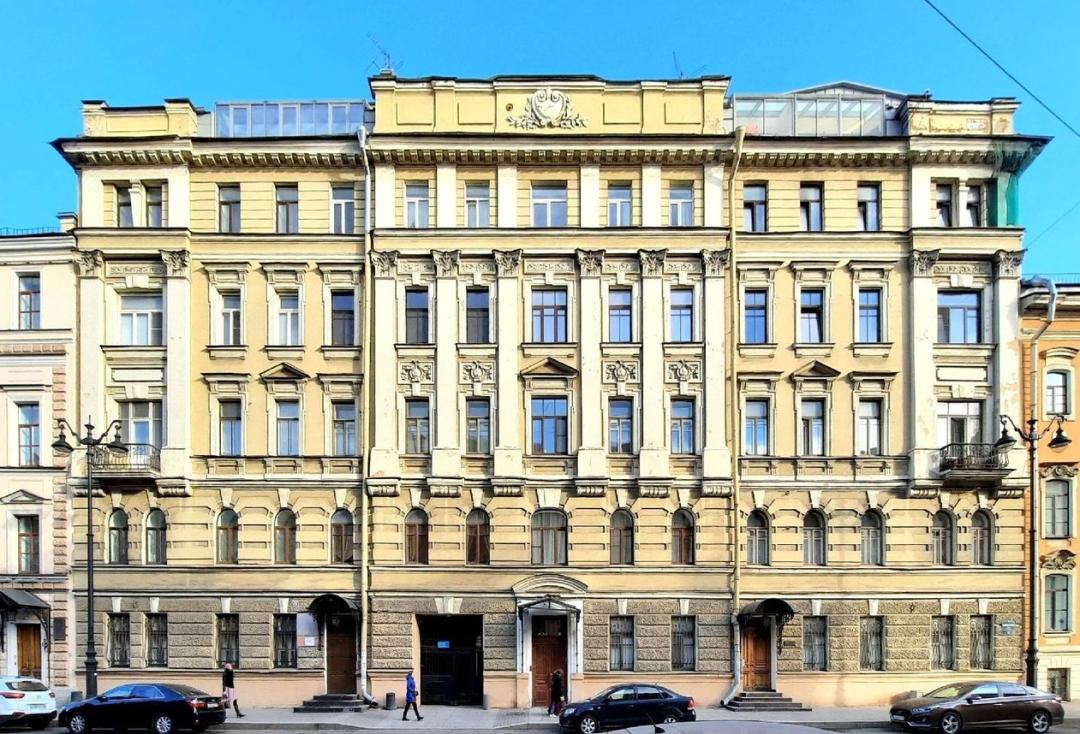
The house where the history of the Romanov dynasty ended

12 Millionnaya St., Saint Petersburg, Russia, 191186

The apartment in house No. 12 on Millionnaya Street belonged to Prince Pavel Pavlovich Putyatin. On March 3, 1917, a meeting took place there that influenced the fate of the monarchy in Russia. Grand Duke Mikhail Alexandrovich and a delegation of politicians, including Milyukov, Guchkov, Nabokov (father of the writer V. V. Nabokov), Rodzyanko (chairman of the State Duma), Kerensky, Shulgin, Prince Lvov (the first head of the Provisional Government), and others, held negotiations here. The reason for this meeting was Nicholas II's abdication of the throne in favor of his brother Mikhail.
This building is located in the city center. Unlike many others, it has no memorial plaque. And few remember that here, in the apartment of the Putyatin princes, on March 3, 1917, the more than 300-year history of imperial Russia came to an end. Textbooks mention this event, which drastically changed the country's life, in just two or three lines: they say that after consulting with members of the Provisional Government, Grand Duke Michael Alexandrovich signed the Manifesto of Abdication. But how exactly did it happen?
At the meeting, besides the Grand Duke, there were seven ministers of the Provisional Government and five deputies of the State Duma led by Rodzianko. Some of them left memoirs, thanks to which we can reconstruct the long-past events. But first—a few words about who was destined at that moment to take responsibility for the country.
It is commonly believed that the last Russian emperor was Nicholas II. But after his abdication, there was another—Michael Romanov. Only he reigned less than a day, from March 2 to 3, 1917. Abdicating the throne in favor of his younger brother, the former autocrat sent him a telegram: “To His Imperial Majesty Michael II. The events of recent days have forced me to irrevocably take this extreme step. Forgive me if I have upset you and for not warning you in time… I fervently pray to God to help you and our Motherland. Nicky” (this text was first published 65 years later in issue 149 of the “New Journal”). Thus, the prophecy came true: the Romanov dynasty began with Michael I and ended with Michael II.
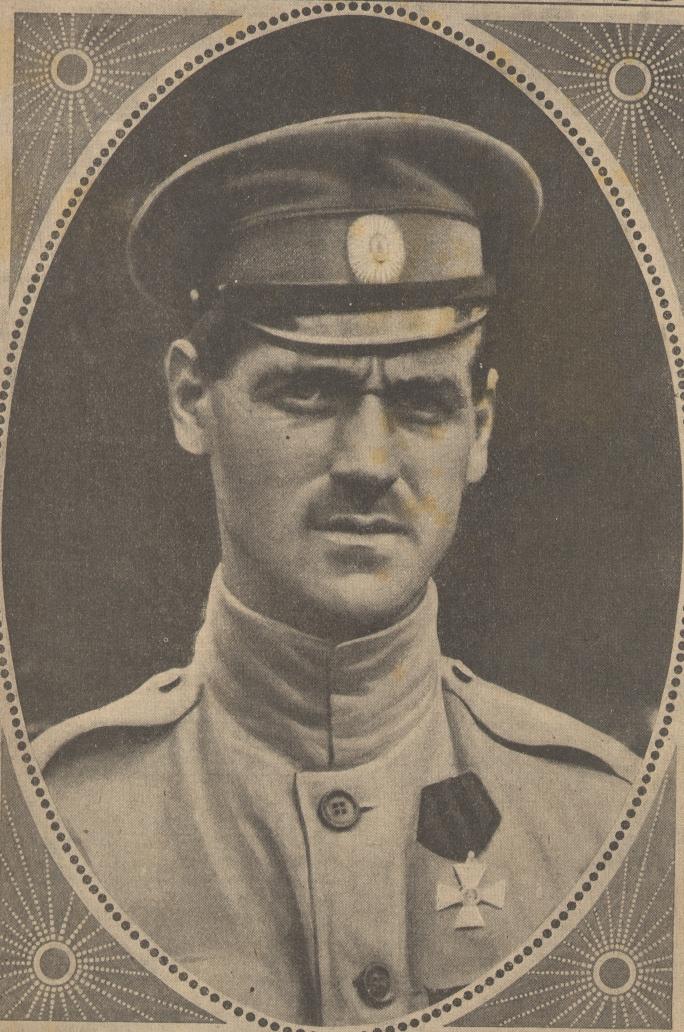
The Grand Duke—the youngest son of Emperor Alexander III and Empress Maria Feodorovna—was born on November 22 (December 5), 1878, in Saint Petersburg. He spent his entire life in the shadow of his elder brother. He was very modest, but that did not prevent him from becoming a brilliant officer and, during World War I, a combat general. It is no coincidence that the horsemen serving under Michael in the Caucasian Native Cavalry Division (the Wild Division) called him “Dzhigit Misha,” “the bravest of the brave.”
Shortly before the monarchy’s collapse, the leaders of the “Progressive Bloc” invited the Grand Duke to one of their meetings and asked: was Michael Alexandrovich ready to succeed the throne? He replied:
— May this cup pass me by… 
And so, the burden of supreme power fell on this man’s shoulders, beyond his will.
Early on March 3, after receiving the telegram about Nicholas II’s abdication, a meeting was held of members of the Provisional Government and the Provisional Committee of the State Duma. Milyukov, Guchkov, and Shulgin spoke in favor of the monarchy, arguing that Michael had no right to refuse the throne. Rodzianko and Kerensky thought otherwise. But Michael had already become emperor, and the news was sent throughout the country. The army was about to swear allegiance to him. Those gathered in the Tauride Palace understood: it was necessary to urgently meet with Michael Alexandrovich.
Learning that members of the Council of Ministers would soon arrive at 12 Millionnaya Street, the Grand Duke was not surprised. Only Michael Alexandrovich believed he would be offered to become regent for his underage nephew. But events rapidly unfolded…
The room was prepared for the meeting. The deputies, mostly in favor of Michael Alexandrovich’s abdication, were anxious: what would happen if he refused? Prime Minister Prince Lvov and seven other ministers would resign. Rodzianko might also be out of a job. And with the emperor would remain the Minister of Foreign Affairs and possibly the Minister of War, Guchkov.
At quarter to ten, a tall, youthful man entered the hall and shook hands with everyone. Fear was evident on the faces of those present, skillfully fueled by Kerensky. Several times he said that armed men could burst in at any moment and kill everyone. Rodzianko and Prince Lvov echoed him. Milyukov urged the Grand Duke not to refuse the throne:
— If you refuse… it will be disaster! Because Russia will lose its axis… The monarch is the axis… The mass, the Russian mass… Around what will it gather?.. If you refuse, there will be horror! Complete uncertainty, because there will be no oath!.. There will be no state! No Russia! There will be nothing…
Kerensky interrupted him:
— …By accepting the throne, you will not save Russia! On the contrary… I know the mood of the masses… Right now, sharp discontent is directed precisely against the monarchy… In the face of an external enemy, civil, internal strife will begin!.. I beg you, for Russia’s sake, to make this sacrifice!..
Silence fell in the living room. Then Guchkov made a final effort. As French diplomat Maurice Paleologue writes, “addressing the Grand Duke personally… he began to prove to him the necessity of immediately presenting the Russian people with a living image of a popular leader:
— If you are afraid, Your Highness, to immediately take upon yourself the burden of the Imperial crown, accept… supreme power as ‘Regent of the Empire until the Throne is occupied,’ or… the title of ‘People’s Protector’… At the same time, you could solemnly pledge to the people to hand over power to the Constituent Assembly as soon as the war ends.
This excellent idea… caused Kerensky to have a fit of rage, a storm of curses and threats.” 
No result was reached. Michael Alexandrovich said he wanted to discuss the situation privately with two of those present before making a decision. He chose Prince Lvov and Rodzianko. The first was the Prime Minister, the second the Chairman of the State Duma. From them, he wanted confirmation that the Provisional Government could preserve the existing order and guarantee the conditions necessary for elections to the Constituent Assembly.
Rodzianko repeatedly asserted that transferring powers to the Constituent Assembly did not exclude the possibility of the dynasty’s return to power. He told the Grand Duke the same: abdication would not have fatal consequences for the crown. For Michael, these words were a convincing argument, and after weighing everything, he said:
— Under the current circumstances, I cannot accept the throne.
Everyone was stunned. Guchkov, as if trying to ease his conscience, shouted:
— Gentlemen, you are leading Russia to ruin; I will not follow you…
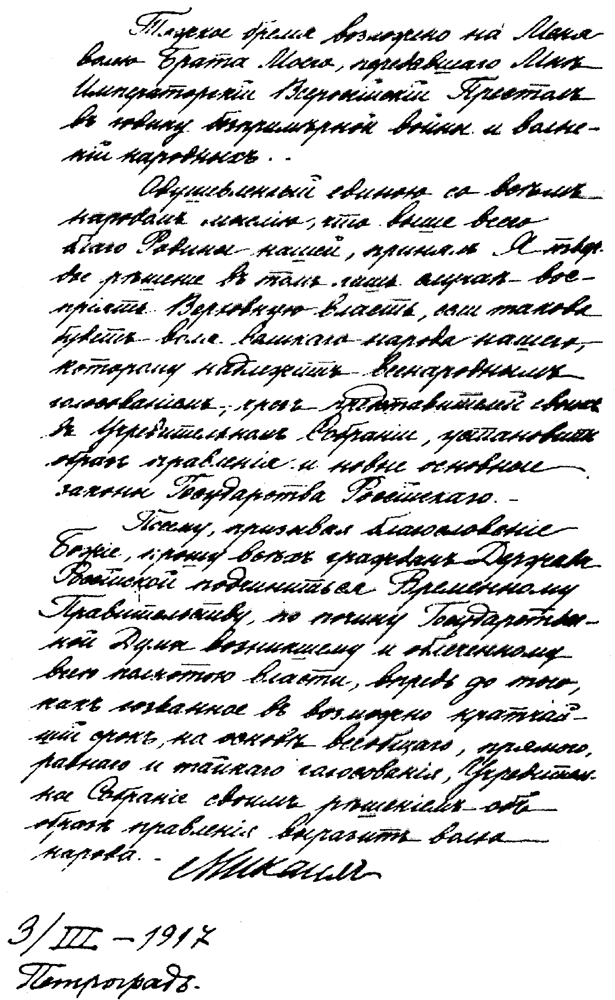
At 12 Millionnaya Street, two well-known lawyers—Baron Nolde and Nabokov—were summoned. They understood that by law, Nicholas II had no right to abdicate the throne on behalf of his son. But he did, and his will had to be fulfilled. After discussing the situation, they decided a political Manifesto was needed. Thus, the document called the Manifesto of Abdication appeared. But interestingly—the word “abdication” does not appear in the text:
“A heavy burden has been laid upon me by the will of my brother, who transferred to me the Imperial All-Russian Throne in a time of unprecedented war and popular unrest.
Inspired by the single thought shared with all the people that above all is the good of our Motherland, I have made a firm decision to accept supreme power only if such is the will of our great people, who must by national vote, through their representatives in the Constituent Assembly, establish the form of government and new fundamental laws of the Russian State.
Therefore, invoking God's blessing, I ask all citizens of the Russian State to obey the Provisional Government, arisen by the initiative of the State Duma and endowed with full authority, until the Constituent Assembly, convened as soon as possible on the basis of universal, direct, equal, and secret voting, expresses the will of the people by its decision on the form of government.
Michael.”
Michael Alexandrovich agreed to accept supreme power only if the Constituent Assembly so decided. At the same time, he empowered the Provisional Government.
From a political point of view, the Manifesto was brilliantly composed: the new emperor recognized the authority of the Provisional Government. Although he said he was not yet emperor, he could become one. Michael conditionally accepted the crown and temporarily refused it. Russia became a republic while remaining a monarchy at the same time.
From a legal standpoint, however, the Manifesto did not hold up. Grand Duke Michael could not transfer supreme power because he did not possess it himself. According to Nicholas II’s abdication, he was supposed to rule “in unity with the State Council and the State Duma.” The “abdication” canceled all three sources of power.
The Manifestos of the two royal brothers were taken to the printing house, and soon posters appeared all over the city: “Nicholas abdicated in favor of Michael. Michael abdicated in favor of the people.”
The goal of the Manifesto signed by Michael was to buy time. Members of the Provisional Government hoped, as did he, that law and order would be restored in the country and conditions created for convening the Constituent Assembly. If that happened, the Manifesto would not be a capitulation of royal power to the uprising crowd but a factor supporting the monarchy until the Constituent Assembly convened. Moreover, the idea of a “chosen” tsar by the people was not new. Michael I, from whom the Romanov dynasty began, was chosen by the Zemsky Sobor in 1613.
Immediately after the Manifesto’s publication, the gunfire in Petrograd ceased. In fact, Michael II stopped the February Revolution and gave the country, exhausted by fighting an external enemy, a respite from internal strife, delaying the start of the Civil War. When the “Red Terror” engulfed Russia, he became simply citizen Romanov—without title, military rank, positions, or financial support.
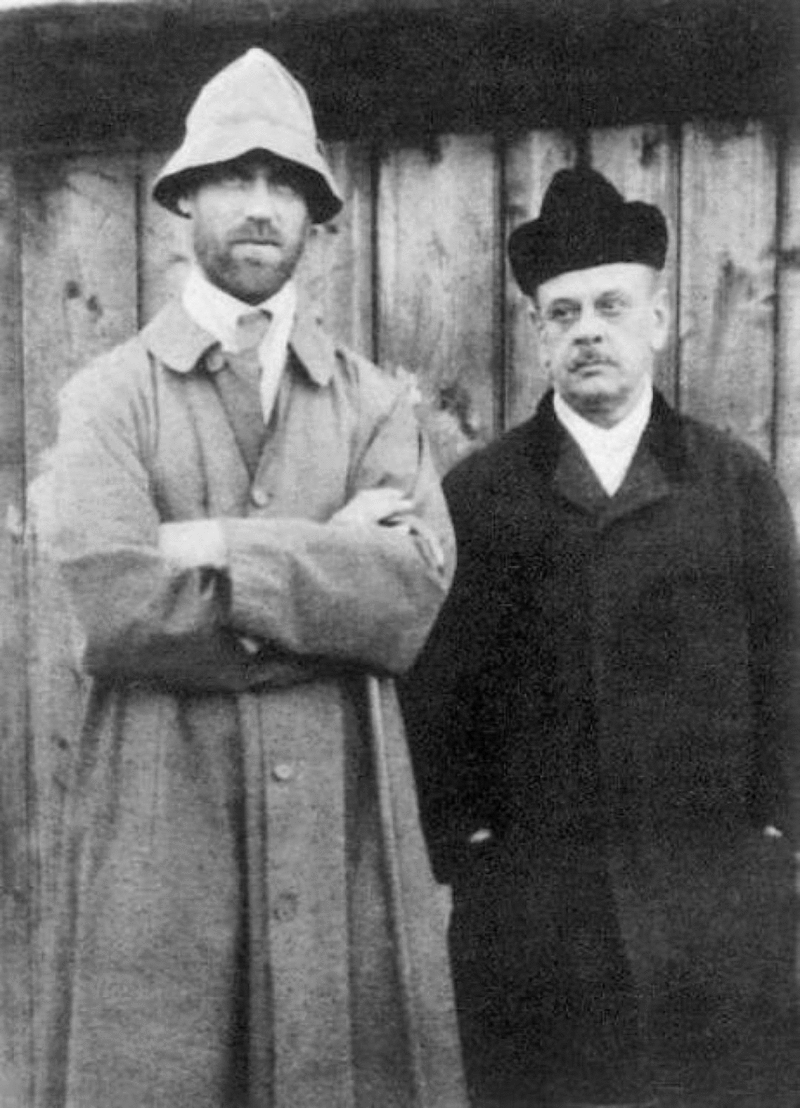
According to the generally accepted version, M. A. Romanov and his secretary were shot on the night of June 12–13, 1918, in a forest near Perm by local Chekists. But this version is based only on the memories of potential killers. They can be questioned. Paragraph 1 of Article 61 of the Civil Procedure Code of the Russian Federation states: circumstances recognized by the court as publicly known do not require proof. However, the fact of M. A. Romanov’s and N. N. Johnson’s deaths was never established by the court.
The press announced their escape. Some researchers believe that such a statement indicates the Bolsheviks’ cunning, who wanted to hide the fact of the murder. We will turn to a document written not for newspaper publication but for “internal,” party use, kept for many years in the State Archive of the Perm Region under “secret” classification. These are the memoirs of Chekist M. F. Potapov: “And Borchaninov tells me: Michael Romanov has been brought here; he must be received and guarded. For this purpose… a large room was allocated, and Michael Romanov and his secretary Johnson were placed here… They sat for three months, and I guarded them… Later it turned out… an order came to release Michael Romanov… under Cheka supervision, and he was placed in the former Royal chambers… After that… I asked to come home on leave… I was let go. And when I returned here, Michael Romanov was not here, he escaped.”
Another document giving hope that Michael Alexandrovich did not die in 1918 is the order of Baron Ungern von Sternberg, commander of the Asian Division, No. 15. It contains the lines: “The Bolsheviks have come… among the people we see disappointment… They need names… well-known, dear, and revered. There is only one such name—the lawful owner of the Russian Land, the IMPERIAL ALL-RUSSIAN EMPEROR MICHAEL ALEXANDROVICH, who saw the people’s turmoil and wisely refrained by the words of his HIGHEST Manifesto from exercising his sovereign rights until the time of the people’s awakening and recovery…”
On August 20, 1921, Baron Ungern was captured by the “Reds” and tried on September 15. He was charged with three accusations, including: he waged armed struggle against Soviet power aiming to restore the monarchy and place Michael Romanov on the throne. Baron Ungern did not deny any of the charges. On the same day, he was executed. The question arises: did he, like Perm Chekist M. F. Potapov, know that Grand Duke Michael Alexandrovich survived in 1918?
It is reliably known: on the night of June 12–13, 1918, Perm Chekists kidnapped M. A. Romanov and his secretary N. N. Johnson. No one saw them again—neither alive nor dead. One hopes that someday we will learn the truth.
In 1981, Grand Duke Michael Alexandrovich was canonized among the New Martyrs of Russia by the Russian Orthodox Church Outside Russia. On June 8, 2009, the Prosecutor General’s Office of the Russian Federation rehabilitated several members of the imperial family, including Grand Duke Michael Alexandrovich and his secretary N. N. Johnson, who had been considered “enemies of the people.”

Sources:
https://adresaspb.com/category/geography/chast-goroda/millionnaya-ulitsa-dom-12/

Follow us on social media

More stories from Petersburg: Stories, Legends, and Myths

The History of the Name of Vasilievsky Island

Unnamed Road, Saint Petersburg, Russia, 199178

Vasilyev Island had three names at once — Russian, Finno-Ugric, and Swedish. The Russian name remained the same: Vasilyev Island (in the Swedish cadastre book — Wassilie Ostroff); the Finnish name Hirvisaari — Moose Island (in the Swedish cadastre book — Hirfwisari); the Swedish name Dammarholm, meaning Pond Island, because fish traps were located there.

The Tear of Socialism. The House of Forgotten Writers

Rubinstein St., 7, Saint Petersburg, Russia, 191025

A symbol of an era that never happened and a new way of life that even those who promoted it did not want to live in. A house of joy that became the tear of its time.

The Church of the Savior on Spilled Blood — Legends and Myths

Griboedov Canal Embankment, 2B, Saint Petersburg, Russia, 191186

The Church of the Savior on Spilled Blood — an Orthodox church, whose full name is the Cathedral of the Resurrection of Christ, is located in the historic center of Saint Petersburg, on the embankment of the Griboedov Canal. It is a memorial to Tsar-Martyr Alexander II, who died at this site at the hands of terrorists.

Legends of the Mikhailovsky Castle

Sadovaya St., 2, Saint Petersburg, Russia, 191023

There is no place in Saint Petersburg more mysterious and mystical than the Mikhailovsky Castle. Everything is unusual—the very appearance of the fortress-like building, the color of its facade, and, of course, the tragic history of its owner, the Russian Emperor Paul I, who shared the fate of his father Peter III, dying as a result of a palace coup in his bedroom within the walls of his castle.

The House of the Queen of Spades

Malaya Morskaya St., 10-4, Saint Petersburg, Russia, 191186

In every corner stood porcelain shepherdesses, a dining clock made by the renowned Leroy, little boxes, tape measures, fans, and various ladies' toys invented at the end of the past century along with the Montgolfier balloon and Mesmer's magnetism. Hermann went behind the screens. Behind them stood a small iron bed; to the right was a door leading to the study; to the left, another — to the corridor. Hermann opened it and saw a narrow, winding staircase that led to the room of the poor ward... A. Pushkin. The Queen of Spades

Legends and Monuments of Malaya Sadovaya

Malaya Sadovaya St., 8, Saint Petersburg, Russia, 191023

Formerly Shuvalovsky, then Novy Lane, later Ekaterininskaya Street. On a very short stretch (less than two hundred meters), this is one of the shortest streets in the city, its length is only 179 meters, yet it holds so many stories, interesting sculptures, and monuments that it would be enough for an avenue.

Chizhik Pyzhik

Fontanka River Embankment, 2, Saint Petersburg, Russia, 191187

The smallest monument in Petersburg

Singer House or House of Books

Nevsky Ave., 28, Saint Petersburg, Russia, 191186

Not only today's entrepreneurs strive to immortalize their ambitions in the height of their office buildings. And the passions regarding the appearance and height regulations were intense.

Mysterious Obelisk near Kazan Cathedral

Kazan Square, 2, Saint Petersburg, 191186

How the Budget Financing Problems of the Early 19th Century Influenced the Development of Alternative History.

Lions from the Bronze Horseman

Admiralteysky Ave, 12, Saint Petersburg, Russia, 190000

Where above the elevated porch, With a raised paw, as if alive, Stand two guardian lions,

Secrets of the Alexander Column

Palace Square, 6, Saint Petersburg, Russia, 191186

The Alexander Column, which stands in the middle of Palace Square, was erected to commemorate the victory over the French in 1812.

Russian Tristan and Isolde – punishment for the "vile abomination"

Nevsky Ave., 16, Saint Petersburg, Russia, 191186

The story began on a May day in 1851, when a carriage pulled up to the "English Shop." Lavinia, who had flown out of the store, disappeared into it, and the horses galloped at full speed along Nevsky.

A Jew of Peter the Great or the First Bathhouse Scandal of Russia

Nevsky Ave., 39A, Saint Petersburg, Russia, 191023

The first "bathhouse scandal" in Russian history occurred in 1727, and its protagonist was Anton Devier, the General Police Master of Saint Petersburg, the first and highest-ranking official in law enforcement. The fact that he was also Jewish makes the situation even more intriguing.

Anichkov Palace is the oldest surviving building on Nevsky Prospect.

Nevsky Ave., 39, Saint Petersburg, Russia, 191023

The name of the palace and the nearby bridge comes from the **Anichkov Palace** and the **Anichkov Bridge** in Saint Petersburg, Russia. Both are named after Mikhail Anichkov, an engineer who supervised the construction of the first wooden bridge at this location in the early 18th century. The palace later took its name from the bridge and the area.

Burned alive

Nevsky Ave., 15, Saint Petersburg, Russia, 191186

About the Famous Case of Voznitsyn and Leibov in the 18th Century

The Empress's Doctor, the First Russian Jewish Academician

Dvortsovaya Square, 2, Saint Petersburg, Russia, 190000

About paired Russian banyas, since they contribute to the strengthening, preservation, and restoration of health

The Best Diplomat of Peter the Great

Bolshaya Morskaya St., 20, Saint Petersburg, Russia, 191186

For where do I need you! The career of Petr Pavlovich Shafirov seems utterly incredible. A baptized Jew finds his way to the court of Peter I, becomes a diplomat, heads the postal service, mining and metallurgy, oversees foreign trade, saves the tsar and tsarina from Turkish captivity, becomes one of the richest and most powerful people in the empire, and then, one fine day, loses everything.

Samoyed King

Dvortsovaya Embankment, 2E, Saint Petersburg, Leningrad Region, Russia, 191186

He helped Peter I shave the beards of the boyars, became a king, and was exiled.

Half-lions-half-dogs-half-frogs — on Petrovskaya Embankment

Petrovskaya Embankment, 6, Saint Petersburg, Russia, 197046

Lions Shi-Zi – granite mythological lions brought from China, they decorate the ceremonial descent to the Neva opposite Peter the Great's cabin.

Cathedral Mosque

Kronverksky Ave, 7, Saint Petersburg, Russia, 197046

Already in the early years of the existence of Saint Petersburg, a Tatar settlement appeared near the Peter and Paul Fortress. In 1798, more than five hundred Muslim servicemen submitted a petition requesting the granting of a prayer house and the allocation of land for a cemetery.

Where and how was Barmaley born?

Barmaleeva St., 5, Saint Petersburg, Russia, 197136

We will take Barmaley with us, We will carry him off to distant Leningrad! Korney Chukovsky. Barmaley

Sea prison or where they trapped in a bottle

Admiralteysky Canal Embankment, 2t, Saint Petersburg, Russia, 190121

The building of the maritime prison was called "the bottle," and according to one version, the colloquial expression "Don't get into the bottle" originated from this.

Doctor Pel's Pharmacy

7th Line V.O., 16-18, Saint Petersburg, Russia, 199034

Doctor Pel's Pharmacy is located in the historic center of Vasilievsky Island. The pharmacy building is over 300 years old. Since 1710, it has housed an operating pharmacy to this day. Not only in this building but throughout the island, there was a pharmacist quarter where, at one time, anyone interested engaged in alchemy. Originally, the building housed a pharmacy shop that frequently changed owners until it came into Pel's possession.

Moisey Nappelbaum – artist or photographer?

Nevsky Ave., 72, Saint Petersburg, Russia, 191025

Nappelbaum considered Rembrandt his spiritual inspiration, who, according to him, more than any other artist, brilliantly worked with light and shadow. “Our life is continuously enriched, renewed, and moves forward. And photographic art must develop, spiritually mature, otherwise it will wither, take on a frozen form, and lose everything that was so arduously gained. To prevent this from happening, it is necessary to learn not only the technique of photography, the laws of visual art, composition, and lighting – one must study life, people, human faces, characters in their movement. It is necessary to learn to creatively comprehend the subject.” M. S. Nappelbaum from the book *From Craft to Art*.

The Death of the Poet – Yesenin

Malaya Morskaya St., 24, Saint Petersburg, Russia, 190000

On December 28, 1925, at 10:30 AM in room number five of the "International" hotel (formerly "Angleterre," now the hotel has returned to its historical name), a man was found hanging from a central heating pipe. According to the presented documents, the man who hanged himself was Sergey Alexandrovich Yesenin, a writer... (from the "Incident Scene Inspection Report"). This is how the 30-year-old Russian poet ended his life.

Karl Skavronsky - servant, accidental Russian, and relative of the imperial family

Millionnaya St., 7, Saint Petersburg, Russia, 191186

The origin of Catherine I is unclear. Her relatives are named Skovorotsky in some documents, Skovorodsky in others, Skovoronsky, and even Ikavronsky. According to Relbig, the surname "Skavronsky" was adopted at the suggestion of Count Peter Sapieha.

Amazing Architect Rossi Street

2 Zodchego Rossi Street, Saint Petersburg, Russia, 191023

Its uniqueness lies in the fact that the development is carried out in exact accordance with ancient canons — the height of the buildings equals the width of the street and is 22 meters, while its length is exactly ten times greater — 220 meters.

Willem Mons: How Peter I Executed His Wife’s Lover

X83G+65 Petrogradsky District, Saint Petersburg, Russia

Despite the fact that Peter I changed many historically established traditions in Russia, in some circumstances he displayed seemingly senseless cruelty, more characteristic of medieval monarchs than an enlightened emperor. In particular, this refers to the execution of William Mons.

The Ghost of the Academy of Arts

Universitetskaya Embankment, 17, Saint Petersburg, Russia, 199034

The circumstances of the death of the first director and architect of the building of the Imperial Academy of Arts gave rise to one of the many Petersburg legends, known as the "Ghost of the Academy of Arts." It is said that the soul of the suicide, having found no rest in the Higher World, is doomed to wander forever within the walls he once created.

Were the lands of Petersburg "desolate and empty"?

WCV4+84 Krasnogvardeysky District, Saint Petersburg, Russia

The very foundation of Petersburg is surrounded by mysticism and legends. The most important one, perhaps, tells that the land on which the future capital of the Russian Empire arose was, to use biblical language, "formless and empty." But this is not true.

Kunstkamera - History and Legends

Universitetskaya Embankment, 3, Saint Petersburg, Russia, 199034

When Peter I set out on the Great Embassy to establish military-political and cultural-economic relations, he visited private collections and museums that were completely absent in Russia at that time. During his travels, he purchased entire collections and individual items: books, instruments, tools, weapons, natural rarities. When Peter I returned to Russia, he began to arrange his own "cabinet of curiosities" and the first museum in Russia – the Kunstkamera.

Aircraft carrier on the Neva

Angliyskaya Embankment, 76, Saint Petersburg, Russia, 199034

Few people know that in October 1955, the British aircraft carrier HMS Triumph arrived in Leningrad on a friendly visit. Many Leningrad residents gladly came to the Lieutenant Schmidt Embankment, where it was moored, and took photographs of it.

Russian Bastille - the legendary "Crosses". History, secrets, and legends

Arsenalnaya Embankment, 7, Saint Petersburg, Russia, 195009

The legendary Petersburg "Kresty" were built at the end of the 19th century. This is a cross-shaped prison, and many had to endure it — former and future ministers, marshals, writers, scientists, bandits. The history of the country was shaped by the fates of the "residents" of this place. Now the old "Kresty" stand empty, but the stories remain.

Yelagin Palace

1st Elagin Bridge, 1, Saint Petersburg, Russia, 197183

What brush, what chisel, Will depict the Yelagin Palace… Attributed to A.S. Pushkin

The Fateful Café in the History of Pushkin, Dostoevsky, and Tchaikovsky

Nevsky Ave., 18, Saint Petersburg, Russia, 191186

Fyodor Mikhailovich Dostoevsky loved to spend time here, and it was here that a fateful meeting in his life took place — a meeting with Mikhail Vasilyevich Butashevich-Petrashevsky. This happened in April-May 1846.

Osinovetsky Redoubt, Osinovaya Roshcha Fortress

Golitsynskaya St., 1x, Saint Petersburg, Russia, 194362

Osinovetsky Redoubt, Osinovaya Roshcha Fortress, 18th century — an earthen fortress (sternschanze — a fortification in the shape of a pentagonal star), a characteristic example of late 18th-century earthworks, built on the southern side of the fork in the roads to Yukki and Kexholm (Priozersk). It is located in the historic Osinovaya Roshcha district in the north of Saint Petersburg. It had stone entrance gates and ranger barracks.

The Summer Garden Grille is one of the wonders of the world.

1 Summer Garden St., Saint Petersburg, Leningrad Region, Russia, 191186

The poet K. N. Batyushkov wrote: "Look at the fence of the Summer Garden, which is reflected by the greenery of tall lindens, elms, and oaks! What lightness and what elegance in its design. In 1824, the scholar D. I. Sokolov noted that 'the embankments of Petersburg and the fence of the Summer Garden can be counted among the wonders of the world!'"

Church of the Holy Trinity (Trinity Church)

108 Lenin Ave, Saint Petersburg, Russia, 198320

The Church of the Holy Trinity (Trinity Church) is an Orthodox church in Krasnoye Selo, a monument of "Anna Baroque" architecture. It was the main church of the summer military capital of the Russian Empire. Here prayed the reigning members of the House of Romanov: from Empress Catherine I to Emperor Nicholas II.

The Courtyard of Spirits on Vasilievsky Island

4th Line V.O., 5, Saint Petersburg, Russia, 199034

A tiny courtyard-well on Vasilievsky Island can help fulfill the most cherished wishes, but it opens only to the chosen ones. To get into the miniature courtyard, which resembles the shape of a well, you need to visit Vasilievsky Island. It is worth noting: this place is not ordinary. It is shrouded in so many myths that some tourists are even afraid to look inside.

The House of the Emir of Bukhara

Kamennoostrovsky Ave., 44B, Saint Petersburg, Russia, 197101

A revenue house in Saint Petersburg, built in 1913–1914 by order of the Emir of Bukhara, Said Abdulahad Khan, for his son Said Alim Khan. The emir invited architect Stepan Krichinsky to design it, who had previously participated in the construction of the Cathedral Mosque. For the house project, the emir awarded the architect the Order of Noble Bukhara.

Hotel "Angleterre" (from the French Angleterre – England)

Malaya Morskaya St., 24, Saint Petersburg, Russia, 190000

The history of the "Angleterre" spans more than a century and a half. Located in the very heart of Saint Petersburg, the hotel has been and remains a witness and participant in the historical events not only of the city but also of the country.

An Unusual Lantern Museum in Saint Petersburg

Odessa St., 1, Saint Petersburg, Russia, 191124

There is a very small museum that tells about an important historical event in the Northern capital — the transition of street lighting from oil lamps to electric lamps. This museum is located on the short Odesskaya Street (not far from Smolny) and consists of only seven exhibits.

The market at Udelnaya is the most famous flea market in Russia.

Fermskoye Highway, Building 41, Block 8, Saint Petersburg, Russia, 197341

The Udelny Market (or simply "Udelka") is one of the unique spots in St. Petersburg. It is simultaneously a second-hand store, a flea market, and a bazaar where, like in Greece, you can find everything or almost everything.

Prostitution in Russia: "On the sending of guilty women and girls, who will not be subject to the death penalty, to the spinning workshop"

Fontanka River Embankment, 166, Saint Petersburg, Russia, 190020

KALINKINSKAYA HOSPITAL IN SAINT PETERSBURG: Where the Black River and the Fontanka entwined And at the mouth flowed into the mouth of the Neva River, At the mouths of these rivers, in that very place, Where the Kalinov forest once grew, stood a huge house; It was named after that forest and called a house, And specifically, this house was called Kalinkin; Into it were sent all the dissolute wives For their lustfulness...

"Drezdensha" or the First Brothel

Krasnogradsky Lane, Saint Petersburg, Russia, 190068

Decree of Elizabeth Petrovna: "Since, according to the investigations and testimonies of the caught pimps and prostitutes, some of the immoral women they reveal are hiding, and, as is known, around St. Petersburg on various islands and places, and some have retreated to Kronstadt, therefore Her Imperial Majesty has decreed: those hiding immoral women and girls, both foreigners and Russians, are to be searched for, caught, and brought to the main police station, and from there sent with a note to the Kalinin House."

“Chubarov Case”: The Loudest Criminal Trial in the History of Leningrad

San-Galli Garden, Ligovsky Ave., 64, Saint Petersburg, Russia, 191040

The indictment in the "Chubarov Lane case" presents the following picture of the crime. At 3:40 AM, Lyubov B. came to the police station and reported that around 11 PM, she was raped by about 30 hooligans in the San-Gali garden. B. was walking to visit her acquaintances in the evening. Near Chubarov Lane, she was grabbed by the arms by three unknown men and taken into the garden, where they began to rape her. Throughout the time, new groups kept coming into the garden and continued to rape her. The investigation revealed that the initiators of the crime were Kochergin P., Mikhailov P., and Osipov M. A total of 21 people are accused.

All gopniks are originally from Saint Petersburg.

Ligovsky Ave., 10, Saint Petersburg, Russia, 191036

The slang word "gopnik" does not originate from the gangster-filled 90s, as one might be tempted to assume. In Dahl's dictionary, for example, the word "gop" means a jump or a strike; in Ozhegov's dictionary, there is an example with the phrase "gop-company"; and in the large explanatory dictionary of the Russian language, "gopnik" is simply a person from the lower social strata or just a bum. So what does the word "gopnik" really mean, and where did it come from?

Elephants in Petersburg or How Indian Elephants Improved Russian Roads

Ligovsky Ave., 10/118, Saint Petersburg, Russia, 191036

For centuries, elephants remained a living embodiment of power and strength, which is why many rulers wanted to possess these visible symbols of might. Russian autocrats were no exception, having learned from personal experience that owning an elephant is not only very troublesome but sometimes quite profitable. For example, for the improvement of domestic transportation routes.

Pavilion with restrooms in Alexandrovsky Park

Gorkovskaya, Saint Petersburg, Russia, 197101

At the end of the 19th and the beginning of the 20th centuries, on Kronverksky Prospekt, near the Nikolaevsky Bridge (as the Lieutenant Schmidt Bridge was called until 1918) and the Tuchkov Bridges, three identical toilets were built by order of the wealthy merchant Alexandrov, who owned the market on Kronverkskaya Street. They were designed by architect A. I. Zazersky and resembled small mansions with towers, spires, and patterned brickwork—like miniature fairy-tale castles.

Smolny Cathedral (Resurrection Cathedral of All Educational Institutions, Smolny Cathedral, Cathedral of the Resurrection of the Word of All Educational Institutions, Resurrection of Christ Smolny Cathedral)

4 Kvarengi Lane, Saint Petersburg, Russia, 191060

Smolny Cathedral (Resurrection Cathedral of All Educational Institutions of Smolny, Cathedral of the Resurrection of the Word of All Educational Institutions, Resurrection of Christ Smolny Cathedral) is an Orthodox church in the Central District of Saint Petersburg. It is part of the architectural ensemble of the Smolny Monastery. Historically, the Resurrection Smolny Cathedral has been the church of educational institutions of Saint Petersburg, a church for students; therefore, the main focus of the clergy and laity of the church is the spiritual and moral education of youth. From 1990 to 2015, it served as a concert venue for classical music.

Stories of Sennaya Square – a place with a tragic and criminal past

Spasskaya, Saint Petersburg, Russia

Sennaya Square is a square in the center of Saint Petersburg, located at the intersection of Moskovsky Prospekt and Sadovaya Street. Since August 20, 1739, it was called Bolshaya Square. In the 18th century, the extensive territory of the square (stretching to the Fontanka River) was divided into separate sections, named after the goods sold there: Konnaya Square — near Grivtsov Lane; Sennaya Square — near Obukhovsky Bridge; Sennaya and Drovyanaya Square. Starting from 1764, the name Sennaya Square spread to the entire square. On December 15, 1952, the square was renamed Peace Square, and on July 1, 1992, its former name was restored.

Stories of Sennaya Square - Vyazemskaya Lavra

W8F9+X7 Admiralteysky District, Saint Petersburg, Russia

"Vyazemskaya Lavra" or "the belly of Petersburg" — a slum quarter near Sennaya Square, existing from the late 18th century until the 1920s. The very name Vyazemskaya Lavra is a sarcastic toponym, since "lavra" means a male monastery of the highest rank, while in Vyazemskaya Lavra completely unmonastic rules prevailed. It was named Vyazemskaya after the Vyazemsky family, on whose land the lavra arose. It gained a notorious reputation as a refuge for robbers and inhabitants of the social bottom and lasted until the 1920s. As of 2023, the territory of the former lavra is partially occupied by the shopping center "Sennoy Market."

Stories of Sennaya Square – "Malinnik in Petersburg," or where the criminal slang word "malina" originated.

Sennaya Square, 5, Saint Petersburg, Russia, 190031

Malinnik was a building that existed in the 19th and early 20th centuries in Saint Petersburg, housing a tavern and brothels. It was located at building No. 5 (modern address; the postal address in the 19th century was Sennaya Square, building No. 3). City authorities made several attempts to close the establishment, but after mass raids, the venues in the building would reopen and continue operating. The brothels were eliminated after the October Revolution. The building survived during the Soviet era and was later significantly rebuilt and extended by two floors, becoming part of a residential complex in the Stalinist neoclassical style.

Stories of Sennaya Square: The Cholera Riot in Petersburg

Brinko Lane, 4, Saint Petersburg, Russia, 190068

Unrest among townspeople during the cholera epidemic of 1830–1831. Causes — dissatisfaction with the government-imposed travel bans (quarantines and armed cordons) and rumors that doctors and officials were deliberately poisoning the common people, that the police were burying people alive. Succumbing to panic, "agitated crowds smashed police stations and state hospitals, killed officials, officers, and noble landlords."

The story of how trams used to pass through the house

Ligovsky Ave., 50, Saint Petersburg, Russia, 191036

A well-known building through which a tram used to pass. If you didn't know, you would never guess.

KV-85 - the last tank of this series

pr. Stachek, 108A, Saint Petersburg, Russia, 198207

On a granite pedestal stands a KV-85 tank, produced by the Chelyabinsk Kirov Plant during the Great Patriotic War. Behind it is a preserved pillbox with the inscription 1941–1945. This is one of two known surviving examples of this model. Another tank, representing a KV-1s with an 85mm gun in a standard turret, is located in Kubinka.

The Morozov Treasure in the Leningrad Gostiny Dvor

Nevsky Ave., 35, Saint Petersburg, Russia, 191023

On October 26, 1965, an amazing event took place in Leningrad... On that day, in room No. 87 at the corner of Sadovaya and Lomonosovskaya lines of the Gostiny Dvor, builders from the 33rd Directorate of the Repair Trust of Glavleningradstroy were working: Nadezhda Biryukova and Sofya Komova. They dismantled a transverse wall that separated two rooms and began leveling the floor, preparing it for concrete pouring. Near a tiled stove, they discovered 8 non-standard, unusually heavy bricks. One of the workers had the idea to clean the heavy brick from dirt, and it turned out that under the bricks were hidden 8 gold bars, each weighing 16 kg. The total weight amounted to 128 kg. The workers received the due material reward from the state.

The Legend of the Bobrinsky Family Treasure or the Treasures of Catherine II

Galernaya St., 60, Saint Petersburg, Russia, 190000

1930. The OGPU receives a strange letter from abroad. Someone named Bobrinsky offers to provide the Soviet government with information about the location of a family treasure. In exchange, he wants to receive half of its value! The tempting letter is immediately put under investigation, especially since it concerns the descendants of Alexei Bobrinsky – the illegitimate son of Catherine II and Grigory Orlov. Surely, caring for the future of her child, the crowned mother provided him with a rich dowry. But where? In the Bobrinsky palace in St. Petersburg, gifted to the founder of the family in 1797? Or in the Bogoroditsk estate near Tula, built specifically for Alexei Bobrinsky? Or maybe, by the time the letter was received, there were no treasures of the empress left at all? After all, unlike his descendants, Alexei Bobrinsky himself was known as a reckless bon vivant and spendthrift.