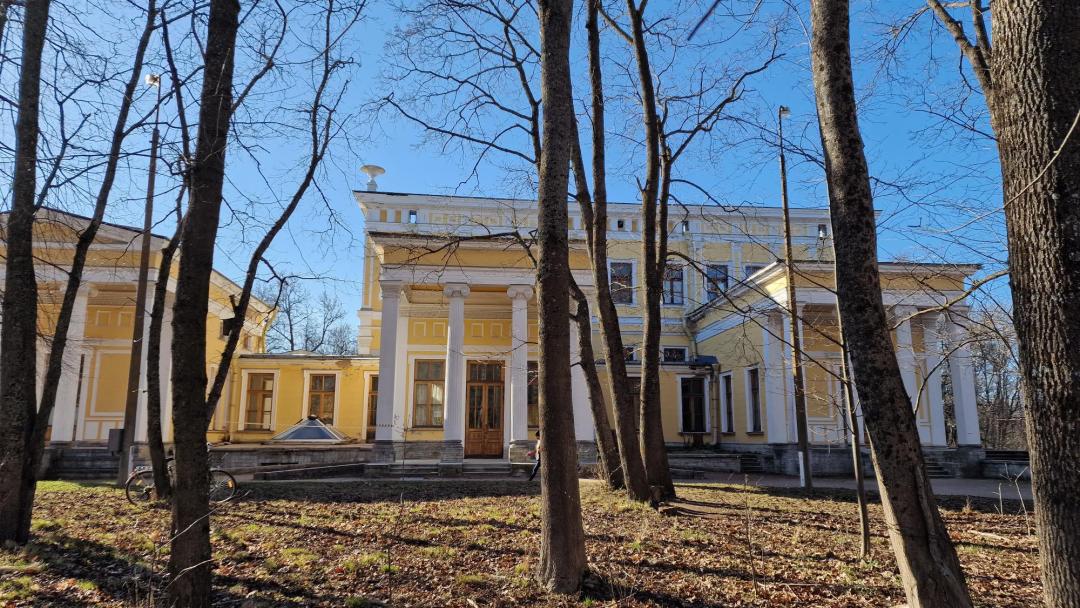

The Leuchtenberg Palace is a palace (country house) located on the crest of a coastal bluff in the northeastern part of the "Sergievka" park on the western outskirts of Peterhof near Saint Petersburg. The building was constructed by architect Andrei Ivanovich Stakenschneider for the daughter of Nicholas I, Maria Nikolaevna, and her husband Maximilian, Duke of Leuchtenberg, between 1839 and 1842. Stakenschneider is also the author of the Leuchtenberg residence in Saint Petersburg — the Mariinsky Palace. During the Great Patriotic War, the building was heavily damaged. It was partially restored in the 1990s and 2000s. In the Soviet period, the palace and the surrounding buildings housed laboratories of the Biological Institute of Saint Petersburg State University.
The architectural style of the country house is close to the "Prussian Hellenism" of K. F. Schinkel’s buildings in Berlin. However, compared to Schinkel’s Prussian constructions, Stakenschneider’s works are more compositionally diverse. Moreover, alongside the "Hellenism" of the country house in Sergievka, the architect built the "Palace at the Private Dacha" in the neo-Baroque style (1844–1846) and the Church of the Holy Trinity in the traditional "Russian style" (1857–1859). Thus, Stakenschneider demonstrated a programmatic polystylism, which became the foundation of the creative method of many masters during the historicism period of the mid and late 19th century.

In the building’s composition, Stakenschneider drew on the traditions of the layout of ancient Roman country villas (Latin: villa suburbana). The asymmetrical plan with varied facades, vases at the corners of the central volume, pergolas with climbing plants, loggias on the southern facade (later glazed), and porticos of the side pavilions give the building a resemblance to Italian villas. The southern facade is complemented by small porticos, like elegant quotations from antiquity (Stakenschneider called them "templelets"), with Corinthian capitals on fluted columns and coffered ceilings painted "up to bright Pompeian red." The overall color of the building is "sand."

The grand entrance on the southern facade was emphasized by a first-floor portico and a second-floor loggia. Adjacent to it were two templelets, as Stakenschneider called them, where busts of the palace owner’s parents — Nicholas I and Alexandra Feodorovna — stood facing each other on marble pedestals. One bust has survived; the other was destroyed.
It is noteworthy that Stakenschneider used different terms to explain the styles of his buildings: Pompeian style, "neo-Greek," "in the Greek taste." The term "neo-Greek," or "à la grecque" (French for "in the Greek manner"), was used in Russia in the 18th–19th centuries but had no precise meaning; it rather indicated a general fashion for antiquity. The palace in Sergievka and even the Tsaritsyn pavilion in the Meadow Park of Peterhof were sometimes called "Italian" and sometimes "Greek." The main reason is the peculiarity of the monuments that served as inspiration, found mainly in the territories of Herculaneum and Pompeii, which absorbed traditions of different cultures: Etruscan, Greek, and Roman. According to one version, the closest prototype (and possibly the specified model) of the palace in Sergievka could have been the "Roman Baths" pavilion, built by Schinkel in the Sanssouci Park in Potsdam (project of 1834), which clearly shows an asymmetrical plan and pergolas as antique quotations.
In 1837–1838, Stakenschneider traveled again through European countries and visited Potsdam (at that time, the interior decoration of the "Roman Baths" was not yet completed). It is also notable that in the "Pompeian houses" in Germany, France, and Russia, the Italian traditions were followed only in the interiors, while the exterior decoration repeated elements of ancient Greek temple decor. The interiors of the estate in Sergievka were decorated in the "Pompeian taste" with the inclusion of authentic antique fragments (in 1845, Emperor Nicholas I and his family visited Italy and the Pompeii excavations, where the Russian emperor acquired authentic antique items and their copies to decorate country residences). "Antique" furniture in Saint Petersburg was supplied by Heinrich Gambs’ workshop.
With the arrival of Soviet power, the Sergievka park was taken under state protection, and in 1921 it was declared a natural monument based on a decree of the Council of People's Commissars. Initially, the estate housed a "Children’s Commune."
Subsequently, the Leuchtenberg estate was transferred to the Biological and Soil Faculty of Leningrad University. The Biological Research Institute of the University was located in the palace and nearby buildings.
During the Great Patriotic War, the Leuchtenberg estate found itself on the front line of the Oranienbaum bridgehead. The Sergievka park and its buildings suffered heavy damage. Most of the decor turned into ruins or simply disappeared. Sculptures were placed throughout the estate in great numbers. None have survived after the war.

Restoration of the palace continues to this day.
Sources:
https://ru.wikipedia.org/wiki/Leuchtenberg_Palace
https://peterburg.center/story/dvorec-leyhtenbergskih-i-park-sergievka-pamyatnik-prirody-istorii-kultury-arhitektury.html
Written by Jermaine
Discuss this with the author and others
No comments yet. Be the first to start the conversation.