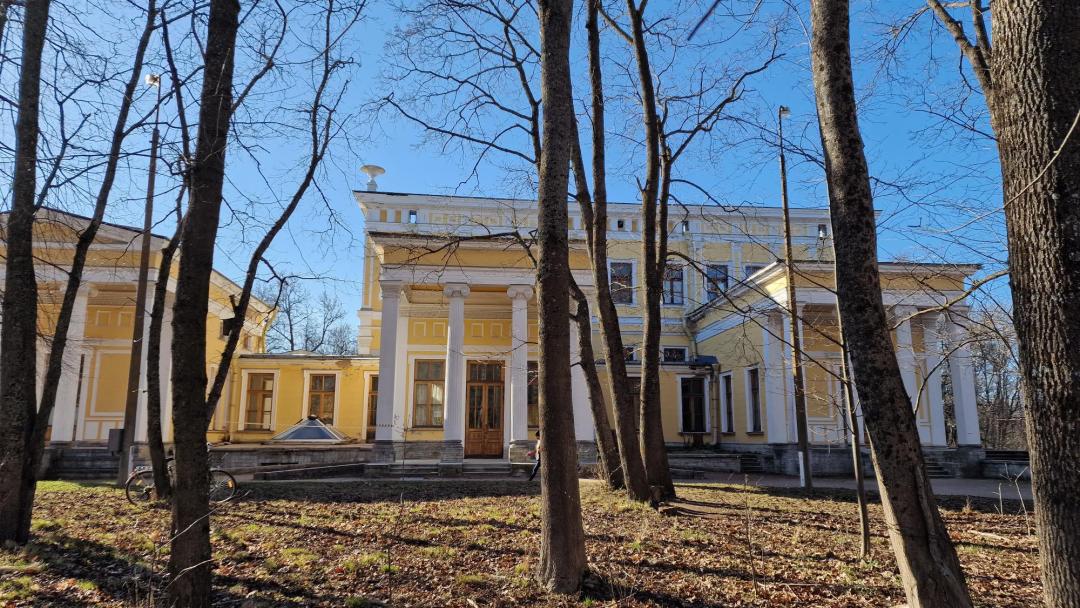
Sergievka — palace and park ensemble

Natural Monument "Park 'Sergievka'," Oranienbaum Highway, Saint Petersburg, Russia, 198411

Sergievka is a palace and park ensemble located in Peterhof (Petrodvortsovy District of Saint Petersburg) on the site of the former Leuchtenberg estate. The palace and park ensemble is a cultural heritage site, an architectural monument of the 19th century of federal significance, and is part of the UNESCO World Heritage Site "Historic Centre of Saint Petersburg and Related Groups of Monuments." The park is a natural monument of regional significance.

Sergievka is a palace and park ensemble located in Peterhof (Petrodvorets District of Saint Petersburg) on the site of the former Leuchtenberg estate. The palace and park ensemble is a cultural heritage site, an architectural monument of the 19th century of federal significance, and is part of the UNESCO World Heritage Site "Historic Centre of Saint Petersburg and Related Groups of Monuments." The park is a natural monument of regional significance.

At the beginning of the 18th century, the owner of this territory became Alexander Ivanovich Rumyantsev, a close associate of Peter I. From him, the estate passed to his son, Field Marshal Pyotr Alexandrovich Rumyantsev-Zadunaisky. The estate was named Sergievka after his son, Sergey Petrovich Rumyantsev.

In 1822, Rumyantsev sold the estate to Kirill Naryshkin, who, according to Sollogub, acquired "a landlord's house among various wooden pavilions where summer guests stayed." After the owner's death in 1838, the Naryshkin dacha was purchased by Nicholas I for 560 thousand rubles. Sergievka became the country residence of his daughter Maria Nikolaevna and her husband Maximilian, Duke of Leuchtenberg, and later their descendants.

The architect Stakenschneider, who built the Mariinsky Palace in Saint Petersburg for the Leuchtenberg couple, also became the author of their country palace in Sergievka. In addition to the palace, Stakenschneider built the Kitchen and Hofmeister (Steward) wings, and in 1845–1846, the Orthodox Church of Saint Catherine. The church building, like the palace, was executed in the then-popular European style of "Neo-Greek," inspired by ancient classical architecture. The church facades, which had a concise cubic form and a flat roof, were decorated with pilasters and bas-reliefs of angels embedded in the walls on the north and south sides. The most complete and reliable information about the church is contained in the works of Professor Dmitry Vladimirovich Osipov.

In the mid-19th century, the park's development continued. Benches and sculptures were carved from huge granite boulders, and the collection of plantings was expanded. A unique monument is the giant granite "Head," which provokes debate among art historians and historians.

After the revolution, the park was taken under state protection and declared a natural monument in 1921 based on a decree of the Council of People's Commissars. The Leuchtenberg estate was transferred to the Biological and Soil Faculty of Leningrad University. The Biological Research Institute of the University was located in the palace and adjacent buildings.

During the Great Patriotic War, the Leuchtenberg estate found itself on the front line of the Oranienbaum bridgehead; the park and buildings were severely damaged. After the war, Leningrad University carried out park improvement works. In 1965, the palace facades were mainly restored according to the project of architect Zeideman, and after 1969, restoration work on the park was carried out according to the project of architect Agapova.

The park's pathway drainage system is arranged so that even during the heaviest downpours, the paths always remain dry.

Sources:

https://ru.wikipedia.org/wiki/Сергиевка_(дворцово-парковый_ансамбль)

Follow us on social media

More stories from Imperial Parks: Sergievka, Sobstvennaya Dacha, and Ropsha

History of the Ropsha Estate

Krasnoselskoye Highway, 1, Ropsha, Leningrad Region, Russia, 188515

For example, what do we know about Ropsha? Many have at best heard that it is a settlement in the Leningrad region and that it once belonged to the Romanov dynasty. But few know that there was a remarkable palace and park ensemble there, created through the work of outstanding architects, sculptors, and landscape masters.

Hemorrhoidal colic of Peter III

Krasnoselskoye Highway, 1, Ropsha, Leningrad Region, Russia, 188515

For now, she, Catherine II Alekseevna, felt relieved. Let one legitimate Russian emperor, Ivan VI Antonovich, still be alive and languishing in the casemate of the Shlisselburg Fortress. But she had gotten rid of her main rival, the also legitimate emperor Peter III Fedorovich.

Head of a Knight (Sculpture at the Spring or Adam's Head)

Boulder "Adam's Head," Oranienbaum Highway, Saint Petersburg, Russia, 198504

Head (or Sculpture at the Spring) — a sculpture by an unknown artist, carved into a giant granite boulder and located on the territory of the former Leuchtenberg estate in Peterhof. It is an object of cultural heritage of federal significance.

Palace (Estate) of the Leuchtenberg Family

Leuchtenberg Palace, Oranienbaum Highway, 2, Saint Petersburg, Russia, 198504

The Leuchtenberg Palace is an estate located on the crest of a coastal bluff in the northeastern part of the "Sergievka" park on the western outskirts of Peterhof. The building was constructed by architect Andrey Ivanovich Stakenschneider for Maria Nikolaevna, daughter of Nicholas I, and her husband Maximilian, Duke of Leuchtenberg.

Elizabeth Petrovna’s Own Dacha

Sobstvenny Ave, 84, Saint Petersburg, Russia, 198504

The Private Dacha (until 1740 — the Seaside Dacha) is a palace and park ensemble in Old Peterhof near Saint Petersburg, belonging to Empress Elizabeth Petrovna. It belongs to the type of small travel palaces. The private nature of the palace was emphasized by the fact that no one was admitted there without a report.

The Church of the Holy Trinity at His Imperial Majesty's Private Dacha

Petergof, Saint Petersburg, Russia, 198504

The Church of the Holy Trinity is an Orthodox church in Peterhof near Saint Petersburg, built between 1858 and 1860 on His Imperial Majesty's Own Dacha. It is affiliated with the Church of St. Seraphim of Sarov of the Saint Petersburg Diocese of the Russian Orthodox Church.

Church of Saint Catherine or "The Chapel"

Oranienbaum Highway, Building 2, Block 4, Saint Petersburg, Russia, 198504

In Sergievka Park behind the Leuchtenberg Palace, on the other side of the long palace meadow, among the bushes, one can notice the ruins of a small cubic red-brick building. It seems to be the remains of some kind of wing or a gatehouse. Hardly anyone today would guess in these ruins the skeleton of the Orthodox estate church of Saint Catherine. Meanwhile, it is exactly that. Closing the perspective of the palace meadow, it compositionally echoed the cubic volume of the main part of the palace.

Water pumping station – Shtakenshneider water-lifting machine

VRXW+M6 Petrodvortsovy District, Saint Petersburg, Russia

Near the shore of the bay, between the palace meadow and the mouth of the Kristatelka River, in its steep bend, there is a picturesque clearing where, among apple trees, stands a red brick ruin with a long chimney protruding upwards. This is all that remains of the palace water pumping station after the destruction of the Great Patriotic War. Although the Sergievka park was outside the occupied territory, within the Oranienbaum bridgehead, the ensemble was heavily damaged by shells.

Viewing stone

WR2W+5R Petrodvortsovy District, Saint Petersburg, Russia

Next to the water pumping station, right on the shore of the bay, lies an unusual boulder. On the side facing the shore, as well as on the side facing the bay, steps are carved into it, and on the western edge, four deep holes are hollowed out. Nearby lies a flat granite slab, in which four recesses are also hollowed out. Posts fit into these, supporting a canopy over the grandstand.