

In the "Sergievka" park behind the Leuchtenberg Palace, on the other side of the long palace meadow, among the bushes, one can notice the ruins of a small red-brick cubic building. It seems to be the remains of some kind of wing or a guardhouse. Hardly anyone nowadays would guess that these are the remains of the Orthodox estate church of Saint Catherine. Meanwhile, it is indeed that church. Closing the perspective of the palace meadow, it compositionally echoed the cubic volume of the main part of the palace.

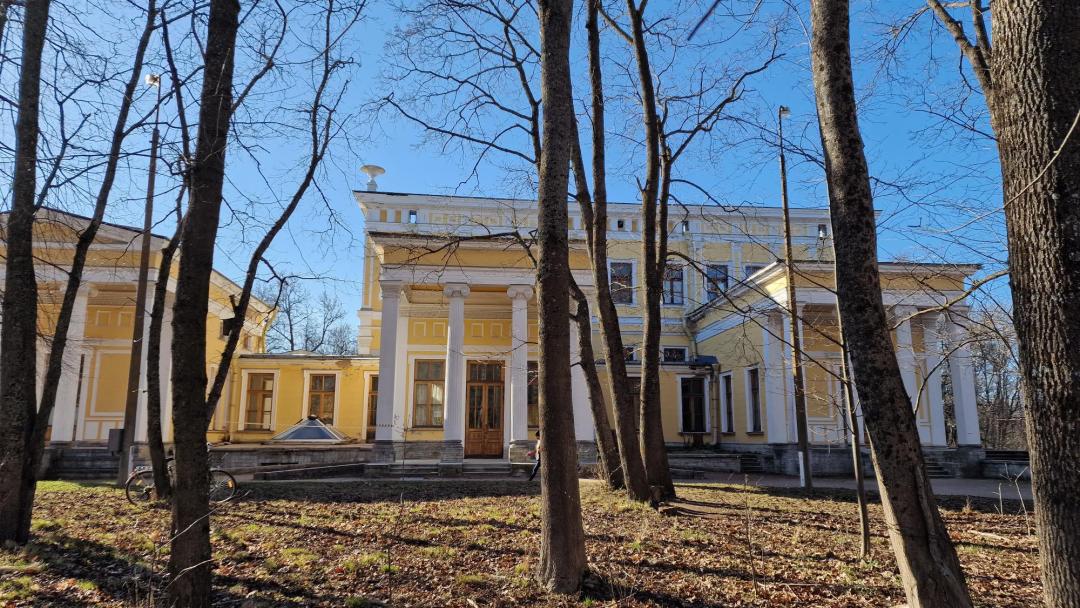
The church was built according to the project of the St. Petersburg architect Andrey Ivanovich Stakenschneider in 1843–46, during the comprehensive formation of the palace and park ensemble of Sergievka for the young couple of the Leuchtenberg dukes — Maximilian Leuchtenberg and Maria Nikolaevna, daughter of Nicholas I. This marriage was a very strange phenomenon for those times — the eldest daughter of the Russian emperor married a rather modest German duke with a tarnished pedigree (he was the son of Napoleon’s stepson Eugène de Beauharnais). However, in the second half of the 1830s, Nicholas I yielded to the wishes of his beloved daughter. Moreover, since the duke was a devout Catholic, the ceremony was conducted according to both Orthodox and Catholic rites, with priests from both confessions participating. But to avoid scandals in Europe, the tsar made them sign a “non-departure agreement,” ordering them to live in Russia for life with the rights of Russian nobility. The eight children born from this marriage were raised in Orthodoxy at the insistence of their imperial grandfather. As a summer residence, the tsar assigned them the current Sergievka estate, where, according to Stakenschneider’s design, a rich estate complex began to be created, rivaling other grand ducal country estates (and perhaps even surpassing them). The central part of the seaside estate was, of course, the palace. Its southern facade faced the park and the vast meadow. To the side of the meadow, service buildings were erected according to the architect’s project, and behind — the estate church, located directly opposite the central part of the palace and closing the perspective of the palace meadow. The church was completed in 1846 and consecrated in the name of St. Catherine the Great Martyr. According to Stakenschneider’s idea, the church was to compositionally echo the cubic volume of the palace. It was also made in the form of a cube, with a flat roof.
Because of its peculiar appearance, this church is sometimes called a chapel, although it was an Orthodox temple. There was also a real chapel in the park: Duke Maximilian Leuchtenberg remained a Catholic. Besides, if you look at an old photograph, you can see that the building resembled not a chapel but an ancient villa, being, like the palace, restrained in the “neo-Greek” style inspired by the recently discovered ancient Pompeian buildings popular in Europe at the time. And the building’s appearance was generally very secular. A small building with very strict forms. A smooth cube faced with marble with a flat roof. The facades of the church, like the palace, were decorated with pilasters. On the north and south sides — bas-reliefs built into the wall (only blind openings remain from them to this day). Only the religious nature of the bas-reliefs, made in the form of angels, plus one angel with a cross above the western entrance, and a now-lost statue of John the Theologian in front of it — immediately revealed the church’s purpose. Inscriptions in Church Slavonic ran along the frieze.
Moreover, it was here, in this church, that the secret wedding of Maria Nikolaevna with Count Grigory Alexandrovich Stroganov was prepared. The grand duchess had fallen in love with him while still married to the Duke of Leuchtenberg. After observing the required year following the death of her lawful husband, they decided to marry secretly. The marriage was to be secret so that the emperor would not find out, because if he learned of such a misalliance, he might try to annul it, sparing none of his daughter’s feelings. Of all their numerous relatives, Maria Nikolaevna confided only in her brother Alexander, the future Emperor Alexander II. For greater secrecy, they decided to marry outside the city, in Sergievka. But the priest of the Church of St. Catherine did not want to participate in this scandalous affair and claimed to be ill. The proposal was accepted only by the priest of the Gostilitsy church named Ioann Stefanov, who liked Maria Nikolaevna’s offer to pay him a lifelong pension for this (at that time, according to many folk tales and proverbs, the greed of clergy was often practically encouraged from above. Parish priests received very little from the diocese, and to live well, they either had to extort money from villagers or rely on charity from important secular persons). However, since it was already late autumn, staying at the summer estate was absurd and suspicious, so the secret wedding was risked to be held in Saint Petersburg, in the house chapel of the Mariinsky Winter Palace. In this secret marriage, Maria Nikolaevna bore two children, who were registered as Stroganovs.
As for the Church of Catherine in Sergievka, it suffered greatly from shelling during the Great Patriotic War, and then was never restored and still lies in ruins. The sculptural decoration and marble decor disappeared without a trace. Everything around it and even inside has overgrown with bushes.
However, due to the lack of full measurements, any attempt to restore the church would result in a modern reconstruction.
Sources:



Written by Jermaine
Discuss this with the author and others
No comments yet. Be the first to start the conversation.