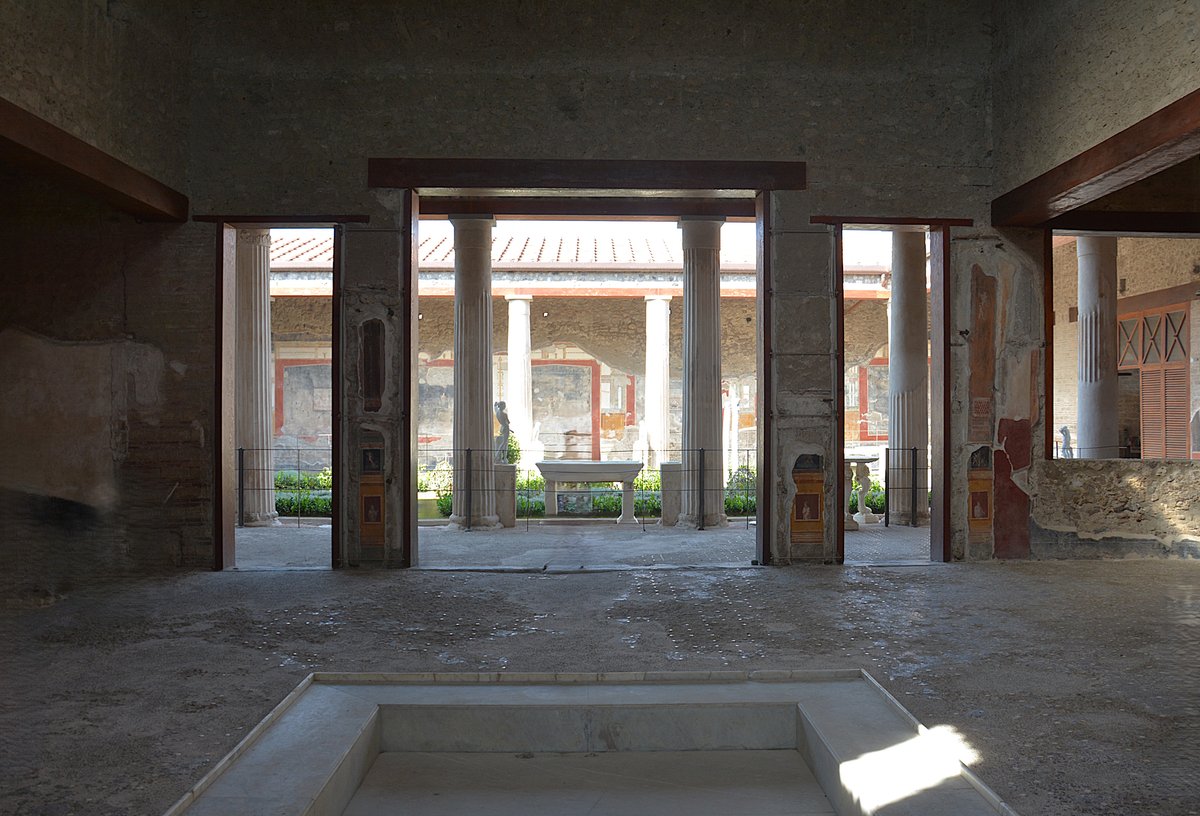

Named after two successful freedmen, Aulus Vettius Conviva and Aulus Vettius Restitutus, the House of the Vettii in Pompeii showcases an intriguing blend of palatial grandeur and homey intimacy, earning it the moniker of a house, not villa. Spanning an entire city block, this domus is divided into five key sections: a large atrium, a smaller atrium, a large peristyle, a smaller peristyle, and a shop. This grand house boasts a large garden, main living quarters, and servant quarters.
The service areas, centred around the smaller atrium, are where the lesser folk dwell, while the primary inhabitants reside near the larger atrium. The house can be accessed through the Vicolo dei Vettii on the eastern facade, with five small windows on the same side, two narrow windows on the south, and one on the west. The small atrium is encircled by four rooms suspected to have been for servants and storage. A kitchen is located nearby, as well as a cubiculum for the cook, and an impluvium.
A staircase once stood in the southeast corner of the small atrium, though the upper floor is no longer extant. The shop, or taberna, features a large gate for draft animals, and adjacent are a chamber and latrine. Above the large peristyle are two triclinia, an oecus, and two storage rooms. This house is adorned with a large assortment of fresco paintings in the Pompeian Fourth style. Surviving are twelve panels in the House of the Vettii, depicting mythological scenes, offering a theme of divine reward and punishment.
A captivating painting illustrates the power of Jupiter (Zeus) and his sons as the enforcers of world order. Ixion, having betrayed Zeus, is punished in a scene on the east wall of the north triclinium; Ixion bound to a wheel, with Hermes standing in the forefront, Hephaestus behind the wheel, and Hera enthroned to the right, holding a long golden scepter and crimson crown. Iris, Hera’s messenger, extends her arm to convey Ixion’s punishment to Hera. Beyond these twelve mythological paintings, many other works are displayed in the House of the Vettii, including two depictions of Priapus, the Greek god of fertility.
Sources: Wikipedia, OpenStreetMap, Wikidata, Wikimedia Commons
Written by Nicolo Ciampini
Discuss this with the author and others
No comments yet. Be the first to start the conversation.