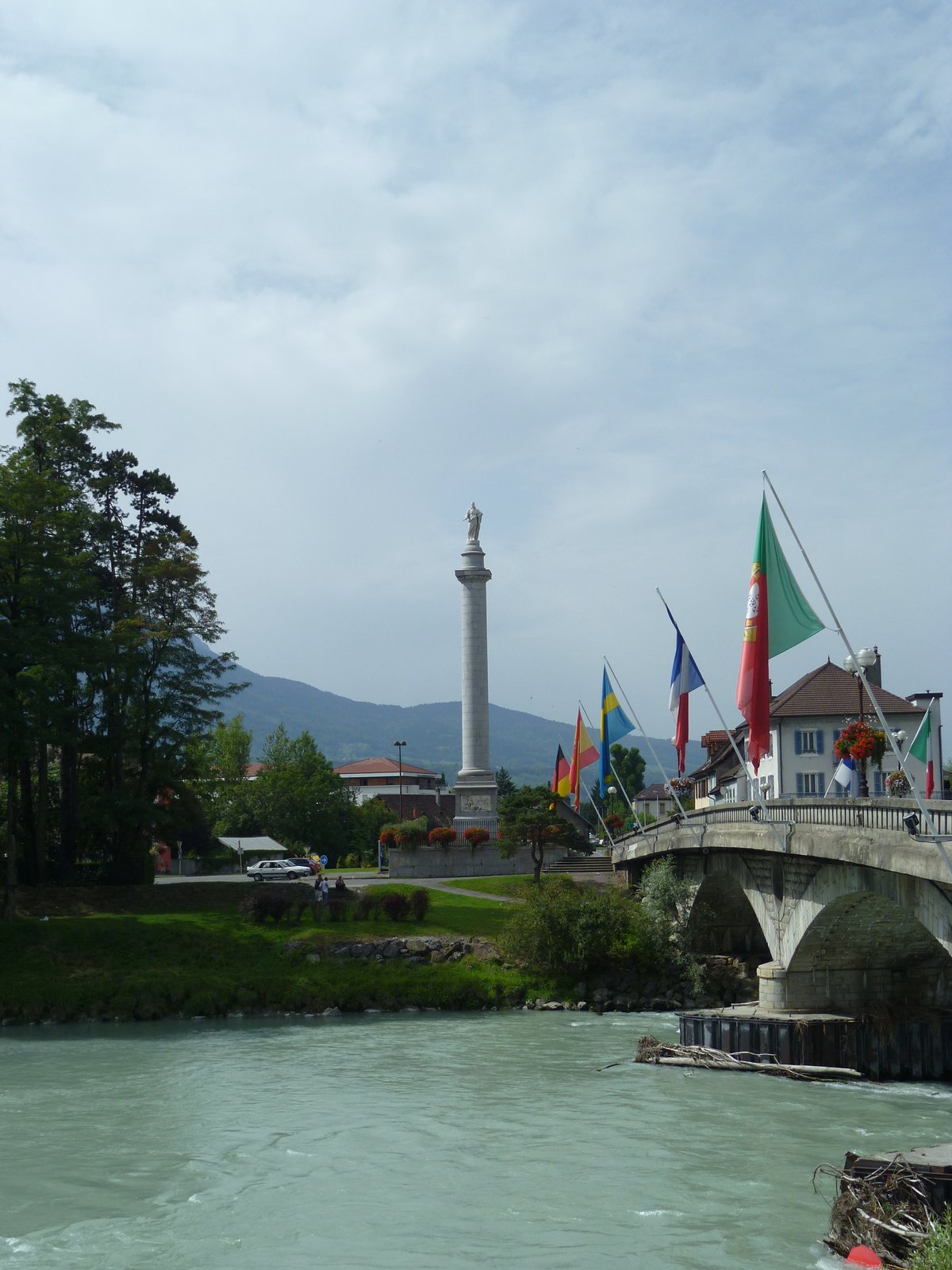

The Arve river regularly caused significant damage during its floods until the 19th century, inundating fields, villages, and towns in the valley. During a visit to the region, King Charles-Félix de Savoie granted a subsidy of 60,000 livres to carry out flood protection works. These works protected Bonneville and the middle Arve valley. In 1824, the local inhabitants erected a wooden column to thank the king for these works.
Two years later, the wooden structure was replaced by the current stone column, which was inaugurated in July 1826. Standing 19 metres high, the column is built in the Doric style and sits on a pedestal. It was designed to highlight the traditional functions of the sovereign and reflects his paternal role by being located near the dikes. The monument was listed as a historic monument in 1942.
The pedestal features a bas-relief representing the river Arve personified as a nymph, shown chained and dressed in ancient style, half-lying in the reeds. Latin inscriptions on the other faces explain that the king contained the river's floods in 1824. While the original relief is preserved in the Bonneville town hall, it was replaced in 2012 by a version made of blue marble by Béatrice Sassone Bouvet.
At the top of the column stands a 3-metre statue of the beloved Charles-Félix. This statue was made of Carrara marble by the Cacciatori brothers, the same artists who originally restored the abbey of Hautecombe. The monument stands on the left bank of the Arve at the Pont de l'Europe, along the Avenue des Glières.
Sources: Wikipedia, OpenStreetMap, Wikidata, Wikimedia Commons


Written by Nicolo Ciampini
Discuss this with the author and others
No comments yet. Be the first to start the conversation.