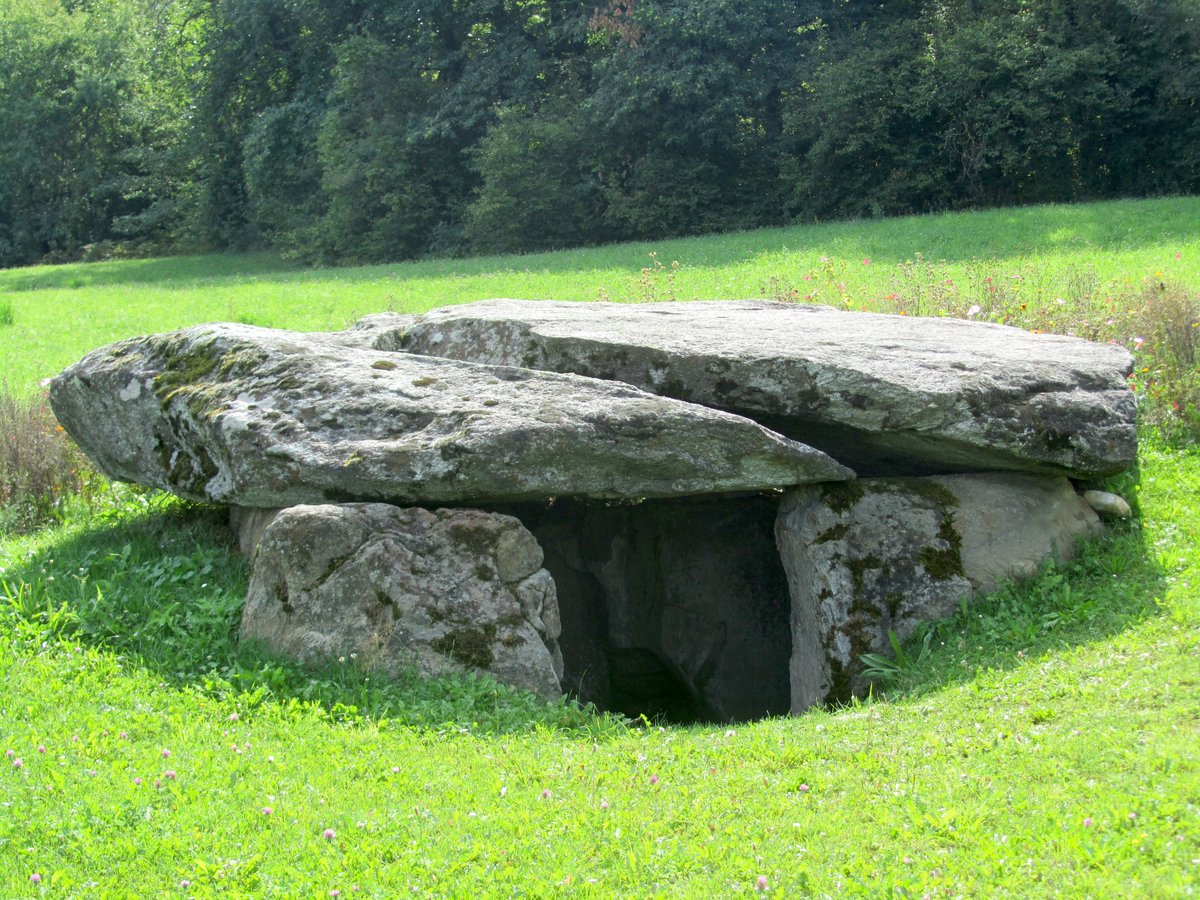

In the heart of the French Alps, nestled among towering peaks and rugged landscapes, lies a hidden gem - the Cave aux Fées, or the Fairy’s Cave. This archaeological site, dating back nearly 4,500 years, is one of the oldest monuments in the Haute-Savoie region of France. The Cave aux Fées was classified as a monument historique in 1889. Its orientation leans towards the north-east and south-west, and it is covered by a single arkose slab, broken into two parts, each weighing approximately 7.5 tons.
The chamber, defined by six orthostates, is rectangular in shape, measuring 3.20 meters in length and 2.30 meters in width. The entrance, located on the north-west side, is 1.40 meters wide and 1.25 meters high. All the slabs are made of protogine, grès, and serpentine, with traces of carving visible. The dolmen is now partially buried due to a landslide, and the chamber floor is approximately 1.50 meters below the surrounding ground level. Recent clandestine excavations revealed fragments of pottery with geometric patterns characteristic of the Campaniform culture.
The slab from the northern end of the dolmen measures 2.80 meters in height. According to one theory, the Cave aux Fées was a burial site for high-status individuals. The chamber holds some calcinated bones, but the identities of the individuals remain unknown.
Sources: Wikipedia, OpenStreetMap, Wikidata, Wikimedia Commons
Written by Nicolo Ciampini
Discuss this with the author and others
No comments yet. Be the first to start the conversation.