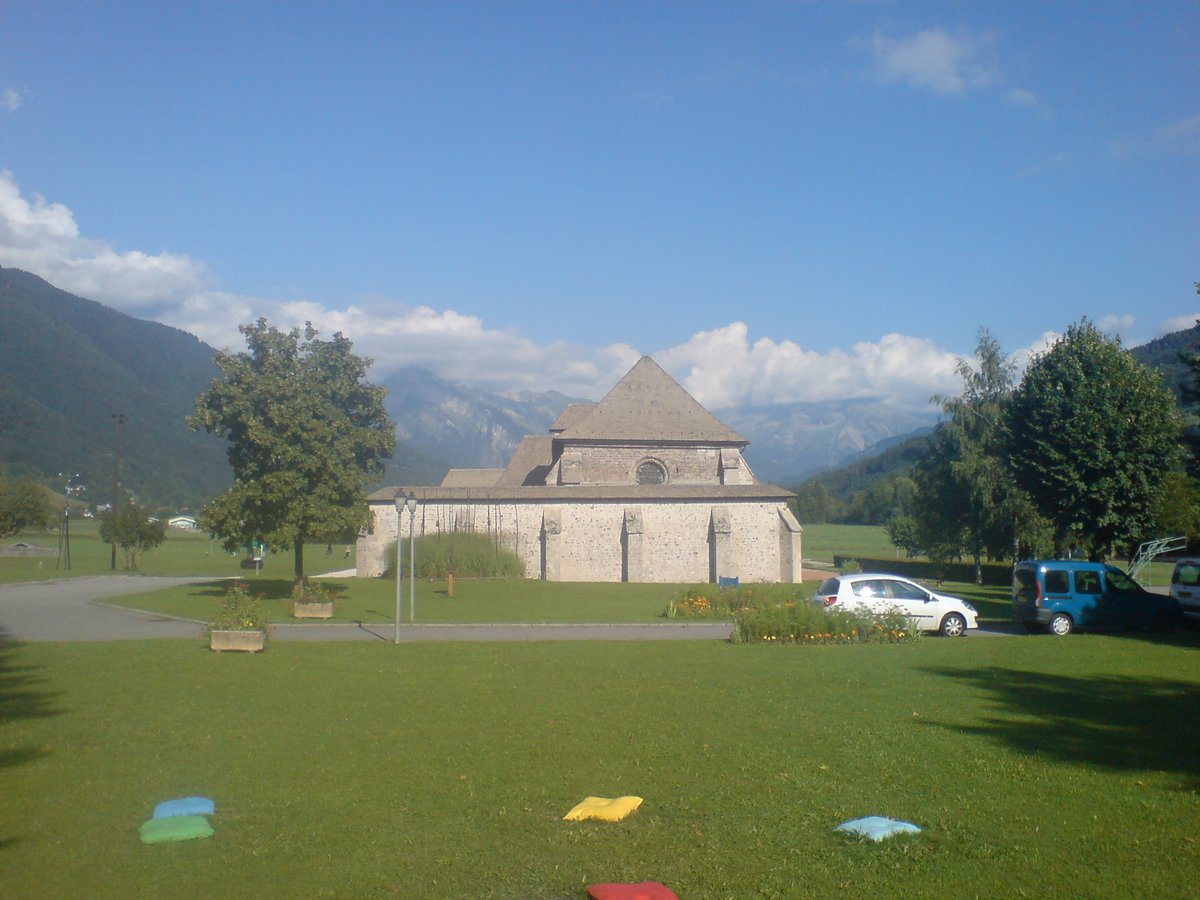

The Melan Charterhouse, located in the commune of Taninges, Haute-Savoie in the Auvergne-Rhône-Alpes region, was originally established as a Carthusian monastery for nuns. The site had previously been occupied by a residence and chapel constructed by its founder, Béatrice of Faucigny and her parents Agnes of Faucigny and Peter II, Count of Savoy. Archaeological evidence suggests the presence of an earlier Gallo-Roman villa, with discoveries including Roman tile fragments and the remains of a necropolis. The foundation of Melan Charterhouse occurred on a site historically referred to as a mediolanum, a term of Celtic origin derived from medios (meaning 'middle') and lanon (meaning 'plain').
The land initially belonged to the lords of Faucigny, who held the eponymous fief. The location is on the alluvial plain of the Giffre River, and is situated near the A40 motorway and accessed via the RD902 toward Châtillon-sur-Cluses and Taninges, reached by the Route de Mélan.
The site has a rich history, with the chartreuse de Mélan being established by Béatrice of Faucigny in 1282. It was consecrated on 28 December 1290, intended as a burial place for Beatrice's son John I, who died in 1282. Initially accommodating forty nuns and seven fathers, the monastery's land holdings were estimated at 583 hectares in 1732. A fire partially destroyed the charterhouse in 1528, and Dom Innocent Le Masson renovated the monastery in the 17th century.
The French Revolution initiated the nationalization of Church property on 2 November 1789. On 18 November 1789, the state ordered an inventory of all movable and immovable assets belonging to churches and monastic institutions. The National Constituent Assembly abolished monastic vows and suppressed religious orders and congregations on 13 to 19 February 1790, except those engaged in public education and charity. However, the reforms did not initially apply to Savoy, but the French Army of the Alps entered Savoy through Les Marches and Apremont on 21 to 22 September 1792, triggering further changes.
The National Assembly of the Allobroges abolished the sovereign rights of the House of Savoy, the privileges of the nobility, feudal dues, and the tithe and ordered the confiscation of ecclesiastical property in October 1792. On 31 October 1792, a departmental commission delegated citizens Thévenet and Ducret to assess the movable and immovable assets of Mélan Charterhouse. Savoy was officially annexed by France and became the 84th department under the name Mont-Blanc department on 28 November 1792.
In 1793, the forty nuns and seven priests of Mélan Charterhouse were expelled and the monastery was sold as national property. The General Council of the Mont-Blanc department ordered the expulsion of the nuns on 27 August 1793. The charterhouse was vandalized and looted during the winter of 1793–1794.
Abbé Marin Ducrey established a secondary school at the former charterhouse in 1803. The institution provided a classical and religious education for boarding students. The school became a minor seminary in 1809, with Jesuits joining the institution in 1809 to support its educational mission and remaining until 1848. Priests from the Diocese of Annecy replaced the Jesuits in 1848, and the Missionaries of Saint Francis de Sales, a congregation founded in 1838 by Pierre Mermier, administered the seminary until 1905.
After the enactment of the 1905 Law on the Separation of Churches and the State, the college was closed. Today, Melan Charterhouse continues to be an historic and cultural landmark, attracting visitors from all over the country and beyond.
Sources: Wikipedia, OpenStreetMap, Wikidata, Wikimedia Commons
Written by Nicolo Ciampini
Discuss this with the author and others
No comments yet. Be the first to start the conversation.