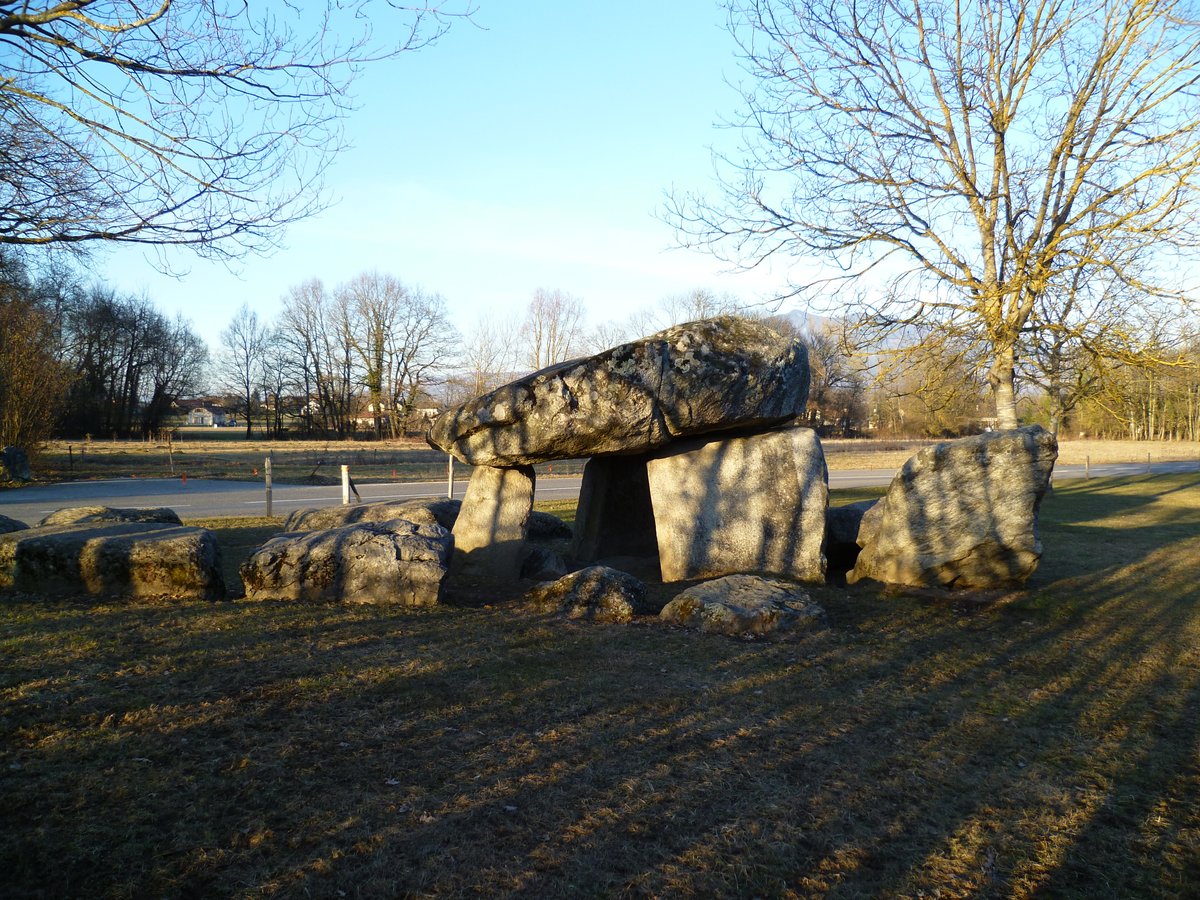

The Pierre des morts, also known as Pierre aux fées, is a dolmen located near the hameau de Saint-Ange in Reignier, France. It is an archaeological site that dates back to the Neolithic Era, around 3200 to 2800 BCE.
The site is a morainic region, where large stones were left by retreating glaciers. The Pierre-aux-Fées dolmen was first mentioned in 1819 as a druidic altar, though it is likely much older. The site appears to have been partially covered by the remains of a tumulus.
The dolmen is oriented to the east and consists of a large table, supported by three orthostates. The table is made of Mont-Blanc granite and measures 4.90 meters in length, 4.30 meters in width, and up to 1.20 meters in thickness, for a total volume of 15.04 cubic meters. The table's interior surface has been smoothed, and deep grooves can be found, which may have been used for some ritual purpose.
The four orthostates measure around 2 meters in width, with heights ranging from 1.60 to 1.85 meters, and thicknesses between 0.35 and 0.85 meters (West Pillar). All orthostates have a rectilinear border that has been smoothed. The North and South pillars have a vertical groove on their inner surface, which may have been used as a burial chamber.
The college of Pierre-aux-Fées in Reignier is named after the dolmen. Three pillars are missing on the North, South, and East sides. The missing pillars, possibly of large size, were recovered, without causing the collapse of the structure, at an unknown time. A small, quadrangular block is located in the center of the chamber.
Two long, flat slabs, 3.10m and 2.80cm long, are visible to the east of the structure. The bulging faces of these slabs result from the rock's cleaving, rather than intentional shaping. The upper edges of these slabs are irregular and do not appear to have been used as pillars supporting a table. They may instead have been antennae, a common construction type in Jura and Valaisian dolmens.
Several massive slabs are lying flat on the West, South, and North sides. On the South and North sides, they appear to be aligned with respective east-west and east-southeast/west-northwest axes and may be remnants of a facing. A slab on the South side features an oval groove made by pounding, which may represent a polished ax.
The table cover, the three orthostates, and two flat slabs on the ground are made of Mont-Blanc granite (protogine), while other slabs are of varied nature. The site architecture has not undergone significant changes since the mid-19th century, but the soil has undergone a decasing of between 0.30m and 0.60m. These amendment works were carried out after the site's classification and were intended to improve the monument's visibility.
Sources: Wikipedia, OpenStreetMap, Wikidata, Wikimedia Commons
Written by Nicolo Ciampini
Discuss this with the author and others
No comments yet. Be the first to start the conversation.