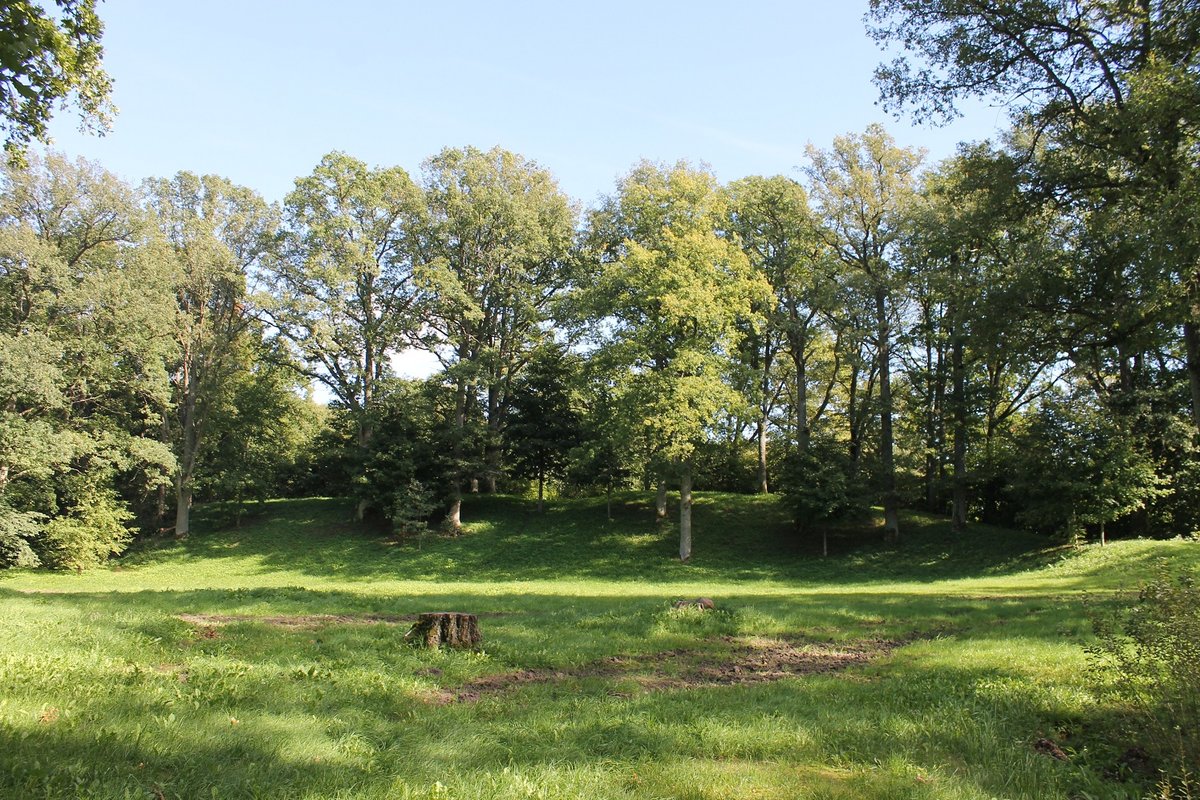
Apuolė hillfort is a historical archaeological site in Lithuania that is considered a cultural monument of Lithuania. Situated in the village of Apuolė, in Skuodas district municipality, it is located at the confluence of the Luoba River and its tributary, Brukis Stream.
The hillfort, which covers an area of 318,028 square meters, is associated with the Curonians, one of the Baltic tribes. Archeologists have dated the wooden fortress to the 1st century AD.
According to historical records, Apuolė was the first Lithuanian place mentioned in historical sources, dated to 853. The hillfort was an important Curonian stronghold. Around it, a large village was situated, suggesting early stages of city development.
In 854, the Curonians rebelled against the Swedish rule. The rebellious fortress was first attacked by the Danes who hoped to make the town pay tribute to Denmark. However, the locals were victorious and gained much war loot. After learning of Danish failure, King Olof of Sweden organized a major expedition into Curonian lands. First, he attacked and destroyed the village of Grobiņa before besieging Apuolė. 15,000 locals defended themselves for eight days but then agreed to surrender. The Curonians paid silver ransom for each man in the fortress, pledged their loyalty to Sweden, and gave 30 hostages to guarantee future payments.
Apuolė was mentioned in a 1253 treaty between Bishop of Riga and Livonian Order. The location was described as uncultivated land, suggesting that the castle was probably destroyed and the villagers moved to safer areas. The settlement was mentioned again in the 17th century, and by late 18th century gained the attention of historians and archaeologists. The first excavations were carried out by Eduards Volters and Birger Nerman in 1928-1932.
Sources: Wikipedia, OpenStreetMap, Wikidata, Wikimedia Commons
Written by Nicolo Ciampini
Discuss this with the author and others
No comments yet. Be the first to start the conversation.