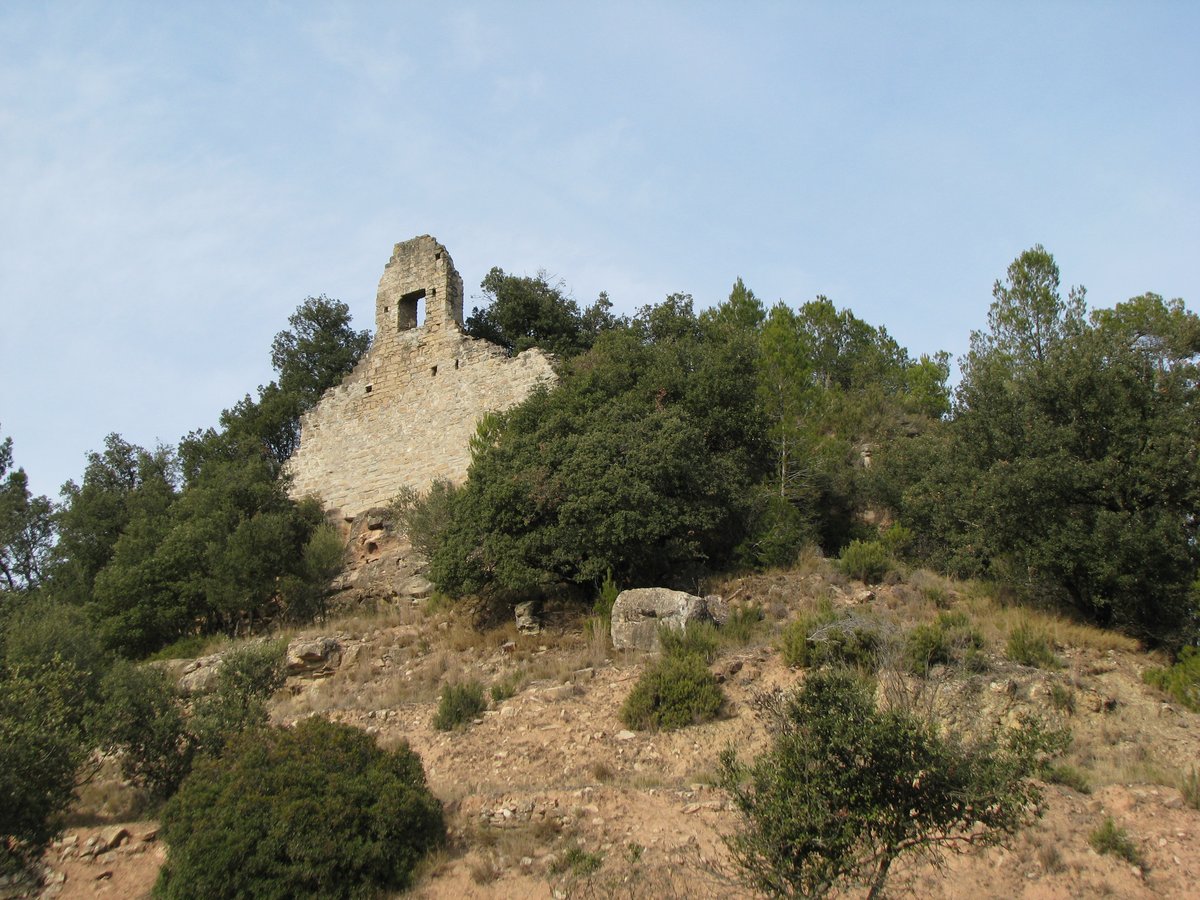

The **Ruins of the Rocafort Castle** command a hill in the village of Rocafort de Bages, Catalonia, Spain. Initially built in the 11th century and recorded in a 909 document, the castle's ancestry traces back to Néspola, a larger territory that eventually fractured into three separate territories. In the 11th century, the name Rocafort emerged, a moniker that would be synonymous with the castle, the village, and local mobility for centuries.
Throughout the centuries, the castle changed hands, with Guillema Nerell, wife of Pere de Sitjar, commissioning the renowned sculptor Berenguer Ferrer to create her husband's sarcophagus in 1348 and restoring the castle chapel. Later, she bequeathed the castle to the monastery of Sant Benet de Bages. The monastery exercised jurisdictional authority over Rocafort until the 19th century, when senyorius jurisdiccionals were abolished.
Today, remnants of the original castle persist, including a southwest wall segment that spans 10.90 meters, with an 85-centimeter thickness and a square opening, possibly a window. A second wall fragment saves a 5.78-meter length. A visible stone wall extends 5.70 meters towards the west, interrupted by a ravine, but the remains of the tower, which should have been erected on the hill's highest point, are not evident.
Sources: Wikipedia, OpenStreetMap, Wikidata, Wikimedia Commons
Written by Nik Frost
Discuss this with the author and others
No comments yet. Be the first to start the conversation.