
The southernmost point of the Struve Arc is the Staraya-Nekrasovka point.
Dormitory, T1607, Stara Nekrasivka, Odesa Oblast, Ukraine, 68672
Struve Arc: Russo-Scandinavian Arc Jermaine
 For Browsing
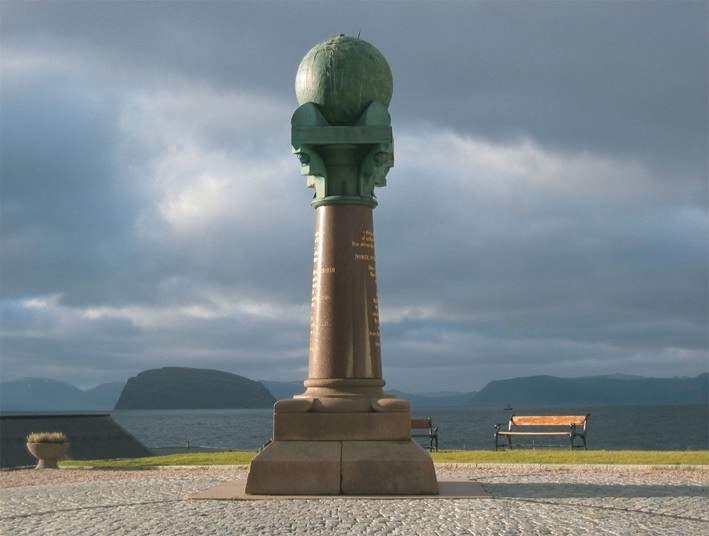
The Struve Arc is a chain of triangulation points stretching 2,820 km across the territories of ten European countries. The reference points of the meridian network were marked on the ground by hollows carved into rocks, iron crosses, stone pyramids, or specially erected obelisks. Monuments were installed at the terminal points of the Arc: the "Fuglenes Point" lies on the coast of the Barents Sea, near the North Cape and the Norwegian city of Hammerfest (70° 40′11″ north latitude), and the "Staro-Nekrasovka Point" is located in the Odessa region of Ukraine near the city of Izmail (45° 20′28″ north latitude). These reference observation points were established during the period 1816–1855 by the astronomer Friedrich Georg Wilhelm Struve (also known as Vasily Yakovlevich Struve), who thus carried out the first reliable measurement of a large segment of the Earth's meridian arc. This allowed for the precise determination of the size and shape of our planet, which was an important step in the development of Earth sciences and topographic mapping. The work related to the Russian arc was carried out under the auspices of the St. Petersburg Academy of Sciences. Measurements on the Scandinavian arc were conducted with the approval of King Oscar I of Sweden and Norway, through the joint efforts of Swedish, Norwegian, and Russian surveyors and officers, with the assistance of astronomers from the Pulkovo Observatory. In 1828, the renowned surveyor and cartographer, later Lieutenant General of the Russian Imperial Army, Iosif Khodzko, participated in connecting the Lithuanian degree measurement with the Livonian one, which was then being conducted by the director of the Dorpat Observatory, Vasily Struve. Struve’s measurement accuracy was very high: verification by satellite methods in the 20th century showed an error of only 2 cm. This was an exceptional example of scientific cooperation between scholars of different countries and between reigning monarchs. Initially, the "arc" consisted of 258 geodetic "triangles" (polygons) with 265 main triangulation points. The World Heritage site includes 34 such points (the best preserved to date), which are marked on the ground in various ways, such as hollows carved into rocks, iron crosses, stone pyramids, or specially erected obelisks. The purpose of the degree measurement is to determine the length of the meridian with an accuracy of one degree of arc to calculate the shape and size of the Earth using the results of precise geodetic, astronomical, and gravimetric measurements and observations. To prove that the Earth is not perfectly spherical, the Paris Academy of Sciences organized two expeditions in 1735: one to the equator in Peru, and another to the polar line in Lapland. At the same time, third-degree measurements were conducted in France. The expeditions of the Paris Academy of Sciences determined that the length of the meridian arc corresponding to 1° is 110.9 km at the equator, 111.3 km in Paris, and 111.9 km at the polar line. Thus, degree measurements proved that the Earth is flattened at the poles. In the 19th century, measurements over several degrees were conducted in Europe, India, and America. The most important among them were the Anglo-French degree from northern Scotland to Algeria (1783–1808) and the Russian Academy of Sciences’ measurements from the Arctic Ocean to the Danube during 1816–1855. Friedrich Georg Wilhelm Struve (1793–1864) was a German astronomer and surveyor, academician of the St. Petersburg Academy of Sciences since 1832, director of the Tartu University Observatory from 1820 to 1839, and professor of astronomy and geodesy at Tartu University from 1814 to 1838. He was the founder and director of the Pulkovo Observatory from 1839 to 1862. Karl Friedrich Tenner (1783–1859) was born in Virumaa County, Vaivara Parish, Auvere. He began studying geodesy in St. Petersburg in 1802. In 1809, he was tasked with creating a triangulation network from St. Petersburg through Narva to Tallinn, and from there to Tartu. In 1816, Tenner and his colleagues began creating triangulation in the territory of modern Lithuania. Based on an agreement concluded in 1828, the Struve and Tenner arcs were combined, with Tenner retaining the geodetic part and Struve the astronomical. The measurement of the meridian arc length was conducted from 1816 to 1855 under the leadership of astronomer Struve. The high accuracy for that time (±12 m) demonstrated the first precise measurement of a long segment of the meridian arc. Measurements of the meridian arc led to determining the length of the corresponding meridian arc (2,880 km) at 25° 20′, which was the largest degree measurement in the 19th century. Comparison of measurements of various sections of the Tartu meridian arc showed that the length of the arc corresponding to one degree of latitude increases unevenly toward the pole. The results of the meridian arc were used by Gauss to refine cartographic projections and by Bessel to determine the parameters of the ellipsoid (Bessel 1841). Further (final) processing of the Struve meridian arc measurement data was carried out on the Bessel ellipsoid. The Earth ellipsoid parameters determined by Bessel were used in Estonia until 1946, and in some countries (Indonesia, Japan, Korea, etc.) they are still used today. On July 15, 2005, in Durban, South Africa, a meeting of the UNESCO World Heritage Committee took place, at which the Struve Geodetic Arc was included in the list of World Heritage sites. To confirm this, each country was issued a certificate confirming that the Struve Meridian Arc is a UNESCO World Heritage site. The surviving points of the Struve Meridian Arc were added to the list from ten countries (a total of 34 points) as follows: Norway (4 points), Finland (6 points), Russia (2 points), Estonia (3 points), Latvia (3 points), Lithuania (3 points), Belarus (5 points), Moldova (1 point), and Ukraine (4 points). https://whc.unesco.org/en/list/1187
Jermaine Loading stories…
Dormitory, T1607, Stara Nekrasivka, Odesa Oblast, Ukraine, 68672
Struve Arc: Russo-Scandinavian Arc Jermaine 




46233, Võivere, Võivere, 46233 Lääne-Viru County, Estonia
Struve Arc: Russo-Scandinavian Arc Jermaine 

Observatooriumi 9, Tõravere, 61602 Tartu County, Estonia
Struve Arc: Russo-Scandinavian Arc Jermaine 


WC3P+2J Gireišiai, Rokiškis District Municipality, Lithuania
Struve Arc: Russo-Scandinavian Arc Jermaine 
W8J8+CM Meškonys, Vilnius District Municipality, Lithuania
Struve Arc: Russo-Scandinavian Arc Jermaine 
JCMH+QJ Paliepiukai, Vilnius District Municipality, Lithuania
Struve Arc: Russo-Scandinavian Arc Jermaine 


