


Point Dorpat (Tartu Observatory) was the first point of the arc. The Tartu Observatory was built in 1810, and much of the research was conducted there. From 1818 to 1839, Struve was the director of the Tartu (then "Derpt") Observatory. Next to the observatory is the house where Struve lived while working at the observatory. In the park near the observatory, a monument is erected in his honor.

The old observatory is located in the center of Tartu, on a tree-covered hill. From various points on the hill, stairs lead up to the observatory. Directly in front of the old observatory stands a monument to Struve, and next to the entrance is a UNESCO memorial plaque made of metal. Near the point, there is an information board about Struve and a huge one-story map indicating the geodetic points. Although the interior of the old observatory is mainly focused on astronomy, there is a special cabinet with several of Struve’s instruments used for constructing the geodetic arc. With the help of these instruments, complex mathematical measurements and calculations were made.
The Struve Arc, once known as the "Russian" and later the "Russo-Scandinavian Meridian Arc," is one of UNESCO’s World Heritage monuments. The arc consists of 265 triangulation points, where measurements were conducted from 1816 to 1852 that allowed the precise determination of the Earth's size and shape.
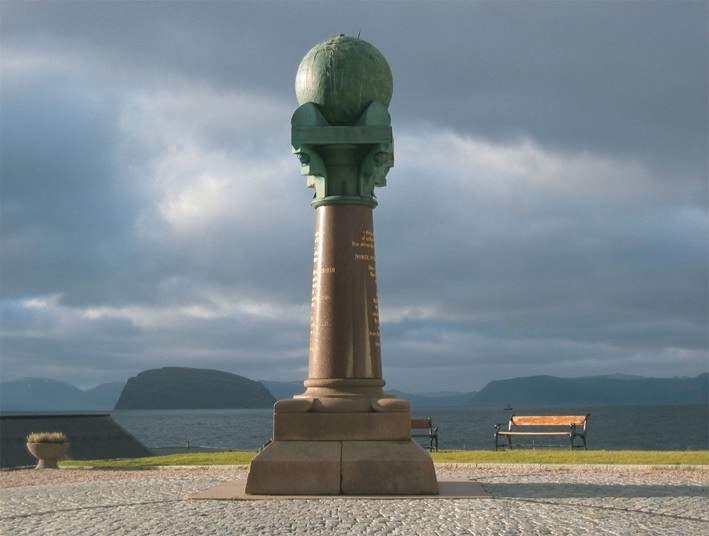
The reference points of this triangulation network were marked on the terrain in various ways: hollows carved into rocks, iron crosses, stone pyramids, or specially installed obelisks. Often they were marked with sandstone bricks laid at the bottom of a pit; sometimes it was a granite cube with a cavity filled with lead, placed in a pit with cobblestones.
During the project to include the Struve Arc in the UNESCO list, which lasted 8 years, special search and geodetic work was carried out in each country to locate the original points. All information from all the countries of the Struve Arc was collected, structured, and standardized.
Not all of the original points were found during the special search and geodetic work carried out in recent years with active cooperation from scientists of the interested countries, and many of them were found to be heavily damaged. Therefore, only the best-preserved points — a total of 34 — were included in the World Heritage site.
Sources:
http://www.gototrip.com/publications/geodezicheskaya-duga-struve
https://en.wikipedia.org/wiki/Tartu_Observatory



Written by Jermaine
Discuss this with the author and others
No comments yet. Be the first to start the conversation.