


The Alatornio Church is one of the few points in the Struve chain formed by buildings. The church tower served both as a measurement point and as a signal over a distance. The French expedition and Mopertuis used the church tower in the town of Tornio during their previous measurements. The tall tower of Alatornio Church was completed only after 1797 and thus existed in its current form at the time of the Struve chain measurements. In an earlier measurement conducted by Jens Svanberg in 1802, Alatornio Church was also used. During the measurements in the 1840s, a new parish house building was constructed.
The square of Alatornio Church was central to the measurements. Many stages of measurements took place there. Triangulation and astronomical measurements were conducted in the church area as part of the Pulkovo Academy of Sciences, as well as Swedish triangulation. At the final stage of measurements, the measurement network across Finland, built in 1851 under Russian administration, was connected to the Swedish measurement network in the Alatornio Church area. The Swedes continued the Triangular Chain up the Tornio valley.
Years were also spent creating the triangulation chain in its northern section. The work was done in the summer. In the last years of measurements, scientists arrived in the north during the thaw by steamboat. Measurements in the Alatornio Church area were mainly conducted during 1842–1851, when the so-called "Alatornio Church" was also used. Chains in Lapland and Finnmark were measured. The church and nearby Kokkomäki were trigonometric measurement points, or triangulation points. The church was a prominent landmark when viewed from afar, and the tower was visible from a distance. The church tower still posed a complex challenge, as measurements were taken from the church balcony, i.e., slightly off-center from the tower. The center of the tower also had to be calculated mathematically using an angle of inclination measurement.
The heights of the measurement points around the church were measured by the Russians in autumn 1842, and their triangulation was completed by 1844. The measurements were conducted under the leadership of Fredrik Woldstedt, a Finn working at the Pulkovo Observatory in Russia, who closely collaborated with Struve. Later, Woldstedt became a professor of astronomy. Here ended the Russian-Finnish measurement chain, from which the Swedes continued their path. The Swedes began measurements in the north and measured angles between the southern points of the Lapland measurement chain in 1849. Their southernmost triangle was Alatornio Church, Kaakamavaara, and Peravaara. The leader of the Swedish research group was astronomer and Reichstag deputy Nils Hakvin Selander. Thus, research groups from both empires operated in the Alatornio Church area.
In 1851, the Russian research group arrived at the church to connect the measurement chains. At that time, the research group was also led by Lindhagen, a Swede working at the Pulkovo Observatory. When considering the site for astronomical research in 1851, many advantages were noted in the church area compared, for example, to Kemi. Alatornio Church had already been a measurement point for Jens Svanberg and served as the southernmost point in the Swedish Struve measurement chain. Besides the church building itself, the area was suitable because it was relatively sparsely populated yet located in the town center. Surveyors wanted to work quietly. Nearby there were also open spaces and sandy hills that could be used for measurements. Valuable equipment was placed at the research station, which had to be guarded even in the absence of scientists.
The research station was built on a clearing near the church (distance from the church 860 feet = 279 meters). Using the stars observed there, the triangular chain was positioned correctly on the Earth's surface. The exact position of the points was obtained by measuring the position and movement of stars. The research station was connected to Alatornio Church, the town church, and nearby Kokkomäki by a small baseline (line length 523 feet = 170 meters) and triangulation. This baseline was measured using two rods exactly 22 feet long, installed on tripod scaffolds.
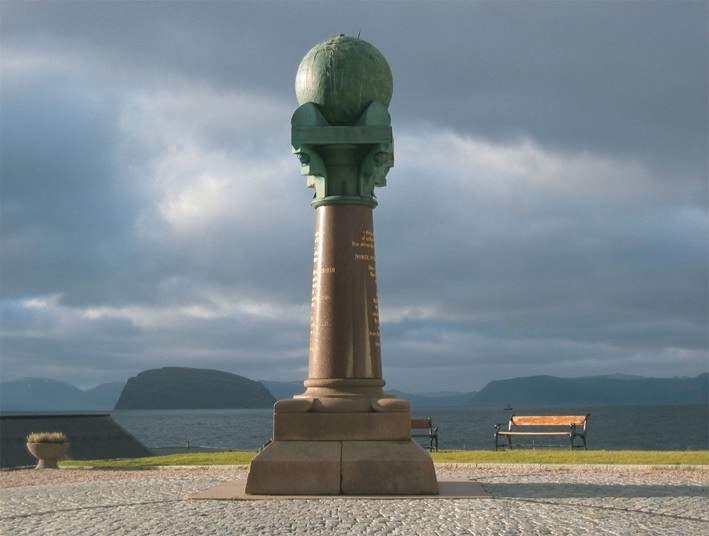
The Struve Arc, once known as the "Russian" and later the "Russian-Scandinavian Meridian Arc," is one of UNESCO's World Heritage monuments. The arc consists of 265 triangulation points, along which measurements were conducted from 1816 to 1852, allowing the precise determination of the Earth's size and shape.
The reference points of this triangulation network were marked in various ways on the terrain: hollows carved into rocks, iron crosses, stone pyramids, or specially installed obelisks. Often they were marked with sandstone bricks laid at the bottom of a pit; sometimes it was a granite cube with a cavity filled with lead, placed in a pit with cobblestones.
During the project to include the Struve Arc in the UNESCO list, which lasted 8 years, special search and geodetic work was undertaken in each country to locate the original points. All information from all the Struve Arc countries was collected, structured, and standardized.
Not all of the original points were found during the special search and geodetic work carried out in recent years with active cooperation from scientists of the interested countries, and many of them were found to be heavily damaged. Therefore, only the best-preserved points—34 in total—were included in the World Heritage site.
Sources:
http://www.gototrip.com/publications/geodezicheskaya-duga-struve
https://visitmeri-lappi.fi/nae-koe/kulttuuri/unescon-maailman-perintokohde/



Written by Jermaine
Discuss this with the author and others
No comments yet. Be the first to start the conversation.