

The southernmost point of the Struve Arc, "Staro-Nekrasovka," is located in the Odessa region in the village of Stara Nekrasovka. This village lies on the border between Ukraine and Romania. It is situated 7 kilometers east of Izmail. The Struve Arc obelisk is located near the local Old Believers' church.
This is one of the surviving obelisks, crowned with the double-headed eagle of the Russian Empire, and is part of the geodetic network known as the Struve Arc. Having survived two centuries of changing regimes and states, the monument has not only endured but also preserved its original appearance. The massive obelisk was erected with funds from Nicholas I and is currently listed as a UNESCO World Heritage site, being not only the main attraction of the village of Stara Nekrasovka in the Odessa region but also a point of contact for ten European countries through whose territories the geodetic Struve Arc (also known as the Russo-Scandinavian Arc) passes.
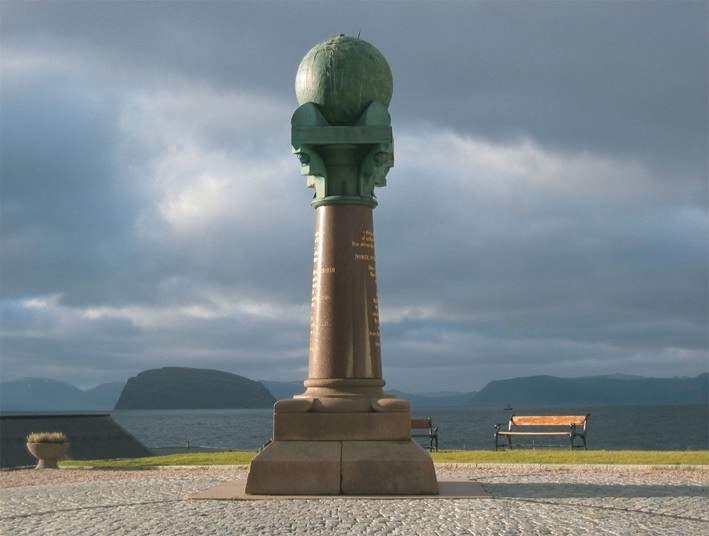
In total, the Struve Arc stretches 2,820 kilometers from the Norwegian city of Hammerfest (point "Fuglenes") to the village of Stara Nekrasovka (point "Staro-Nekrasovka") near Izmail. The arc included 265 geodetic points, of which only 34 remain. Among the surviving points, only two remain almost in their original condition: "Fuglenes" and "Staro-Nekrasovka."
Originally, the points were hastily made and often suffered from the actions of nature or local residents. For example, in Stara Nekrasovka, after geodesists measured the baseline, they piled stone pyramids at its ends, covered them with earth, and surrounded them with ditches. Struve and Tenner asked local officials to protect the baseline "against the mischief of local residents." However, within a couple of months, the point was vandalized, and the stones were scattered in all directions. Only 20 years later was a massive monument installed here, which looks particularly impressive today.
On the tall black obelisk, whose top is adorned with a double-headed eagle, it is written: “Southern limit of the meridian arc 25°20' from the Danube River to the Arctic Ocean through Russia, Sweden, and Norway. By the order of the August Monarchs Emperors Alexander I, Nicholas I, and King Oscar I. Constantly working from 1816 to 1852, geometers of three nations measured. Latitude 45°20'2.8''.”
The Struve Arc is a system of triangulation measurement points used to determine the physical parameters of planet Earth. Its creator was the scientist-astronomer from the Russian Empire named Friedrich Georg Struve. For 40 years, he led an astronomical laboratory and conducted measurements based on a specially constructed "arc." It consisted of more than 260 markers laid in the ground at various points along the meridian: these were obelisks, pyramids, lead cubes, and simply carved depressions in rocks. These points are found in Norway, Finland, Russia, Belarus, Moldova, the Baltic countries, and other nations, together forming a continuous arc. According to the results of a special committee meeting held in January 2004, the Struve Arc was recognized as a UNESCO World Heritage site. At each point, a monument was erected indicating detailed information about the coordinates, its location, and significance within the overall Arc.
Stara Nekrasovka, where the obelisk is installed, is mainly inhabited by Old Believers, called Lipovans here, who settled in Bessarabia in the early 18th century. The village itself was founded by descendants of Cossacks who had participated in Kondraty Bulavin's uprising of 1707-1708. After their defeat and to escape retribution, the Cossacks with their families moved to the Danube under the protection of the Turkish Sultan, where they founded the village of Nekrasovka, named after the Don Ataman Ignat Nekrasov. In 1814, due to the introduction of new land privileges for the indigenous people of Bessarabia, the Nekrasovites decided to change their previous place of residence and, dividing, founded two new settlements — Stara Nekrasovka and Novaya Nekrasovka, which became suburbs of Izmail.
Today, Stara Nekrasovka is a large village with a population of just over 3,000 people. Besides the Meridian monument, visitors can explore architectural heritage such as the Romanian-built outpatient clinic building and visit the Old Believers' Church of John the Theologian. The population is friendly, but the problems are the same as in many other rural settlements. The decline in fish catch in the Danube, the sale of which is almost the only source of income, worsens the situation of local residents. It is believed that the fish die-off is due to the activities of Romanian oil extraction enterprises.
The geodetic Struve Arc is a unique phenomenon in the history of science, surrounded by an aura of mysteries, events, and coincidences.
Sources:
https://ua.igotoworld.com/ru/poi_object/70308_duga-struve-staraya-nekrasovka.htm
https://dzen.ru/media/mir_v_ego_mnogoobrazii/duga-struve-dvuglavyi-orel-na-rubejah-ukrainy-61ed125e8d744c4ecf700fc7




Written by Jermaine
Discuss this with the author and others
No comments yet. Be the first to start the conversation.