


The Dabor-Kalns point is located on the highest hill at the northern end of the Selia upland. Its absolute height is 157.8 meters above sea level. At Tabor-Kalns there is the geodetic point of the Struve Arc "Dabor-kalns" and the Tabor-Kalns observation tower, which is 28 meters tall. This is not only a triangulation point of the Struve Arc but also an astronomical station, the southern terminal point of Struve’s personal measurements, and through the triangular side Tabor-Kalns – Jekabpils (Dabor-Kalns - Jakobstadt), a connection was established between the Struve Arc and the Tenner Arc. The point was established and used for measurements from 1825 to 1827 by the outstanding geodesist Karl Tenner, a colleague of Friedrich Georg Wilhelm Struve. It was here, during the process of connecting the two arcs, that real problems arose because two different types of length units were used: the Russian-English sazhen (7-foot Tenner standard) and the Russian-French toise (6-foot Struve standard). This connection was carried out under the supervision of the famous scientist Bessel, who confirmed that the connection was accurate. Since the granite block was placed over the old one in 1931, no significant changes in the physical preservation of the object have been detected. Scientists managed to find the marker in 2015. Since the terrain of Latvia is mostly flat and forested, Friedrich Georg Struve and Karl Friedrich Tenner had to build tall wooden towers to conduct geodetic measurements. Visitors to the Tabor-Kalns observation tower can see a vast area and understand in which directions the sensors were aimed to measure the size and shape of the Earth two centuries ago.
The Struve Arc, once known as the "Russian" and later the "Russian-Scandinavian Meridian Arc," is one of UNESCO’s World Heritage monuments. The arc consists of 265 triangulation points, along which measurements were conducted from 1816 to 1852, allowing the precise determination of the Earth's size and shape.
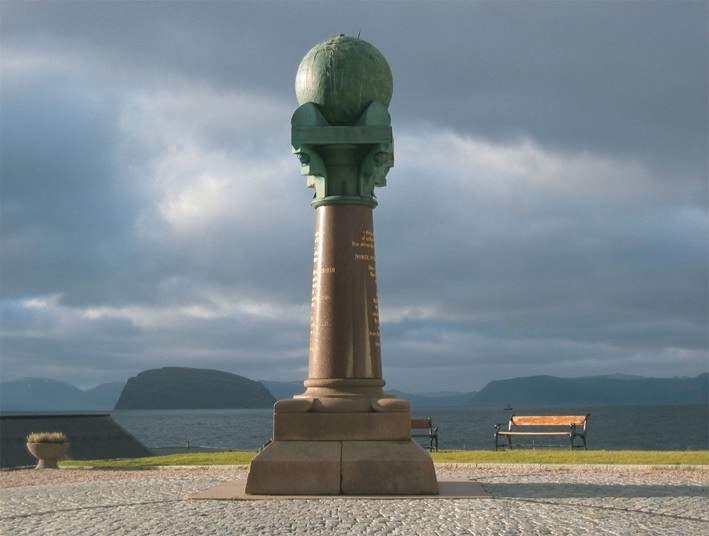
The reference points of this triangulation network were marked in various ways on the terrain: hollows carved into rocks, iron crosses, stone pyramids, or specially installed obelisks. Often they were marked with sandstone bricks laid at the bottom of a pit; sometimes it was a granite cube with a cavity filled with lead, placed in a pit with cobblestones.
During the project to include the Struve Arc in the UNESCO list, which lasted 8 years, special search and geodetic work was carried out in each country to locate the original points. All information from all the countries of the Struve Arc was collected, structured, and standardized.
Not all of the original points were found during the special search and geodetic work carried out in recent years with active cooperation from scientists of the interested countries, and many of them were found to be heavily damaged. Therefore, only the best-preserved points—a total of 34—were included in the World Heritage site.
Sources:
http://www.gototrip.com/publications/geodezicheskaya-duga-struve
https://eurogeographics.org/wp-content/uploads/2018/04/1187.pdf
The Struve Arc, once known as the "Russian" and later the "Russian-Scandinavian Meridian Arc," is one of UNESCO’s World Heritage monuments. The arc consists of 265 triangulation points, along which measurements were conducted from 1816 to 1852, allowing the precise determination of the Earth's size and shape.
The reference points of this triangulation network were marked in various ways on the terrain: hollows carved into rocks, iron crosses, stone pyramids, or specially installed obelisks. Often they were marked with sandstone bricks laid at the bottom of a pit; sometimes it was a granite cube with a cavity filled with lead, placed in a pit with cobblestones.
During the project to include the Struve Arc in the UNESCO list, which lasted 8 years, special search and geodetic work was carried out in each country to locate the original points. All information from all the countries of the Struve Arc was collected, structured, and standardized.
Not all of the original points were found during the special search and geodetic work carried out in recent years with active cooperation from scientists of the interested countries, and many of them were found to be heavily damaged. Therefore, only the best-preserved points—a total of 34—were included in the World Heritage site.
Sources:
http://www.gototrip.com/publications/geodezicheskaya-duga-struve
http://struvearc.wikidot.com/latvia



Written by Jermaine
Discuss this with the author and others
No comments yet. Be the first to start the conversation.