

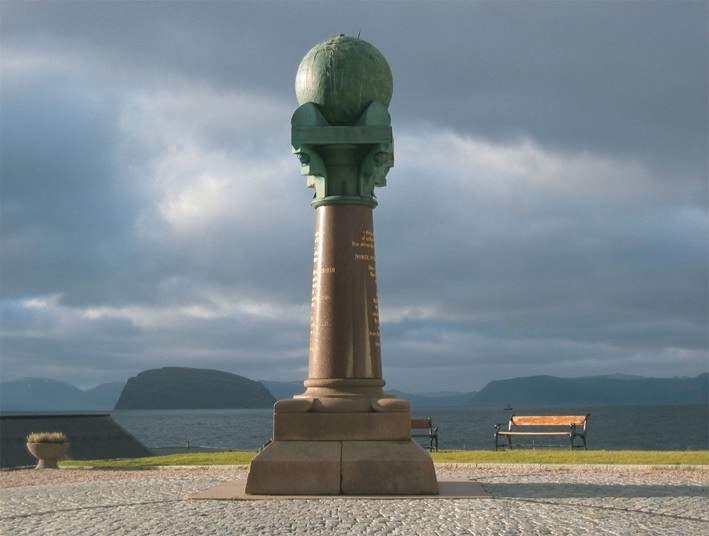
The monument to Struve, opened in 1969, is dedicated to the former director of the Tartu Observatory Vasily Yakovlevich Struve (born Friedrich Georg Wilhelm Struve; born April 15, 1793, Altona, Germany — died November 23, 1864, Saint Petersburg) — a Russian astronomer of German origin, one of the founders of stellar astronomy. Under his leadership, between 1816 and 1855, a meridian arc was measured to determine the shape and size of the Earth (https://reveal.world/collection/duga-struve-russko-skandinavskaya-duga).

The first director of the Pulkovo Observatory, founding member of the Russian Geographical Society. Ordinary academician of the St. Petersburg Academy of Sciences (1832–1861; corresponding member since 1822), foreign member of the Royal Society of London (1827). Member of the American Philosophical Society (1853). Privy Councillor (1856).
Vasily Yakovlevich Struve was born into the family of the director of the Christianeum Gymnasium, mathematician Jakob Struve (1755–1841), who came from peasants, in the Danish (now German) city of Altona near Hamburg and spent his school years in this city.
In 1808, due to the threat of forced conscription into Napoleon’s Grand Army, he moved from Germany to Dorpat, where he received a philological education at the University of Dorpat. In 1810, he wrote an essay "De studiis criticis et grammaticis opud Alexandrinos," for which he was awarded a gold medal. Then, over three years, he studied astronomy and, defending his dissertation "De geographicae Speculae Dorpatensis positione" in 1813, began working at the Dorpat University Astronomical Observatory, simultaneously teaching at the university.
In 1815, in Altona, he married Emilia Wall, with whom he had 12 children, four of whom died in childhood and adolescence. Among his sons were the astronomer Otto Struve, statesman Bernhard Struve, and (from his second wife Johanna Bartels) astronomer and diplomat Kirill Struve.
Since 1819 — director of the Dorpat Observatory and ordinary professor at the university.
During twenty years as director of the observatory, he equipped it with first-class instruments for that time: a Fraunhofer refractor and a heliometer from the Repsold firm. Starting from 1824 (until 1837), he conducted micrometric measurements of 2,714 double stars; the first catalog was published in 1827.
In 1830, Nicholas I was presented with Struve’s report on the tasks of the new large astronomical observatory near Saint Petersburg. From 1833, he was the most active participant in the construction of the Pulkovo Observatory, opened on August 19, 1839. Struve became its first director.
After the death of his first wife in 1834, he married Johanna Bartels (1807–1867), daughter of mathematician Martin Bartels; with her, he had six more children, four of whom outlived him.

Thanks to his efforts, the Pulkovo Observatory was equipped with advanced instruments (including, at that time, the world’s largest refractor with a 38-centimeter objective). Together with military surveyor Tenner, Struve conducted degree measurement of the meridian arc over a vast area from the Arctic Ocean coast to the Danube delta (the Struve Geodetic Arc), obtaining valuable data for determining the shape and size of the Earth.
Under Struve’s leadership, a system of astronomical constants was determined, which gained worldwide recognition and was used for 50 years. Using a transit instrument built on his idea, Struve determined the constant of the aberration of light.
In the field of stellar astronomy, Struve discovered the real concentration of stars toward the central parts of the Galaxy and substantiated conclusions about the existence and magnitude of interstellar light absorption. He devoted much time to the study of double stars. Two catalogs of double stars compiled by him were published in 1827 and 1852. Struve is credited with one of the first successful measurements of the annual parallax of a star (Vega in the constellation Lyra) in history (1837). In the mid-19th century, he participated in the creation of the Lisbon Astronomical Observatory.
Struve was an honorary member of many foreign academies and societies.
The monument is an abstract work inspired by the spirit of its era, reflecting humanity’s aspiration toward space. The lower part of the sculpture represents a sundial, and the upper part an hourglass. The authors of the monument are Ola Mini and Udo Ivask.
Sources:
https://www.visitestonia.com/en/friedrich-georg-wilhelm-struve-monument
https://ru.wikipedia.org/wiki/Струве,_Василий_Яковлевич



Written by Jermaine
Discuss this with the author and others
No comments yet. Be the first to start the conversation.