

Geographical location of the Struve geodetic arc stations "TUPISHKI," "LOPATY," "OSSOVNITSA," "CHEKUTSK," and "LESKOVICHI" was confirmed by recent special works carried out in 2002. They were obtained as a result of satellite measurements in the coordinate system of the Republic of Belarus and calculated using measurement values taken from the published work of Struve "Arc du méridien de 25º 20' entre le Danube et la Mer Glaciale mésure depuis 1816 jusqu’en 1855" and the "Catalog of first-class triangulation points, compiled by the Corps of Military Topographers on the territory of European Russia and the Caucasus from 1816 to 1910 and corrected by the commission of military topographer K.V. Sharngorst" (1926). As a result, when recalculated into a unified system, the results practically coincided.

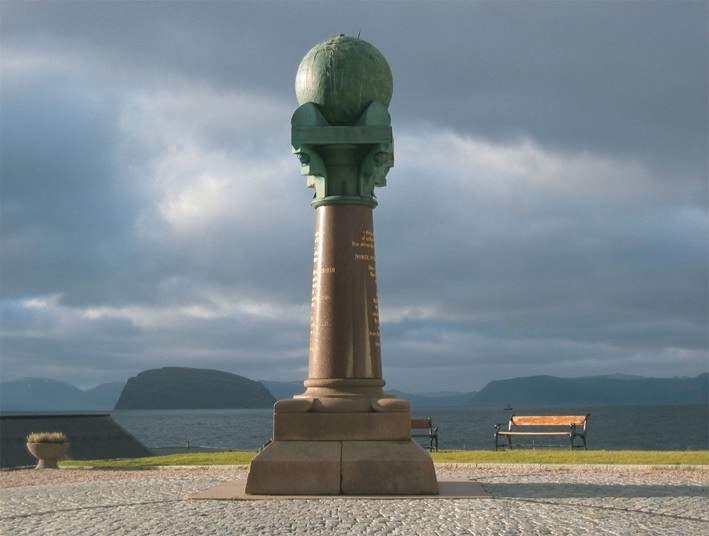
One of such remaining points is the geodetic point "Lopaty," located in the Grodno region, near the village of Lopaty and near the R141 highway Zheludok-Rozhanka. The object is a black stele made of gabrodiabase from Karelia, about 1.5 meters high. At the top of the stele is a 100-kilogram sphere "Earth," on which the outline of Belarus is visible, including the part of the Struve arc passing through it and the sign "Lopaty."
The Struve arc, once known as the "Russian" and later the "Russo-Scandinavian meridian arc," is one of UNESCO's World Heritage monuments. The arc consists of 265 triangulation points, along which measurements were conducted from 1816 to 1852, allowing the precise size and shape of the Earth to be determined.
The reference points of this triangulation network were marked on the ground in various ways: hollows carved into rocks, iron crosses, stone pyramids, or specially installed obelisks. Often they were marked with sandstone bricks laid at the bottom of a pit; sometimes it was a granite cube with a cavity filled with lead, placed in a pit with cobblestones.
During the project work to include the Struve arc in the UNESCO list, which lasted 8 years, special search and geodetic works were undertaken in each country to locate the original points. All information from all the countries of the Struve Arc was collected, structured, and standardized.
Not all of the original points were found during the special search and geodetic works carried out in recent years with active cooperation of scientists from interested countries, and many of them were heavily damaged. Therefore, only the best-preserved points—34 in total—were included in the World Heritage site.
Sources:
http://www.gototrip.com/publications/geodezicheskaya-duga-struve
http://www.struve.by/index.php/belarus/punkty-dugi-v-belarusi/punkt-dugi-lopaty



Written by Jermaine
Discuss this with the author and others
No comments yet. Be the first to start the conversation.