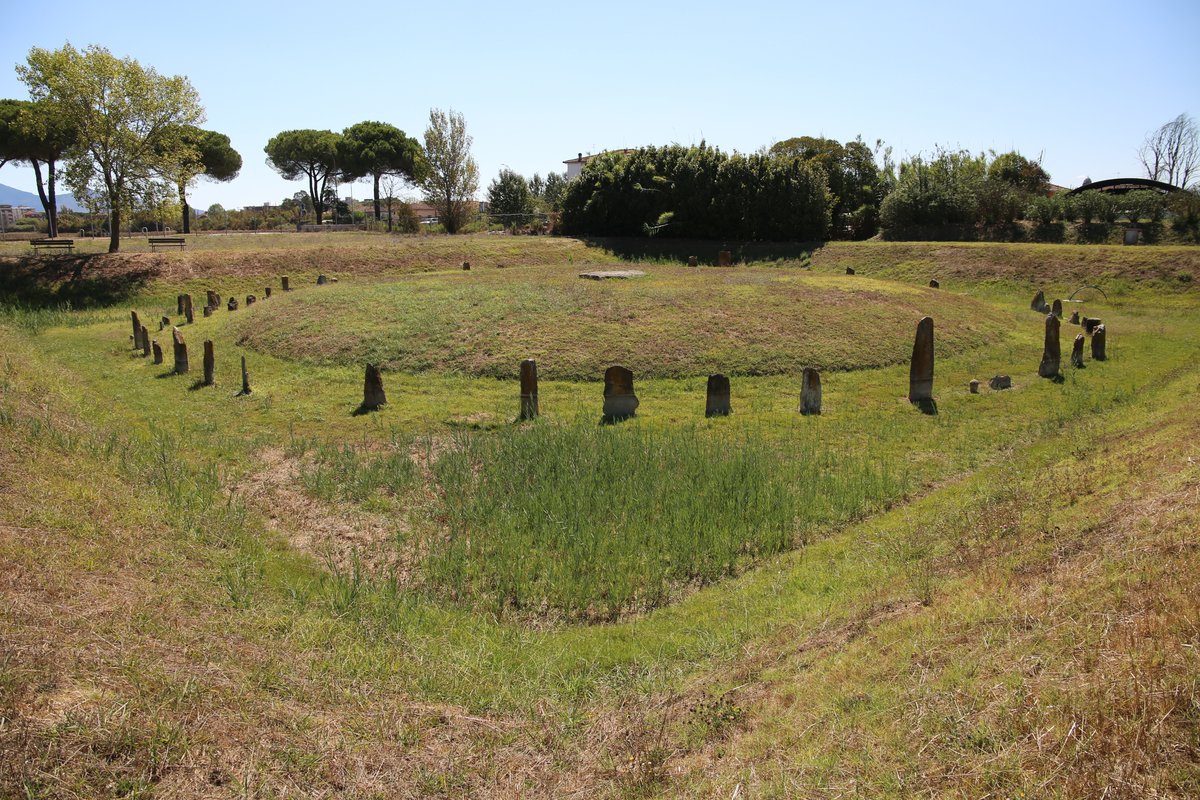

The Tumulo del Principe Etrusco is an Etruscan tomb, built around the 7th century BC. Mapped as a historic archaeological site, it was discovered in the Gagno neighborhood of Pisa, in via San Iacopo. In 1853, a number of tombs were found during the expansion of the cemetery in via S. Jacopo. However, only in 1994, during more intensive research, was a more extensive necropolis with the ancient Etruscan tomb found. The tomb has a diameter of 30 meters and is defined by a circle of stones sunk into the ground. Seven meters from the circle of stones, pairs of monolithic stones are arranged, two meters apart.
In the north-east sector of the circle, two small slabs are inserted perpendicularly to the ground, which once supported a step to access the area around the tomb. At the center of the tomb, there is a complex structure, including a large quadrangular pit, 4 meters long, 1 meter deep, in which a wooden box was found (2.5m x 1.5m x 0.7m). Inside the box, a few fragments of vases, a bronze cup, and sheep bones were found, probably remnants of a funeral meal.
Above the pit, there is a triangular-shaped opening filled with sterile clay, into which a trident was buried. An altar was found above the opening, on which an iron knife, four iron spikes, and a horse's jawbone were discovered. The altar was then dismantled, and some of its parts were deposited in a quadrangular pit five meters away. Near the altar, in the north-east, a large decorated dolio was found, containing a large amount of ashes, small bronze nails, a bronze sheet, and a thin gold wire.
The items found inside the dolio suggest a dating to the first quarter of the 7th century BC. The Tumulo del Principe etrusco contains four burials dating back to the third quarter of the 7th century BCE. Two of the burials contain the remains of females with their cineraries in large dolioi. One female burial includes an olla as part of the corredo, placed in a circular hole with a monolithic covering stone. Another female burial, less preserved, has the cinerary in a litic cassetta.
Another two male burials have cineraries represented by small ollae, placed with the corredo on a stone platform, in a dolium with reversed top covered with earth. A fifth burial, belonging to a young girl, was found in the space between the crown of the tumulus and the series of stone pairs. Her ashes are contained in a dolium placed in a pit in the ground, along with a few items from her corredo: an unguentary, a gold collar with pendants, and a clasp.
In the third quarter of the 7th century BCE, the space around the tumulus was used by a important Pisano gentilizio group to emphasize their role in society. In the 6th century BCE, a series of burials were found south of the burial complex, marked by cippi, highlighting the role of the tumulus as a monumentum gentis. The presence of the various members of the gentes around it seems to project the image of the group. In this period, the entrance to the tumulus was monumentalized with a complex of stone articles that marked the area of access to the tomb.
During the 6th century BCE, a crater and an anfora were found in the internal void of the two blocchi più interni, decorated with figures in black and dated to the 6th century BCE. Outside the tumulus, there are two rudimentary altars, sites of sacrificial rituals, testified by animal bone remains and a coppa attica. The first mention of the existence of the complex monumental structure occurred on April 5, 1967 during the construction of a well by the landowner.
The relics found were identified as Etruscan by Prof. Antonio Fascetti and made public through the press, then delivered to the Superintendence. Only in December of 1994, thanks to the photo and the article published in 1967, began more in-depth research in the area. After a few days of excavation, the stones that were part of the tumulus crown were found. Burials of prehistoric age, cippi, and other stones that were part of the monumental complex were found in September of the same year.
Today, this complex is called the 'Tomb of the Etruscan Prince' and represents a museum reality of the city, a tangible testimony of the past of Pisa.
Sources: Wikipedia, OpenStreetMap, Wikidata, Wikimedia Commons
Written by Nicolo Ciampini
Discuss this with the author and others
No comments yet. Be the first to start the conversation.