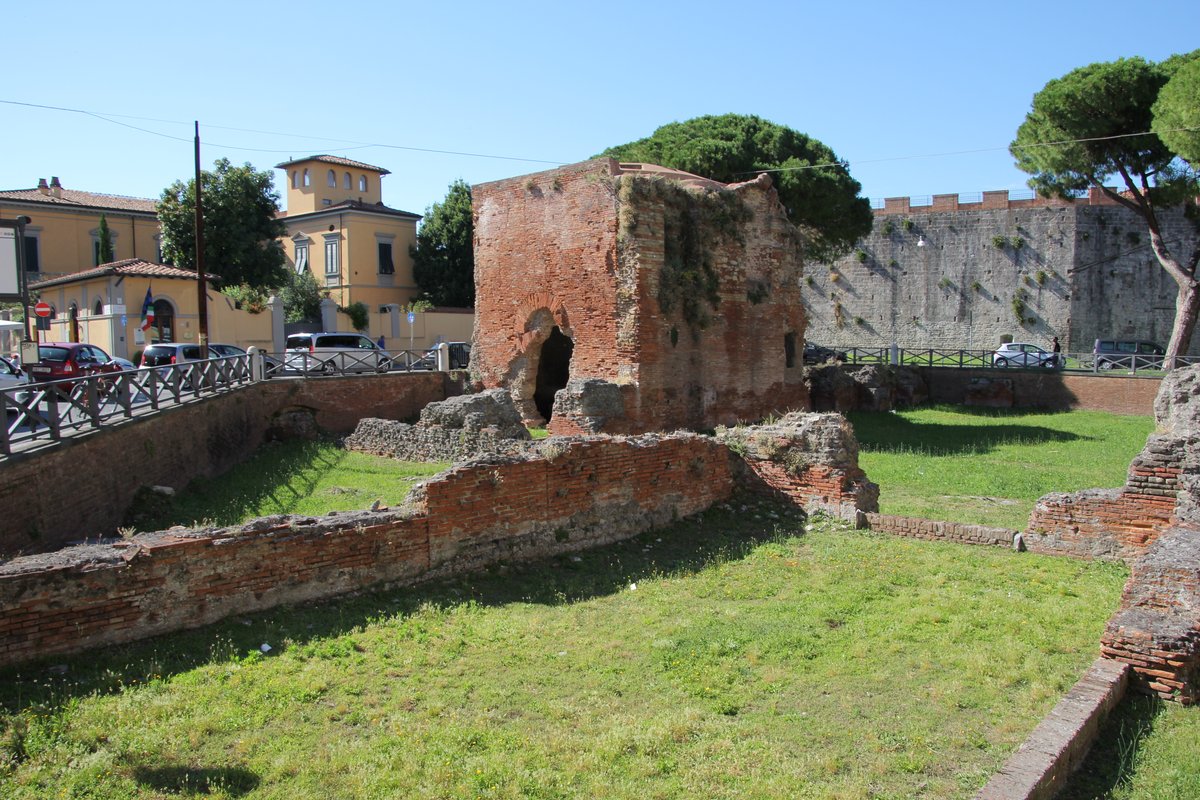

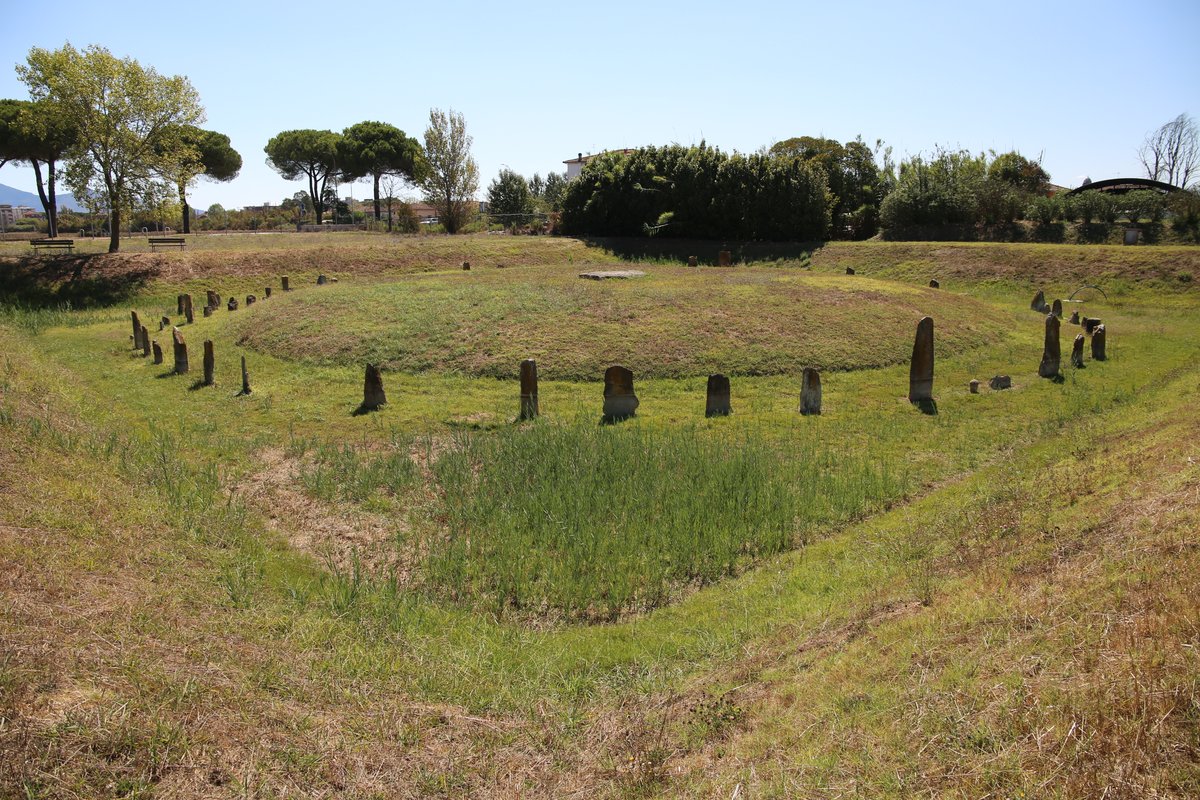
The Bagni di Nerone are an archaeological site near the Porta a Lucca in Pisa, representing the city's only remaining Roman remains. Although the name suggests a connection to Nero, this is a medieval misnomer. The site is actually a thermae complex whose earliest levels date to the final decades of the 1st century, during the reign of Domitian. The use of opus vittatum mixtum, a building technique with alternating layers of brick and tuff blocks, confirms this period.
The complex was rebuilt during the 2nd century and funded by Lucius Venuleius Apronianus Priscus. He was a patronus of Roman Pisa and a consul of Attidium who financed several public projects, including the Caldaccoli Aqueduct in 92. An inscription from this period, now held in the National Museum of San Matteo, cites the Veruleii Aproniani family, who were known for owning extensive grounds and ceramics factories.
The best-preserved part of the complex is the laconicum, a hot room composed of an octagonal room with an apse and a dome-shaped perforated roof. Other remains include walls from the palaestra of the apodyterium and the tepidarium, as well as marble remains and decorative sculptures. The site was supplied with water from the nearby river Auser and the Caldaccoli aqueduct.
Following a period of neglect, the site was re-discovered and restored in the 16th and 17th centuries by command of Cosimo III. It was excavated by Clemente Lupi in 1881, fenced off in 1938, and fully restored in 1947. While a covering dome was installed, it was replaced in 2007 after being worn out by the weather.
Sources: Wikipedia, OpenStreetMap, Wikidata, Wikimedia Commons
Written by Nicolo Ciampini
Discuss this with the author and others
No comments yet. Be the first to start the conversation.