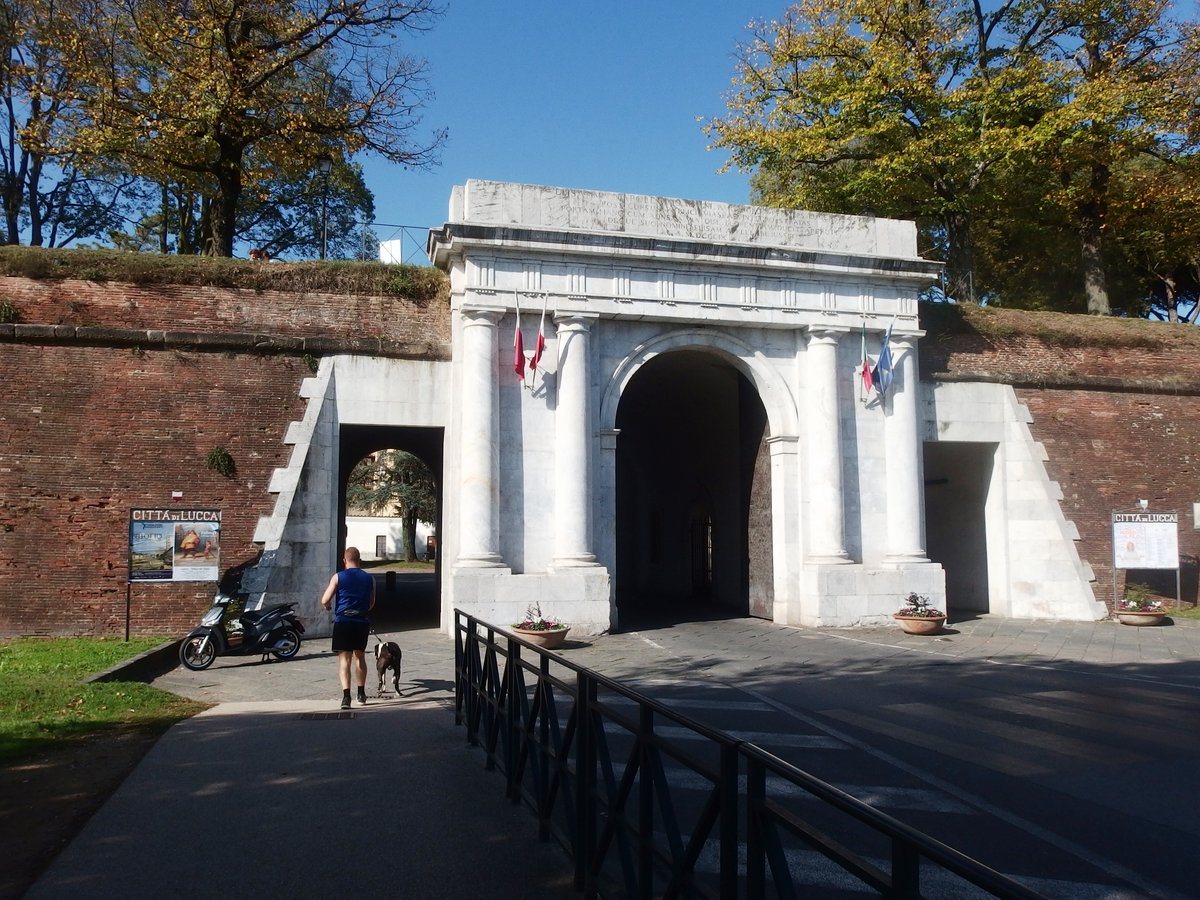

Why is there a gate here? Historically, there shouldn't be one. The city walls were designed to block sudden attacks, which meant the eastern side was meant to remain a dead end. Travelers coming from the current Via Pesciatina were forced to turn around the walls for a long stretch, making them visible and easy targets to be fired upon.
Then came Napoleon's sister, Elisa Baciocchi. She had a very different vision for Lucca, which she saw as an old-fashioned town of no importance. She wanted to bring the city up to the standards of the modern cities she admired. To do that, she needed a direct route to the main roads leading to places like Capannori and Pistoia. In 1811, she saw the completion of Porta Elisa, a gate named not after a saint, but after her to reflect the secularism of the time.
The gate looks like a modest triumphal arch, featuring white marble that stands out against the red bricks of the walls. It was intended to be the start of a new access road, Via Elisa, which in the initial project was meant to cut through the old neighborhoods. This plan included the demolition of the Romanesque Porta San Gervasio to create a large covered street. However, the fall of the Napoleonic rule stopped the demolitions, and only a small initial section of the road was completed.
Today, you can still see the neoclassical columns and the tre fornici, with the lateral arches added in 1937. It remains a landmark in the city and even gives its name to a local football stadium. It stands as a result of Elisa's desire to modernize the city, creating a shortcut that changed the layout of the ancient walls.
Sources: Wikipedia, OpenStreetMap, Wikidata, Wikimedia Commons
Written by Nicolo Ciampini
Discuss this with the author and others
No comments yet. Be the first to start the conversation.