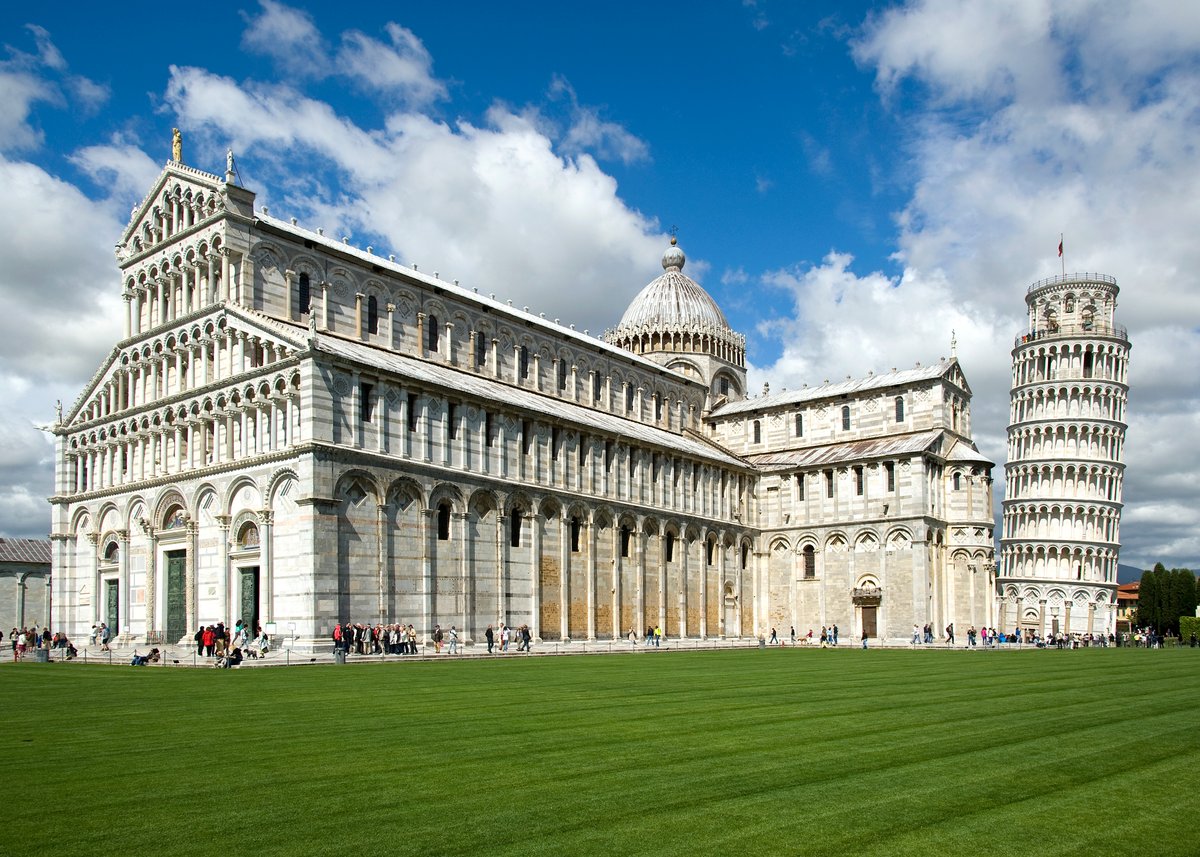

Why is this building so striking? It is the result of a strong rivalry between the maritime republics of Pisa and Venice to see which could create the most beautiful and luxurious place of worship. While Venice reconstructed St. Mark's Basilica, Pisa financed a cathedral using spoils received from fighting against the Muslims in Sicily and Ifriqiya. The cathedral was intentionally erected outside the early medieval walls to demonstrate that the city had no fear of being attacked.
Is this style a coherent choice? The cathedral is a notable example of Pisan Romanesque architecture, incorporating a variety of stylistic elements. You can see Islamic influence in the elliptical dome and the use of raised lancet arches, which create a spatial effect similar to great mosques. There is also a clear Byzantine influence in the raised matronea in the nave, featuring solid monolithic columns of granite. While the original plan was a Greek cross with a grand cupola, the structure today follows a Latin cross plan with a central nave flanked by two side aisles.
Why did the walls change in the 18th century? A group of citizens arranged for special financing to create 'quadroni' - large paintings on the inside walls depicting stories of the blessed and saints of Pisa. You can also see the scars of 1595; a fire forced a roof replacement and led to the creation of three bronze doors by sculptors from the workshop of Giambologna. The structure is a complex layer of history, featuring numerous restoration campaigns and the reassembling of a dismantled pulpit in the 20th century.
How do you view this masterpiece today? Many of the original facade statues were removed during 19th-century restorations and are now housed in the cathedral museum, replaced by copies on the exterior. The rich decoration continues to showcase the maritime power of the past, featuring multicolored marble, mosaics, and bronze objects from historical spoils of war, such as the Pisa Griffin.
Sources: Wikipedia, OpenStreetMap, Wikidata, Wikimedia Commons
Written by Nicolo Ciampini
Discuss this with the author and others
No comments yet. Be the first to start the conversation.