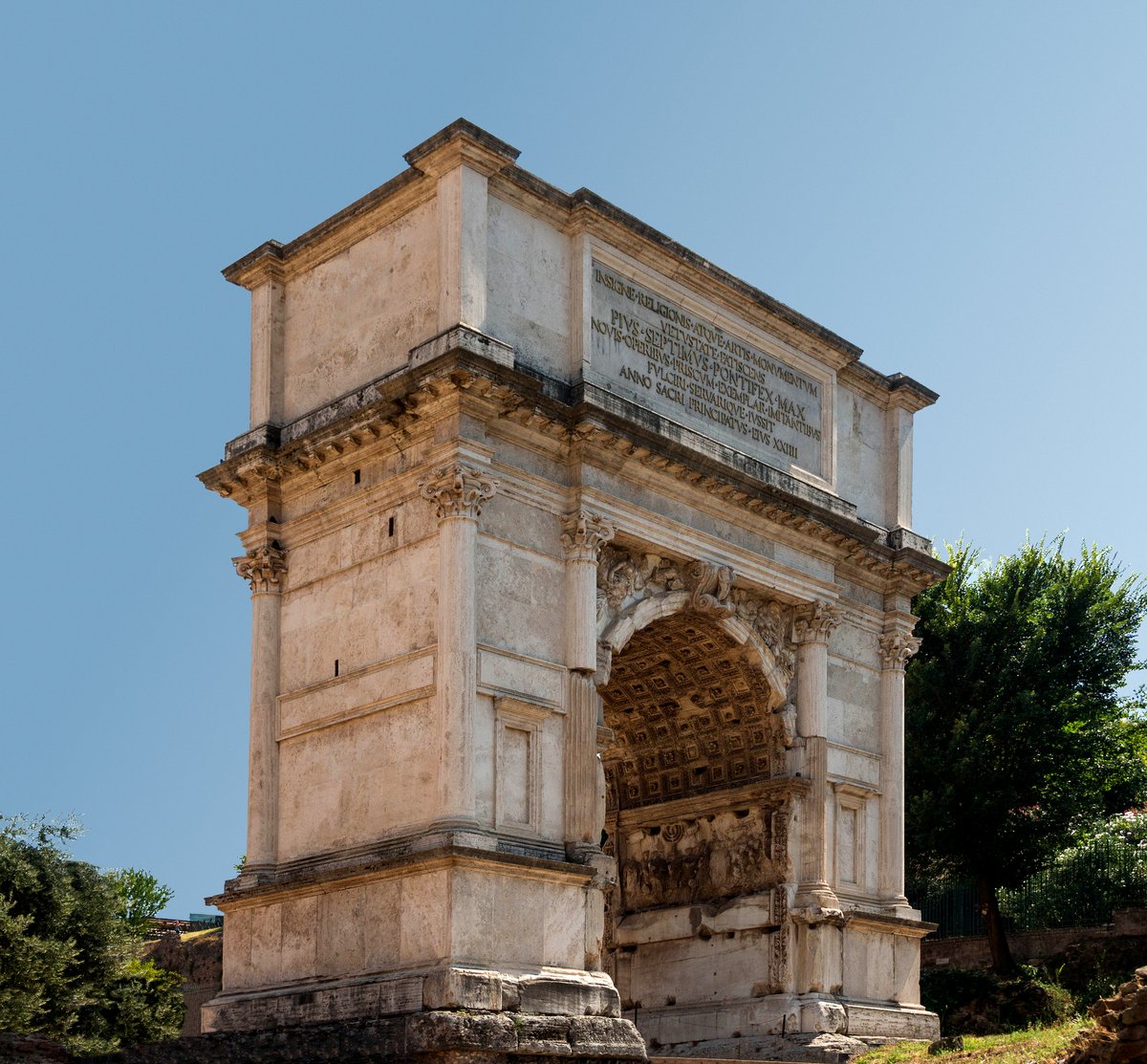

The Arch of Titus, located on the Via Sacra in Rome, was constructed in c. 81 AD by Emperor Domitian in honor of his brother Titus, who succeeded Vespasian as emperor. The arch commemorates Titus’s victories over the Jewish rebellion and the conquest of Jerusalem. The triumphal procession depicted in the panels of the arch closely parallels the narrative of the Roman conquest described in Josephus's The Jewish War. The arch serves as a symbol of the Jewish diaspora, with the menorah depicted on the arch serving as the model for the menorah used as the emblem of the State of Israel.
The arch has provided the general model for many triumphal arches erected since the 16th century, including the Arc de Triomphe in Paris. It is the focus of Franz Wickhiff's appreciation of Roman art. The arch has influenced the design of other structures such as the Basilica di Sant’Andrea di Mantova and the Washington Square Arch.
Based on the style of sculptural details, Domitian’s favored architect Rabirius, sometimes credited with the Colosseum, may have executed the arch. The medieval Latin travel guide Mirabilia Urbis Romae noted the monument. During the Middle Ages, the Frangipani family added a second story to the vault, converting it into a fortified tower; beam holes from the construction remain in the panels. A chamber was built in the upper half, and the roadway was lowered to expose the travertine foundations.
Sources: Wikipedia, OpenStreetMap, Wikidata, Wikimedia Commons
Written by Nicolo Ciampini
Discuss this with the author and others
No comments yet. Be the first to start the conversation.